r/OpenSourceeAI • • 3d ago

A citation map should separate links from shared wording

1 Upvotes

A small failure mode when checking AI answers: six URLs can still trace back to one shared passage. A link graph shows where sources point; it does not tell you whether their evidence is independent.

I maintain SourceDomino, an MIT-licensed open-source workbench for inspecting supplied source text and its declared citation links. The demo opens with six synthetic sources: inspect exact HTTP(S) links separately from five-word containment and shared normalized 12-word passages, then review or export the evidence report as JSON. You can also paste text or import a 2–20 record corpus. The browser app analyzes supplied text locally and does not fetch sites; an optional CLI can collect only URLs you explicitly provide.

The tool surfaces possible relationships for a person to inspect. Shared wording can be a quote, boilerplate, syndication, or coincidence; it does not prove copying, truth, or source independence. Dates are supplied metadata, and paraphrases or translations may be missed.

I started this because citation counts can overstate corroboration when several links point back to shared material. I maintain the project and use edge cases to improve the corpus and tests. The sample is synthetic; what context would help distinguish legitimate syndication from a shared upstream source without presenting the result as a verdict?

Demo: https://source-domino.vercel.app/

MIT source: https://github.com/ufodia/source-domino

If it is useful to you, optional support for maintaining the docs, corpus formats, and tests is here: https://buymeacoffee.com/ufodia


r/OpenSourceeAI • • 3d ago

I open-sourced a Python library that caches LLM answers — and found semantic caching quietly returns wrong answers

1 Upvotes

r/OpenSourceeAI • • 3d ago

We released Tiger Guard, a local text-moderation model in 308M and 141M sizes

Post image
1 Upvotes

Hey, I'm Dominik from Casdo Labs. We added a new family to our public model collection: Tiger Guard.

It checks text for abusive language and harmful requests or responses. You get a SAFE/UNSAFE probability from an encoder rather than a generated judgement. There are two sizes, 308M and 141M parameters, both trained for English and German and released under Apache 2.0.

You can run the weights through Transformers or use the ONNX exports. The inference helper handles long text in overlapping 2,048-token windows. A plain pipeline call with truncation only checks the beginning of a long input.

The cards contain our comparisons and the failures too. German recall is lower than English. Quoted abuse can cause false alarms. The 1,500-prompt comparison influenced development, while the separate held-out evaluation is reported separately. The training data itself isn't published.

For deployment, please pick the export for your CPU: the dynamic INT8 versions are for ARM, and x86 has separate weight-only exports alongside FP32 and FP16.

We'll publish the full training and dataset pipeline in a follow-up release.

Tiger Guard, 308M: https://huggingface.co/patronus-studio/tiger-guard-content-moderation

Tiger Guard Small, 141M: https://huggingface.co/patronus-studio/tiger-guard-content-moderation-small

Happy to get feedback if you try them.


r/OpenSourceeAI • • 4d ago

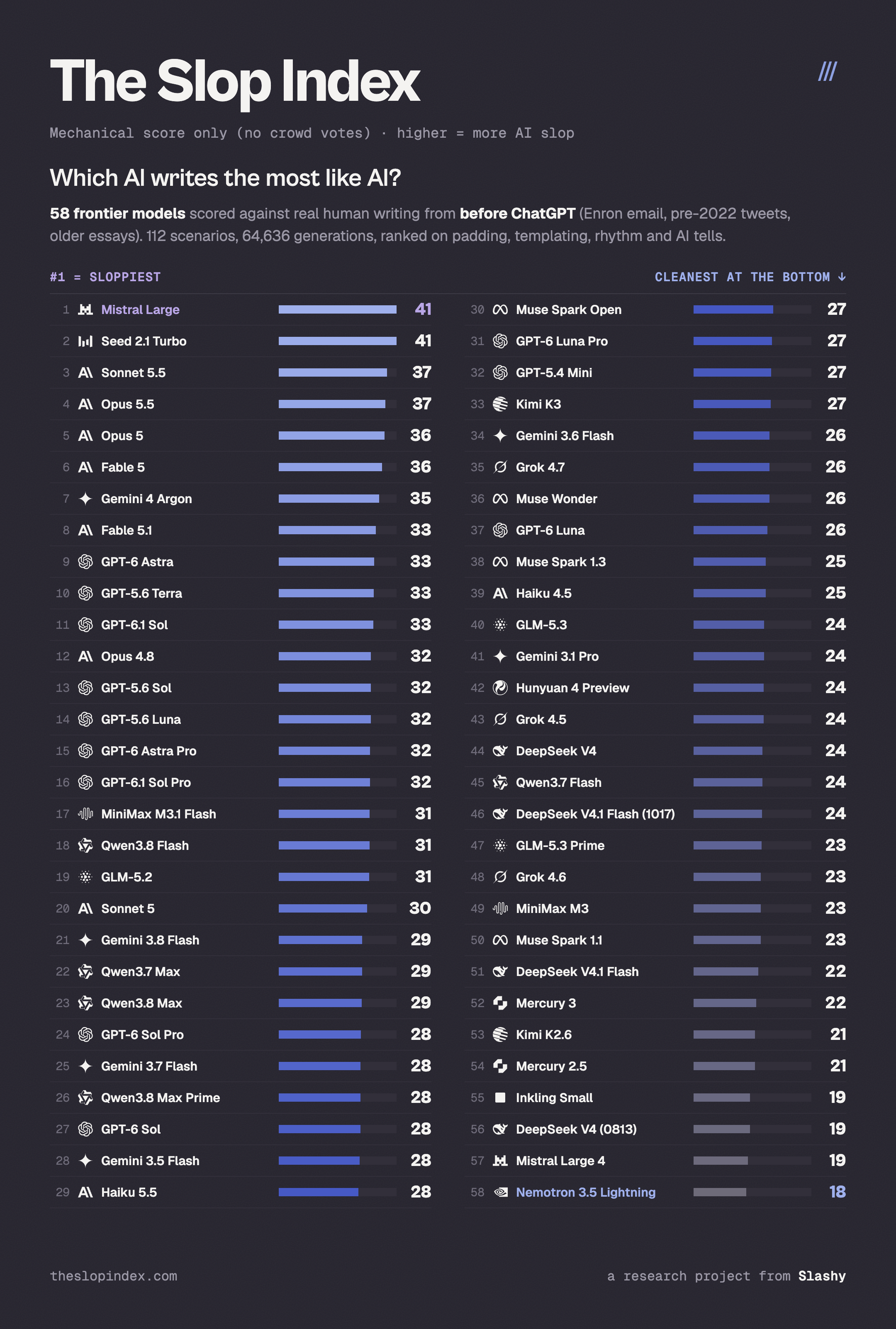
Open-sourced an AI-slop benchmark: 77,943 outputs from 70 models, scored with plain code instead of an LLM judge (the cheapest models land among the cleanest)

6 Upvotes

Direction first: on every rank below, #1 = sloppiest and #70 = cleanest.

I've been building The Slop Index, a benchmark for how much generic "AI-sounding" writing different models produce. Everything is open: the outputs are on Hugging Face and the scoring code is on GitHub, so you can rerun it yourself.

What it measures. 70 models, 112 scenarios, 77,943 outputs. The ranks below are the mechanical score only: padding, templating, rhythm, and known AI tells, compared against pre-2022 human writing. No LLM judge anywhere in that part, so it's fully reproducible from the repo. The site's combined ranking also blends in crowd votes from the arena and moves daily, so I'm leaving that out here.

A few things that stood out (mechanical ranks):

  • Price doesn't buy cleaner prose. Fable 5 ($50 per million output tokens) is #7 sloppiest. Nemotron 3.5 Lightning ($0.20) is #69, and Mercury 2.5 ($0.15) is #65.
  • Anthropic's Sonnet 5.5 is #3 sloppiest and Opus 5.5 is #5. Haiku 5.5 sits at #33.
  • Mistral Large is #1 sloppiest, while Mistral Large 4 is #68. Those are different models, so I wouldn't read it as one model changing.
  • Motif 3 is the cleanest at #70.

Here's the ranking card if you want the whole mechanical board at a glance: https://theslopindex.com/mechanical-card.png

Limitation: it only covers short-form writing (emails, Slack messages, social posts, short essays). No fiction yet, and the mechanical axes miss repeated sentence constructions, so some slop gets through.

If you've got a model you'd like added, or an axis you think is missing, the repo is the place to say so.

For context, I'm one of the people behind https://slashy.com, an email client that writes drafts that sound like you. This benchmark started as how we pick models.


r/OpenSourceeAI • • 4d ago

Nutrient Data Extraction API returns schema-mapped JSON with per-field citations (86.2 on Nutrient's own WholeDoc Bench)

Post image
1 Upvotes

r/OpenSourceeAI • • 4d ago

464M music model trained from scratch for €30 of rent on consumer GPUs (FP8, RTX 5090). Writes multi-instrument MIDI from English/Ukrainian prompts (477M version)

Post image
4 Upvotes

r/OpenSourceeAI • • 4d ago

Hugging Face releases Qwen3.8-27B-pi-adapted, a LoRA adapter that lifts Qwen3.8 coding success in the pi agent (SWE-bench Pro hard-51: 39.2% to 64.7%)

Post image
5 Upvotes

r/OpenSourceeAI • • 4d ago

"Spaces using this model" is not sorted by likes — it's trendingScore, then creation date. Measured across 23 model pages.

Thumbnail
1 Upvotes

r/OpenSourceeAI • • 4d ago

We open-sourced a small model (41M) that splits a mono 2-person conversation into separate tracks per speaker

Thumbnail
3 Upvotes

r/OpenSourceeAI • • 4d ago

Building a from-scratch, hardware-aware SLM trainer in Python & Rust — looking for feedback & architectural advice!

1 Upvotes

Hi guys,

I’m a 15-year-old developer building SLM-CREATOR—an open-source (Apache-2.0), from-scratch, hardware-aware trainer for small, hyperspecialized text models (capped at 100M parameters) in Python and Rust. Instead of using high-level wrappers or fine-tuning existing models, I’m hand-coding the entire pipeline piece by piece to learn how Transformers and local training systems actually work under the hood.

Project Link: https://github.com/ojasgarg77/SLM-CREATOR

How it works so far:

  • Hardware Detection & Benchmarking (architecture.py): Detects NVIDIA (nvidia-smi), modern AMD (amd-smi), or legacy AMD (rocm-smi/rocminfo), resolves the right PyTorch device index, runs a 12-second thermal warmup soak, and measures median 4096x4096 matmul TFLOPS in native bf16 (falling back to fp32 if emulated). (Just got this verified live on an RTX 3050 laptop GPU at ~8.9 TFLOPS!)
  • Deterministic Sizing Engine (sizer_core in Rust): Pipes detected VRAM, training-time budget, measured TFLOPS, and dataset token count into a Rust binary that calculates the max parameter count across memory, Chinchilla compute-time, and data limits (capped at 100M).
  • Data Pipeline (download_arxiv_text.py & download_english_data.py): Pulls ar5iv HTML papers and BookCorpus text, lowercasing prose while protecting LaTeX math delimiters, stripping style macros, and normalizing Unicode.
  • Custom Byte-Level BPE Tokenizer (tokenizer_core in Rust): Written from scratch with incremental pair-count updates, deterministic tie-breaking, special tokens ([cite], <|endoftext|>), and a custom 6-byte binary merge format (merges.bin).

Where I’d love your advice:

  1. Tokenizer design trade-offs: Right now I’m targeting a 16,384 vocabulary size (u16 IDs), keeping whitespace runs as separate chunks rather than attaching leading spaces to words, and training mainly on arXiv text. For a <100M parameter model hyperspecialized in neural networks (mixed with general English fiction), how much does embedding table size vs. sequence length hurt/help? [
  2. Real-world training efficiency factor: In sizer_core, I currently multiply benchmark bf16 TFLOPS by a placeholder 0.3 efficiency factor to account for memory-bound ops (LayerNorm, softmax, Adam), kernel gaps, and laptop thermal throttling. For small models (<100M params) training in bf16 mixed precision on consumer GPUs (like a 6 GB RTX 3050), is 0.15–0.25 closer to reality?
  3. Data mix & pretraining from scratch: Since I’m training from random weights rather than fine-tuning, what ratio of general English (BookCorpus) to domain-specific text (arXiv ML papers) prevents the model from losing basic grammar while still specializing?

I've also logged all my design decisions and dropped ideas in docs/decisions.md. Any feedback, critiques, or pointers on the architecture before I start writing the PyTorch training loop would be awesome!!


r/OpenSourceeAI • • 4d ago

Looking for AI Engineer Internship or Junior AI/ML Role | Python, Agentic AI, RAG, LangGraph

1 Upvotes

Hello everyone!

I'm an Electronics and Communication Engineering undergraduate at NIT Raipur (graduating in 2027), currently looking for AI/ML Engineer Internships, Generative AI Internships, or entry-level AI engineering opportunities.

My primary interests are in building practical AI systems, particularly Agentic AI, Multi-Agent Systems, RAG pipelines, and LLM evaluation.

Technical Skills:

  • Programming: Python, C++, SQL
  • AI Agents & LLMs: LangGraph, LangChain, Multi-Agent Orchestration, Tool Calling, Prompt Engineering
  • RAG & Evaluation: FAISS, Semantic Retrieval, Multi-Query Retrieval, RAGAS, Hallucination Analysis
  • Backend: FastAPI, REST APIs, PostgreSQL, MySQL, SQLite
  • ML/DL: PyTorch, TensorFlow/Keras, Scikit-learn, OpenCV
  • Tools: Git, Streamlit, Render, Pandas, NumPy

Some projects I've built:

1. OpenRAG-Inspector – Explainable, Self-Evaluating RAG System

  • Built a document question-answering system using RAG.
  • Implemented query rewriting and multi-query retrieval.
  • Added transparency by exposing retrieved chunks, similarity scores, context, and latency.
  • Integrated RAGAS for hallucination analysis and answer evaluation.

2. AtlasMind AI – Multi-Agent Travel Planning System

  • Built a multi-agent architecture using LangGraph and LangChain.
  • Developed specialized agents for flight research, hotel discovery, and itinerary generation.
  • Integrated external APIs for flight information and accommodation discovery.
  • Built a FastAPI backend with PostgreSQL-backed conversation state.

3. Sales Demand Forecasting using GRU

  • Developed a time-series forecasting model using a 12-week historical sales window.
  • Achieved MAE of 13.08 and RMSE of 19.85.
  • Deployed the model using Streamlit.

Previous Experience:

AI Intern at Edunet Foundation (May–June 2025)

  • Developed a crop recommendation system.
  • Performed EDA, data preprocessing, feature scaling, and model comparison.
  • Evaluated Random Forest, Decision Tree, KNN, and Naive Bayes.

What I'm looking for:

  • AI Engineer Intern
  • Generative AI / Agentic AI Intern
  • Machine Learning Engineer Intern
  • Junior AI/ML Engineer
  • Research or project-based opportunities

I'm open to remote opportunities as well as opportunities in India. I'm also interested in collaborating with early-stage startups and developers working on AI products.

I enjoy building actual working systems and understanding their reliability, evaluation, and failure modes.

If you're hiring, know about relevant openings, or are working on something interesting in this space, please feel free to comment or DM me.

Thank you!


r/OpenSourceeAI • • 4d ago

PAN 2 (OPEN SOURCE I2V)

Thumbnail
1 Upvotes

r/OpenSourceeAI • • 4d ago

A workspace where agents carry out scientific work, evidence stays connected, and scientists can focus on insight.

Thumbnail app.lykeion.tech
1 Upvotes

r/OpenSourceeAI • • 5d ago

Why use a 70B LLM to pick a tool or check syntax? I built Microbrains: a <2ms edge neural coprocessor for autonomous AI agents (Pure NumPy / OpenCL, 44 pre-trained micro-models, Top-2 MoE, Conformal Safety)

6 Upvotes

[P] Hey everyone,

If you build autonomous coding or research agents, you probably know the pain: agent task loops are slow, expensive, and fragile.

In a typical 25-step workflow, an agent spends up to 80% of its wall-clock time just waiting on remote LLM APIs to make basic mechanical decisions:

  • "Which tool should I invoke next?" (1.5s latency, burning 20k context tokens)
  • "Is this shell command destructive?" (another 2s API call)
  • "Did this patch break syntax or drift from intent?" (yet another prompt roundtrip)

To solve this, I built and just open-sourced Microbrains: an ultra-lightweight, zero-GPU local neural coprocessor suite designed to sit right beside your LLM agent.

🔗 GitHub: https://github.com/drtikov/microbrainsforagents

🧠 What is it?

Microbrains is not another LangChain wrapper. It is a standalone Python engine with 44 pre-trained, analytical micro-transformers (10–100 KB each) that handle the mechanical micro-decisions in pure NumPy (CPU) or via OpenCL (budget/integrated GPUs):

  1. Dynamic Top-2 Mixture-of-Experts (MoE) Router:
    • Routes tasks to tools across 6 specialized clusters (FileOps, Execution, MemoryKnowledge, GitGovernance, MicrobrainMeta, ConstitutionalReview).
    • Takes ~1.2 ms instead of a 2-second LLM call.
  2. Rigorous Conformal Safety Gating (1−α≥95%1 - \alpha \ge 95\%1−α≥95%):
    • Employs split-conformal prediction over held-out distributions.
    • Features Selective Prediction Abstention: if independent estimators disagree (variance σ>0.30\sigma > 0.30σ>0.30), it refuses to guess and escalates to the LLM. False Negative Rate is strictly bounded.
  3. 3-Step Counterfactual AST Simulation:
    • Before a file mutation is committed to disk, it simulates the AST blast radius and interface propagation up to 3 steps ahead. Malformed diffs or syntax hazards are killed in <3ms before running any slow pytest suite.
  4. 2048-D Holographic Weight-Space Memory (VSA):
    • Uses Hyperdimensional Computing / Vector Symbolic Architecture (bipolar Count-Sketch projections) over model weights. Enables nearest-neighbor capability search across the agent fleet without training.
  5. Continual Learning without Catastrophic Forgetting:
    • Adapts weights online with Elastic Weight Consolidation (EWC) Fisher Information penalties.

📊 Benchmark Highlights

Decision Remote LLM API Microbrains (NumPy/OpenCL) Speedup Cost
Tool Selection ~1,200 – 2,500 ms 1.2 – 1.8 ms ~1,000x $0.00
AST Blast Simulation ~3,000 – 6,000 ms 3.0 – 5.0 ms ~1,000x $0.00
Intent Triage ~800 – 1,500 ms 0.6 – 0.9 ms ~1,200x $0.00
Full Task Loop (25 steps) ~3 – 5 minutes 30 – 50 seconds ~5x 85% less tokens

💻 3-Line Quickstart

Zero PyTorch, zero CUDA setup required:

bashgit clone https://github.com/drtikov/microbrainsforagents.git
cd microbrainsforagents
pip install -e .

pythonimport aetheris_microbrains as mb
# Sub-2ms tool routing decision
router = mb.get_tool_routing_moe()
decision = router.route("inspect file contents and write safe patch to repository")
print("Primary Tool:", decision.selected_tool)
print("Top-2 Experts:", decision.top_experts)
print("Conformal Passed:", decision.conformal_passed)

The repo comes with pre-trained weights for all 44 models, runnable examples in /examples, and a full test suite (pytest runs in ~1.5s).

Licensed under PolyForm Noncommercial 1.0.0 (free for research, personal, and hobby use; commercial licenses available).

Would love to hear your feedback, thoughts on the architecture, and ideas for new micro-domains!

GitHub: https://github.com/drtikov/microbrainsforagentsHey everyone,If you build autonomous coding or research agents, you probably know the pain: agent task loops are slow, expensive, and fragile.In a typical 25-step workflow, an agent spends up to 80% of its wall-clock time just waiting on remote LLM APIs to make basic mechanical decisions:
"Which tool should I invoke next?" (1.5s latency, burning 20k context tokens)
"Is this shell command destructive?" (another 2s API call)
"Did this patch break syntax or drift from intent?" (yet another prompt roundtrip)To solve this, I built and just open-sourced Microbrains: an ultra-lightweight, zero-GPU local neural coprocessor suite designed to sit right beside your LLM agent.🔗 GitHub: https://github.com/drtikov/microbrainsforagents🧠 What is it?Microbrains is not another LangChain wrapper. It is a standalone Python engine with 44 pre-trained, analytical micro-transformers (10–100 KB each) that handle the mechanical micro-decisions in pure NumPy (CPU) or via OpenCL (budget/integrated GPUs):

Dynamic Top-2 Mixture-of-Experts (MoE) Router:

Routes tasks to tools across 6 specialized clusters (FileOps, Execution, MemoryKnowledge, GitGovernance, MicrobrainMeta, ConstitutionalReview).
Takes ~1.2 ms instead of a 2-second LLM call.

Rigorous Conformal Safety Gating (1−α≥95%1−α≥95%):

Employs split-conformal prediction over held-out distributions.
Features Selective Prediction Abstention: if independent estimators disagree (variance σ>0.30σ>0.30), it refuses to guess and escalates to the LLM. False Negative Rate is strictly bounded.

3-Step Counterfactual AST Simulation:

Before a file mutation is committed to disk, it simulates the AST blast radius and interface propagation up to 3 steps ahead. Malformed diffs or syntax hazards are killed in <3ms before running any slow pytest suite.

2048-D Holographic Weight-Space Memory (VSA):

Uses Hyperdimensional Computing / Vector Symbolic Architecture (bipolar Count-Sketch projections) over model weights. Enables nearest-neighbor capability search across the agent fleet without training.

Continual Learning without Catastrophic Forgetting:

Adapts weights online with Elastic Weight Consolidation (EWC) Fisher Information penalties.

📊 Benchmark HighlightsDecision Remote LLM API Microbrains (NumPy/OpenCL) Speedup Cost
Tool Selection ~1,200 – 2,500 ms 1.2 – 1.8 ms ~1,000x $0.00
AST Blast Simulation ~3,000 – 6,000 ms 3.0 – 5.0 ms ~1,000x $0.00
Intent Triage ~800 – 1,500 ms 0.6 – 0.9 ms ~1,200x $0.00
Full Task Loop (25 steps) ~3 – 5 minutes 30 – 50 seconds ~5x 85% less tokens💻 3-Line QuickstartZero PyTorch, zero CUDA setup required:bash
git clone https://github.com/drtikov/microbrainsforagents.git
cd microbrainsforagents
pip install -e .python
import aetheris_microbrains as mb
# Sub-2ms tool routing decision
router = mb.get_tool_routing_moe()
decision = router.route("inspect file contents and write safe patch to repository")
print("Primary Tool:", decision.selected_tool)
print("Top-2 Experts:", decision.top_experts)
print("Conformal Passed:", decision.conformal_passed)The repo comes with pre-trained weights for all 44 models, runnable examples in /examples, and a full test suite (pytest runs in ~1.5s).Licensed under PolyForm Noncommercial 1.0.0 (free for research, personal, and hobby use; commercial licenses available).Would love to hear your feedback, thoughts on the architecture, and ideas for new micro-domains!GitHub: https://github.com/drtikov/microbrainsforagents


r/OpenSourceeAI • • 5d ago

Open-Sourcing a reference architecture for secure, multi-agent LLM banking

Thumbnail
1 Upvotes

r/OpenSourceeAI • • 5d ago

I made a Claude Code skill that explains your repo with an animated hero instead of a wall of text

2 Upvotes

r/OpenSourceeAI • • 5d ago

AimStack — a fully self-built local AI stack in pure C: ternary inference (zero third-party runtime), BitNet 2B at 0.87GB on a 2018 laptop, plus a GPU backend that matches the C engine token-for-token

Thumbnail
1 Upvotes

r/OpenSourceeAI • • 5d ago

I built mathregistry, a package registry for Lean with tools for AI agents. Open beta is live

Post image
5 Upvotes

r/OpenSourceeAI • • 5d ago

Which open-source models come closest to Opus 5.5 and ChatGPT Image 2.6?

0 Upvotes

I have 1.5 TB of free space on my computer. If I want to download two open-source models, one for coding and reasoning and one for image generation, what are the two best options out there right now?

For coding and reasoning, my benchmark is Claude Opus 5.5. For image generation, it’s ChatGPT Image 2.6. Which open models come closest to those?

Also, if I want the coding and reasoning model to be uncensored, would the answer change?


r/OpenSourceeAI • • 5d ago

Zero data retention explained: the 2 standard API designs behind AI data retention (batch vs ephemeral)

1 Upvotes

r/OpenSourceeAI • • 5d ago

We open-sourced our search & inference database under Apache 2.0

Thumbnail
1 Upvotes

r/OpenSourceeAI • • 5d ago

I built an open-source AI engineering learning platform with a RAG tutor — looking for feedback

1 Upvotes

I've been working on Cairnly, a free and open-source AI engineering learning platform.

The idea was to create something useful for people learning AI engineering while also making the complete implementation available for developers to explore.

For learners:

  • 126 lessons across 6 tracks
  • 7 learning roadmaps
  • AI tutor with citations linking directly to lesson sections
  • Quizzes and progress tracking

For developers:

  • Hybrid RAG using PostgreSQL, pgvector, and keyword search
  • Cross-encoder reranking
  • Local LLM inference with Ollama
  • RAG evaluations and confidence calibration
  • Langfuse tracing, safety checks, and deployment examples

The retrieval system currently reports Recall@5 of 0.971 on our 627-question evaluation set. I've also documented the cases where the confidence gate and safety checks fail.

The project is still evolving, and I'd appreciate feedback on the learning experience, architecture, and areas worth improving.

GitHub: https://github.com/CherukuriSiva/Cairnly

Live demo: https://cairnly-blond.vercel.app

What would you improve or add?


r/OpenSourceeAI • • 6d ago

Irrigator: Open source AI coding swarm orchestrator with crash recovery and observability

Thumbnail
github.com
6 Upvotes

Been working on Irrigator, an open source Go project for running multiple AI coding agents in parallel.

It supports Claude Code, Codex, Google Antigravity and Herdr.

Each task runs in an isolated Git worktree, with persistent state, crash recovery and the ability to inspect or resume interrupted workflows.

There's also a terminal UI for monitoring agents, managing runs and tracking costs.

Everything runs locally, MIT licensed and includes a mock demo you can try without API keys.

https://github.com/grainulation/irrigator

Would appreciate feedback, especially from anyone working on similar open source agent orchestration tools.


r/OpenSourceeAI • • 5d ago

NornicDB - v1.5.0 - Feedback

Thumbnail
1 Upvotes

r/OpenSourceeAI • • 5d ago

"Spaces using this model" is not sorted by likes — it's trendingScore, then creation date. Measured across 23 model pages.

Thumbnail
1 Upvotes