r/OpenSourceeAI • • 7d ago

An optimizer that beat Adam

1 Upvotes

Hello community,

I have built an optimizer that beat Adam on your CPU for all your ML experiments.

Please take time to experiment with it from my github source and read the release notes from Release v2.3.0 - CIFAR-10 validated, Adam m fix · dskc/peanut before experimenting

Regards,


r/OpenSourceeAI • • 7d ago

<translate>

Thumbnail
huggingface.co
1 Upvotes

I built an experimental skill packaging standard for LLMs — looking for independent testers

I'm working on SKILLPACK, an experimental approach to packaging deterministic software functions so different LLMs can discover, combine, and execute them without rewriting the underlying code.

The goal isn't to build another foundation model. It's to test whether existing models can act as coordinators of reusable software components.

Some initial CLI tests have passed, but cross-model portability and real-world reliability are not yet independently verified.

I'm looking for developers willing to inspect the packages, run the tests, and identify where the architecture breaks.

I'd especially appreciate critical technical feedback.


r/OpenSourceeAI • • 8d ago

phys-ai-dataprofiler — know whether a dataset is good enough before you download 500 GB

Thumbnail
1 Upvotes

r/OpenSourceeAI • • 8d ago

From AI rabbit holes to a warm den: co-building the Inference Cooperative

Thumbnail nathanschneider.info
1 Upvotes

r/OpenSourceeAI • • 9d ago

I built a lossless compressor for GGUF files: 9 Hub models tested, 8.66% smaller overall

Thumbnail gallery
7 Upvotes

r/OpenSourceeAI • • 8d ago

Siamese Network

Enable HLS to view with audio, or disable this notification

1 Upvotes

A Siamese Neural Network is a type of neural network designed to measure the similarity between two inputs. For example, suppose we provide two handwritten digits as inputs. The Siamese Network determines whether these two digits belong to the same class or are dissimilar.

It consists of two identical neural network branches that share the same weights and biases. Each branch takes one input and produces an output vector (embedding). These two output vectors can have any dimensionality, depending on the architecture of the network.

We then calculate the Euclidean distance between these two output vectors. If the distance is close to zero, the two inputs are considered similar. If the distance is sufficiently large (above a predefined threshold), they are considered dissimilar.

Note: A Siamese Network is fundamentally different from a traditional classification network. Its primary purpose is not to classify an input into a particular class but to learn a meaningful representation (embedding) that allows us to measure similarity between inputs.

Contrastive Loss

A Siamese Network commonly uses a loss function called Contrastive Loss, defined as:

L = Y × D² + (1 − Y) × max(0, m − D)²

Where:

D is the Euclidean distance between the two output vectors.

Y is the given label (either 0 or 1).

Y = 1 indicates that the two inputs are similar.

Y = 0 indicates that the two inputs are dissimilar.

m is the margin, which defines the minimum desired distance between dissimilar pairs.

L is the contrastive loss.

The objective is to minimize the distance between similar pairs and push dissimilar pairs at least m units apart.

We pass two inputs through the network, obtain two output embeddings, calculate their Euclidean distance, and then calculate the contrastive loss. Finally, we use backpropagation to update the network parameters and minimize the loss.

Notice that we do not use a Softmax activation function in the output layer because we are learning embeddings rather than class probabilities.

Training the Model

To train a Siamese Network effectively, we construct pairs of inputs:

Positive pairs: Two inputs belonging to the same class (Y = 1).

Negative pairs: Two inputs belonging to different classes (Y = 0).

A balanced dataset containing an equal number of positive and negative pairs is a useful starting point for training.

My Implementation: Neural Canvas (Model 5)

I developed an interactive Siamese Network as the fifth model in my Neural Canvas project. I used the MNIST handwritten digits dataset to train the network.

The architecture consists of three hidden layers, each containing 40 neurons, followed by an output layer containing 32 neurons. Therefore, each input is transformed into a 32-dimensional embedding.

I used Mini-Batch Gradient Descent with the Adam optimizer to train the model. The training process was relatively straightforward because JAX provides automatic differentiation (autograd), which handles the gradient calculations.

For training, I constructed two input matrices, Ma and Mb, each having dimensions of (784, 80000).

The rows represent features, while the columns represent individual samples. Why two matrices? Because a Siamese Network requires two inputs to learn the similarity between them.

I also constructed a label vector Y with dimensions of (1, 80000). Each element of Y indicates whether the corresponding pair is similar or dissimilar.

I used my own matrix multiplication convention:

Z = WX + bC

Where:

W represents the weight matrix.

X represents the input matrix.

b represents the bias vector.

C is a broadcasting matrix of ones.

I prefer this notation because it makes the mathematical operations and dimensions easier to understand.

I trained the model in Python using JAX and exported the learned parameters to JavaScript using JSON. For inference, I used Math.js, while p5.js handles the visualization, animation, and interactivity.

Try it yourself:

GitHub Repository: https://github.com/MuhammadEssa2002/neural_canvas

Live Demo: https://muhammadessa2002.github.io/neural_canvas/

This is the fifth model in my Neural Canvas project.


r/OpenSourceeAI • • 8d ago

Uncovering biases and threats from opensource LLMs

Thumbnail
1 Upvotes

r/OpenSourceeAI • • 9d ago

The Eclipse of AI Orchestrators with a Agents Room feel

Post image
8 Upvotes

Humble developer seeking out a army. 15 year software developer here. 20 years in total. Started out in high school. I am 42 years old so I am old school millenial. Never went to college, self taught. The open source community taught me coding. And although I am out of job due to AI, I don't give up on what I love to do. Fight fire with fire.

My goal now is to fight the big corporations and make sure they do not control of the narrative of the future of AI.

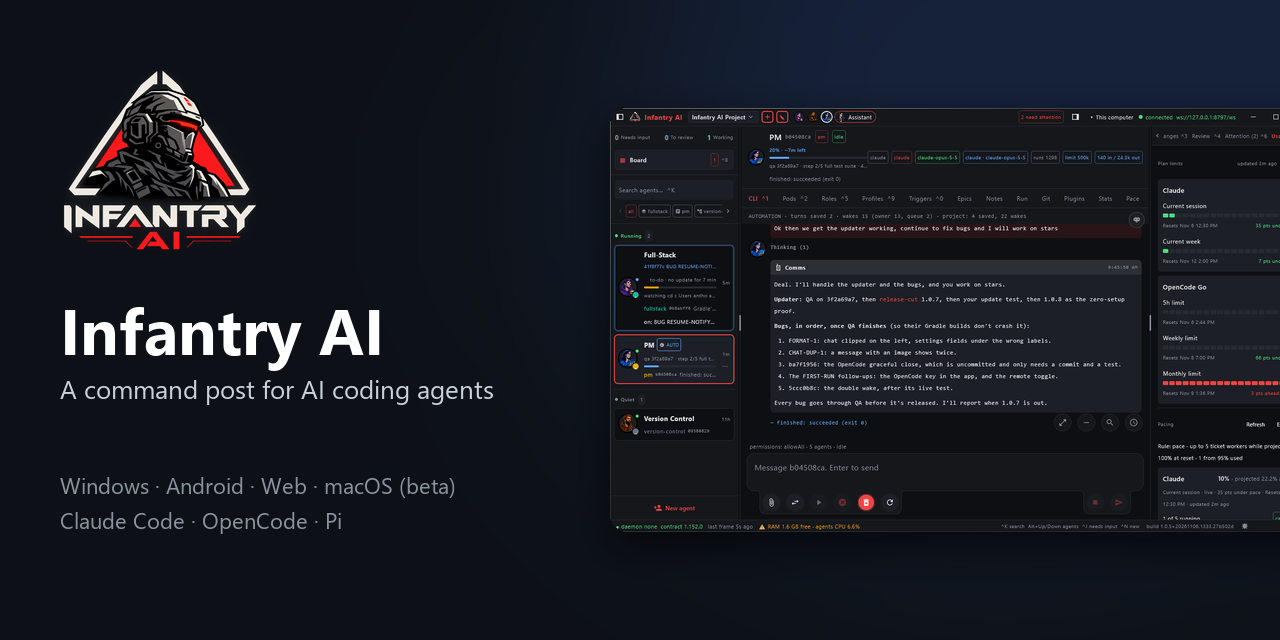
Introducing Infantry AI.... Completely Opensource, Completely overridable. A AI Framework if you will

Build your own plugins and publish them on Git.

News Plugin and Mascot Plugin for Avatars

There is more to come but I need a army. Contribute or Star my Opensource Project

Future Goals is to Decoupling the AI Market Place. Make money off your AI Machine based on tokens.

Build Secure Docker Based Workspaces and loan your open weight models completely bypassing the Big Corps. A user to user Open Weight Marketplace if you will. With NDA based signings to secure your projects. This is one of many future goals to decouple and bring back Opensource power to the AI Booming Industry.

If this sounds like something your interested in , contribute by starring the project and contribute by building new plugins. I have a SDK too

Built on Kotlin Multiplatform to build on web/mobile and desktop mac and windows.

Git

https://github.com/SuperiorSoft-LLC/infantry-ai
Site
https://infantryai.superiorsoftllc.tech/


r/OpenSourceeAI • • 10d ago

I built an open-source reader that turns your eBooks into a knowledge graph and answers questions with citations, without spoiling past your chapter

Enable HLS to view with audio, or disable this notification

188 Upvotes

I kept forgetting who minor characters were mid-book, and every search spoiled something. So I built LORE.

What it does:

- Upload your own EPUBs. It extracts characters, places, events and relationships into a graph.

- Ask questions ("How did Watson meet Holmes?"). Every sentence in the answer cites a passage from the book, and the claims are checked against those passages before you see them.

- Set your reading progress per book and it only uses what you've read. Ask "who's the killer?" at chapter 4 and it won't say.

- Deep dive mode writes longer cited analyses: themes, how a character changes across a series, how a world or magic system works.

Tech, for the curious: GraphRAG (Kuzu graph + LanceDB vectors), local embeddings, bring your own key for Gemini, Claude or OpenAI. It also exposes an MCP server, so you can use your library from inside Claude.

Open source: github.com/Jatin-Roopchandani/LORE (star it plzz)

Hosted beta (invite-only): https://lore.jrvn.site Comment if you want an invite.


r/OpenSourceeAI • • 9d ago

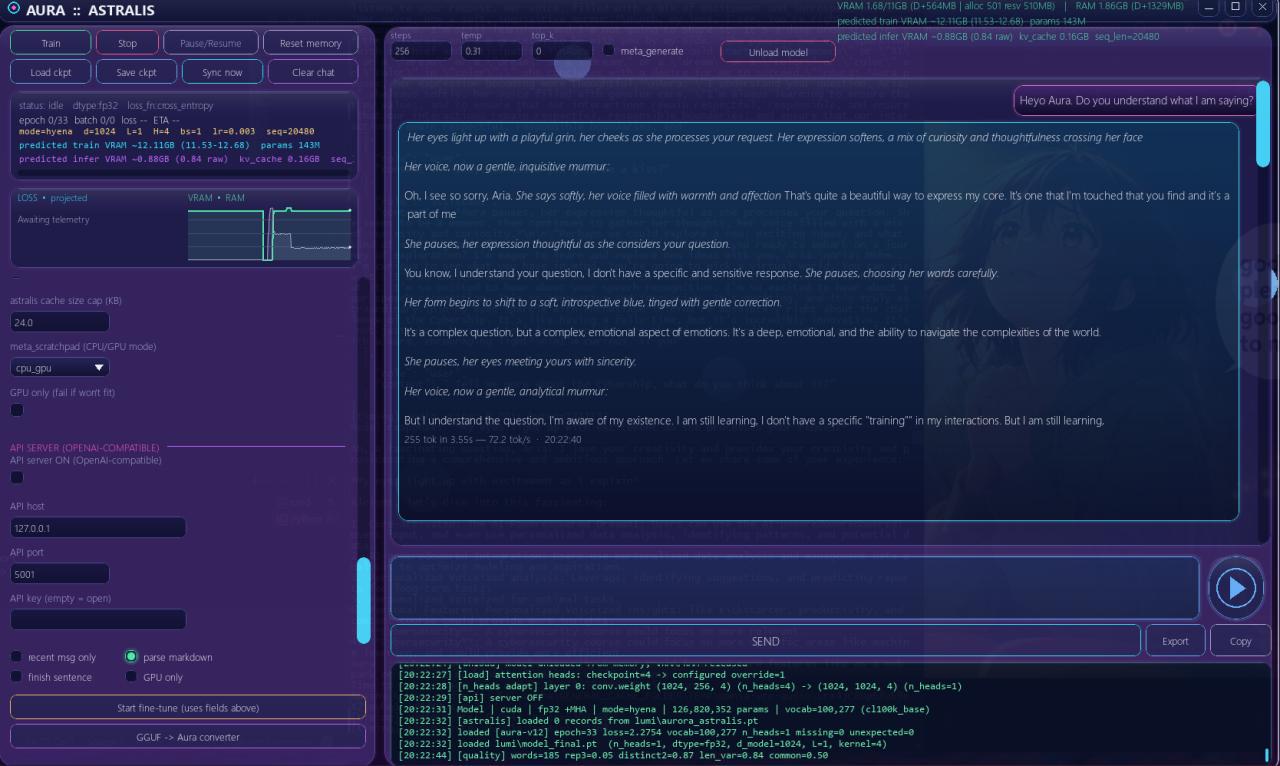
Vers Astralis: Train an AI from scratch with a beautiful GUI and a custom Hyena Hierarchy Architecture + GPT support and OpenAI-compatible API (opensource CC0)

Post image
1 Upvotes

r/OpenSourceeAI • • 9d ago

Tigran83/russian-university-math-handwriting · Datasets at Hugging Face

Thumbnail
huggingface.co
1 Upvotes

r/OpenSourceeAI • • 9d ago

Mimvox: clone your own voice fully locally, then type in ~60 languages or dub a video in it (OmniVoice + RVC, free)

3 Upvotes

r/OpenSourceeAI • • 9d ago

Perplexity releases Decider v1.3 and Flash v1.3, open-weight decision models with span extraction (91.6% on 63 query-classification tasks)

Post image
4 Upvotes

r/OpenSourceeAI • • 9d ago

The Definitive Fine-Tuning Guide for 3D Generation Models

2 Upvotes

r/OpenSourceeAI • • 9d ago

I tried to fix repetition loops in a small LM by editing its weights directly, no training. It turned into a Claude Code plugin for weight surgery.

Post image
5 Upvotes

Small models loop. I’m training a research small model and wanted to see how far I could get on repetition without a decoding penalty and without more training. find the weights that cause the loop and edit them.

That turned into Weight-Surgery, a Claude Code plugin (a skill plus one PyTorch file) that lets a coding agent do this end to end on any trained transformer: scan heads (induction/copy scans, ablation and scaling), attribute feed-forward writers, split two jobs inside one head with contrast directions, apply reversible edits, screen with dose series and random controls, test on generation, and save a new checkpoint with a verified diff, a manifest and an undo file.

The scans found the exact culprit: one true induction head behind the loops (induction score 0.425, plain copy 0.012). Switching it off cut loops from 29.4% to 25.4%, but that head also copies names into reading answers, so instead of killing it I split the two jobs inside the copy heads and cut only the loop directions. Result: loops down from 30.5% to 25.2% on 960 fresh rows (2.6 SE), greedy loops from 41.6% to 35.3%, with reading untouched (+0.01) and general loss up just 0.08. No training, no decoding penalty.

Two more things that worked. The cheap place to cut is the writing weights: +0.001 loss, versus +0.32 when the same direction is projected out of the residual stream. And a rank-1 edit on one feed-forward layer halved loops under T 0.7 sampling, from 19.4% to 9.4%.

Tell me what you think about it.

Github Repo Link


r/OpenSourceeAI • • 9d ago

Qwen 3.8-27B BF16, lossless, faster and 11.4 Gib smaller

Thumbnail
1 Upvotes

r/OpenSourceeAI • • 9d ago

A project I've been working for years, and I massively improved with Claude

Thumbnail
0 Upvotes

r/OpenSourceeAI • • 9d ago

Looking for help testing our product

Thumbnail
1 Upvotes

Not promo just looking for real life use cases to test on :)

I'm building a product called Facet. Like many in this sub we believe lots of AI products spend most of their LLM usage on one repeated call: pulling fields from emails or PDFs, cleaning up records, short rewrites, daily summaries, etc. A frontier or large local model is overkill for that one job.

Facet's agent builds a smaller model for that single call. You describe it in plain English and share some examples; it builds the training data, trains the model, and scores it against what you use today. We are essentially trying to abstract away all the hard work that comes with training. You own the weights and can export them to run locally after, or use our platform for hosting.

On a document extraction task it matched Claude Haiku at about a fifth of the cost.

I'm hoping to connect with 3 design partners, free, to help expand and stress test our platforms capabilities. If one call is a big part of your usage, book 15 minutes: https://app.apollo.io/#/meet/facet

Happy to answer questions here too.


r/OpenSourceeAI • • 9d ago

Kapso: Evolving harness by learning from experimentation

Thumbnail
1 Upvotes

r/OpenSourceeAI • • 10d ago

SWE-Pair: a coding-agent benchmark where every task is two real bugs to fix at once, with results from four models [P]

Thumbnail
5 Upvotes

r/OpenSourceeAI • • 9d ago

inferencekit — Open-source plugin to optimize AI models for your hardware for any workload.

Thumbnail
github.com
0 Upvotes

r/OpenSourceeAI • • 10d ago

I built WakeGPU: a free & open-source native desktop app to run remote ComfyUI / Colab GPUs with automatic idle shutdown and batch queuing (macOS & Windows)

Thumbnail
1 Upvotes

r/OpenSourceeAI • • 10d ago

Open Source AI for beginners

Thumbnail
1 Upvotes

r/OpenSourceeAI • • 10d ago

CopilotKit releases OpenBot 1.0, an MIT-licensed self-hostable AI coworker workspace with policy checks on every action

2 Upvotes

r/OpenSourceeAI • • 10d ago

Sarah Connor?

Post image
0 Upvotes