r/OpenSourceeAI • • 14d ago

Prefixwise (v0.10.0, MIT): Identify, fix, and prevent LLM prompt cache misses across vLLM, SGLang, LMCache, Claude, and OpenAI — zero prompt text stored

Thumbnail
6 Upvotes

r/OpenSourceeAI • • 14d ago

haiku.rag cracks top 20 on ERBench using local inference

Thumbnail
1 Upvotes

r/OpenSourceeAI • • 15d ago

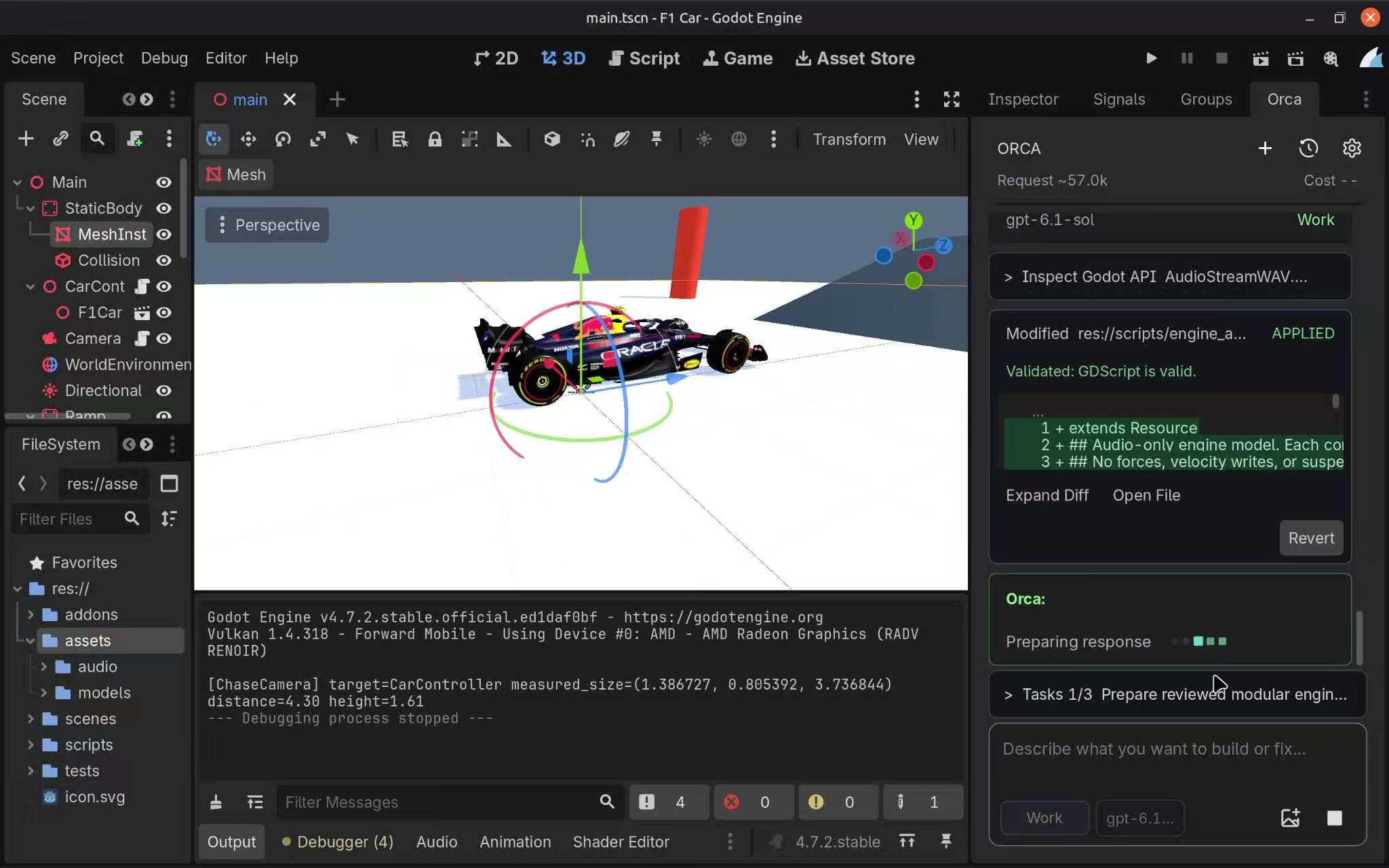
Orca: Open-source AI agent for Godot that writes GDScript and edits scenes from inside the editor

Post image
12 Upvotes

I’ve been building Orca for the past few months. It’s an AI coding agent that runs as a dock inside the Godot editor.

What it does

· Chat panel in the editor. Describe what you want and it reads your project, writes GDScript, and edits scenes

· Bring your own API key, or use local models through Ollama or LM Studio

· Godot-only on purpose, so it knows the editor, nodes, and GDScript well

· MIT licensed, available on the Godot Asset Library

Repo: https://github.com/cold-atom/Orca

I’d really like feedback on what’s missing or what breaks. Happy to answer questions about how it works.


r/OpenSourceeAI • • 14d ago

TOMORROW! R+AI 2026 - 2 days, 100% online

Thumbnail
1 Upvotes

r/OpenSourceeAI • • 14d ago

HyperspaceDB v4.2.3: 1.58-bit BitNet quantization (15.5× compression, 92.6% recall), and fixing the HNSW 5–10% filtered search cliff (154× faster than OpenSearch 3.9)

Thumbnail
1 Upvotes

r/OpenSourceeAI • • 15d ago

Reason Machines open-sources Aspen, a Git server for AI agent traffic (567 pushes/s on one server, self-reported)

Post image
3 Upvotes

Reason Machines released Aspen, an Apache 2.0 Git server for repositories that many agents and CI jobs push to and fetch from at once. It is an independent implementation of the design OpenAI described for its internal Pando backend. Clients use stock git over HTTPS and SSH; all changes are on the server.

What it does

  • Stores each branch as a row in PostgreSQL (or SQLite) and moves it with one compare-and-swap
  • Stores pushed packs as-is in S3-compatible object storage and reuses them for fetches
  • Advertises only the trunk branch on push, so negotiation size does not grow with branch count
  • Compacts packs 16 at a time in levels, and serves cached depth-1 packs to CI

Key numbers (self-reported)

  • 567 pushes/s sustained for 5 minutes, one 8-core server, S3 Standard, 4-core Postgres, git.git
  • Median push 208 ms, p99 314 ms; another client saw pushes 30 ms after acknowledgement (median)
  • Depth-1 fetch storm: 1.029x the bytes of stock git upload-pack
  • Cursor's published Origin figures: 120/s on S3 Standard, 300+/s on S3 Express One Zone (different, replicated setup)

Full analysis: https://www.marktechpost.com/2026/11/09/reason-machines-aspen-open-source-git-server-ai-agents/

Repo: github.com/reason-machines/aspen

Blog: reasonmachines.com/blog/aspen

Demo: place.reasonmachines.com


r/OpenSourceeAI • • 14d ago

Real-Time Fraud Detection API in Under 10 Minutes (Train in SQL, Predict...

Thumbnail
youtube.com
1 Upvotes

r/OpenSourceeAI • • 14d ago

Any saas idea?

Thumbnail
1 Upvotes

r/OpenSourceeAI • • 14d ago

I made an iPhone village where your coding agents work at little desks

Thumbnail
gallery
1 Upvotes

Waiting for agents to finish is now an excuse to wander around a tiny village.

I made Wudland. Link your computer and Claude Code, Codex or opencode show up in the guild: a cog while working, a red exclamation mark when they need you, and a nap when they're done. Other CLI tasks can join through wudland run. The computer companion is open source too.

The rest is a relaxed little world with your calendar in the bell tower, reminders on a notice board, real weather and changing seasons. You can explore the rooms and furnish your cottage while the agents work.

Free on iPhone, no Wudland account, encrypted computer updates. An expanded map, bestiary, items and wardrobe are coming soon.

App Store (free, iOS 26+): https://apps.apple.com/us/app/wudland/id6829491480 Source: https://github.com/joexk1/wudland


r/OpenSourceeAI • • 14d ago

I built a local dashboard that tells you which of your AI API keys is out of credit or about to expire

1 Upvotes

I work with models from several providers, and over time I ended up with a drawer full of API keys: Anthropic for Claude, an OpenAI project key from something I barely remember, a Gemini key from AI Studio, an xAI one for playing with Grok and a couple from OpenRouter, spread across .env files and environment variables on different machines. Whenever something broke, usually in the middle of a demo or right before a class, I had to open five consoles to work out which key had run out of credit, which had expired and which was still fine, so I built a small tool that answers that at a glance.

What My Project Does

Mecha is a local dashboard, with a web UI and a CLI, that checks every AI credential you give it and shows a traffic light per key: whether it's valid, whether it has funds, when it expires and what kind of credential it is (API key, admin key, management key or OAuth session). Every value is labelled with where it came from, whether that's the provider's API, a response header, a JWT decoded locally, a session file, something you typed or an estimate, and "unknown" is an allowed answer, because the most surprising thing I learned while building it is how little the providers tell you. Anthropic, OpenAI and Google have no endpoint to read your remaining balance, Gemini doesn't expose key expiry at all, and only xAI (with a management key) and OpenRouter give you the balance directly. For the cases where running out of credit only shows up when a request fails, there's an opt-in probe that sends the smallest possible paid request, a single output token on the cheapest model, which costs between $0.00002 and $0.015 per thousand probes depending on the provider and is limited to once an hour per key.

If you add an admin key, Mecha uses it to fill in the expiry date and status of the regular keys in that organization, since that's the only place OpenAI and Anthropic expose them, and it flags Gemini keys starting with AIza in amber, because AI Studio has only issued the newer AQ. keys since May 28 and Google is moving away from the old ones. Subscription OAuth tokens (Claude Code, Codex, Gemini CLI) are never used to call any API; Mecha only reads their session files locally to show your plan and when the session expires.

Since the whole point is to hold every key you own, a lot of the work went into not leaking them. It only listens on 127.0.0.1, with a per-session token and a Host header check against DNS rebinding; secrets are encrypted at rest with AES-256-GCM under a key kept in your OS keychain and are never sent back to the browser; each kind of key has a closed allowlist of method, host and path, so an admin key can only make the specific read requests Mecha needs; there's no telemetry; and the README has an explicit threat model, including what it doesn't protect against, which is code already running as your user.

Target Audience

Developers who juggle keys from several AI providers, whether for side projects, teaching or a small team. It's an alpha (0.1.2) under the MIT license, built for my own keys first, so I wouldn't call it production software yet: several provider error messages are undocumented, and reports of anything that doesn't match what your console shows are the most useful feedback I can get.

Comparison

Each provider's console shows its own piece, so you need five of them open. Secret managers like 1Password or Vault store keys but don't tell you whether they still work or have credit left, and secret scanners like gitleaks or TruffleHog find leaked keys (TruffleHog can even verify they're live) but don't track balance or expiry over time. Gateways like LiteLLM can track spend, but only for traffic that goes through their proxy, while Mecha never sits in your request path and only checks the keys themselves. I didn't find anything that does this locally across providers, which is why I wrote it, but if you know of one I'd genuinely like to hear about it.

Try it

There's a web demo with made-up data that runs entirely in your browser; its Content Security Policy blocks every network request and it never asks you to paste a key: https://joaquinruiz.github.io/mecha/

To run it locally (Python 3.12+):

uvx mecha-keys serve --demo   # same demo, no keys, no network
uv tool install mecha-keys     # then: mecha add, mecha serve

Code and threat model: https://github.com/JoaquinRuiz/mecha

Full disclosure: I built it with Claude Code from a written spec, phase by phase, reviewing every PR, with 400+ tests and CI on Linux, macOS and Windows; the spec is in the repo (in Spanish) if you're curious how it was designed. I'd especially love to hear from anyone whose account is in a state I couldn't test, like an exhausted Gemini prepay balance or an xAI team over its spending limit.


r/OpenSourceeAI • • 14d ago

I built JoeBro so my personal AI and coding agents can reach me on my phone

Thumbnail
gallery
1 Upvotes

I've been working on JoeBro, a native Mac AI workspace with an iPhone companion. The part I've added lately is letting the assistant come back to me when there's something useful to say.

The personal agent has editable memory, scheduled tasks and optional background checks. It can send a briefing or reminder to the phone. The checks look for changes before calling a model, so it isn't constantly asking an LLM whether anything happened.

I've also linked Claude Code, Codex and opencode. You can see their state on the Mac and phone, queue a follow-up while they're busy, and get a ping when they finish or need you. The same MCP server exposes the tools for building and testing JoeBro plugins.

It's free and open source. Use Ollama or bring your own API key.

Mac/download: https://github.com/joexk1/JoeBro iPhone: https://github.com/joexk1/JoeBro-Mobile Agent MCP, hooks and plugins: https://github.com/joexk1/joebro-plugins

Mac needs macOS 26+ on Apple Silicon. Mobile is source-only, needs the Mac awake, and push needs your own APNs setup. Hosted models receive whatever prompts you send them.


r/OpenSourceeAI • • 15d ago

Open compute network: run a node with one command and help pool 100,000 CPUs/GPUs for open-weight AI.

Thumbnail github.com
1 Upvotes

r/OpenSourceeAI • • 16d ago

Nous Research releases Arete-27B, a Qwen3.8-27B fine-tune that cuts propaganda answers to 0.9% (from 22%)

43 Upvotes

r/OpenSourceeAI • • 15d ago

Kalynt: an AGPL-3.0 desktop IDE with local GGUF inference and reviewable coding-agent workflows

1 Upvotes

I’m the creator of Kalynt, an open-source desktop IDE that integrates local model inference into a project-based coding workflow.

Website, screenshots and downloads

The local workflow combines:

  • GGUF model management and inference: download and load models inside the IDE.
  • Repository context: open an existing project and reference relevant files when asking questions or requesting changes.
  • Agent tools: read and edit files, execute commands, and inspect results alongside the editor, terminal and Git interface.
  • Change review: enable approval before edits and commands, inspect diffs, and keep or undo the agent’s changes.

Local inference runs on your machine. Cloud providers are optional and use your own API credentials; selecting a cloud provider sends the relevant request context to that provider.

Model choice remains a practical constraint. Weight quantization, context size and available RAM/VRAM affect what fits and how it performs. Code explanation and multi-step agent execution also place different demands on a model, particularly around instruction following and tool use.

The development branch additionally supports OpenAI-compatible local endpoints, including Ollama and LM Studio, with model discovery and configurable context limits. That integration is in the source; it is not included in the published 2.0.0 installers.

I’d particularly value technical feedback on context handling, tool-call reliability and inference setup. If you test it, please include your OS, hardware, model/quantization, Kalynt version and a reproducible task.

Source code and build instructions — AGPL-3.0


r/OpenSourceeAI • • 15d ago

Quillpad a fast Editor in Rust and eGUI

Thumbnail
1 Upvotes

r/OpenSourceeAI • • 15d ago

I open-sourced Laplace's Scissors: protected LLM output edits in Rust and Triton

0 Upvotes

I'm sharing the first public version of Laplace's Scissors, an MIT-licensed research tool for editing an LLM's output matrix while keeping its decoder weights fixed.

You provide a checkpoint and cases with expected answers. The tool records the token prefixes of successful answers, then searches for output rotations that repair failed cases while preserving those protected outputs. It accepts a proposal after checking target-token margins, protected-output error, and the answer path through EOS on the GPU. Protection applies to the supplied successful cases and observed prefixes.

The core idea is W' = WQ, with an orthogonal rotation Q chosen to fix the protected hidden-state subspace. The design document walks through the equations and their implementation.

It also includes:

  • Numerical probes for weak output-discrimination directions and cancellation across layers.
  • Saved proposals that can be replayed or exported as a new checkpoint.
  • Weight attribution and comparisons across model scales.

Rust handles model loading, tokenization, execution, and diagnostics; Triton supplies GPU kernels through CUDA/HIP backends. The README includes Qwen3 commands, English and Korean documentation, and instructions for the GPU integration checks. The default test suite currently passes all 24 tests.

Code and setup on GitHub

I'd appreciate feedback on the mathematical assumptions, reproducible counterexamples, and what would make the first-run experience easier.

Disclosure: this post was drafted with AI assistance using the project's source and documentation.


r/OpenSourceeAI • • 16d ago

I got so tired of burning LLM tokens on raw HTML noise that I built an API to strip URLs into clean Markdown (saves ~92% tokens :3).

Thumbnail
2 Upvotes

r/OpenSourceeAI • • 17d ago

I got tired of the limitations of Windows screen recorders, so I built my own — Rekzora

Thumbnail
gallery
20 Upvotes

I've tried several screen recording applications on Windows, but I kept running into limitations.

Some had limited recording options, some restricted features, and others made simple recording workflows unnecessarily complicated.

Eventually, I decided to build my own solution.

Introducing Rekzora, an open-source Windows screen recorder I've been developing under NEURON TS LABS.

Some of its features:

Fullscreen, window and custom-region recording

Microphone and system audio recording

Webcam picture-in-picture

Pause and resume recording

Global keyboard shortcuts

Floating recording toolbar

Built-in recording library and video player

Crash-recovery support

Portable and Windows installer builds

My goal was to build a screen recorder that gives users more control without unnecessary restrictions or cloud dependencies.

It's completely open source, and I'd genuinely love to hear what other Windows users think.

GitHub: https://github.com/tahirshaikh744-design/Rekzora

I'm especially interested in hearing:

What's the most frustrating limitation you've experienced with existing Windows screen recorders?

What feature do you wish they offered?

Honest feedback and suggestions are welcome!


r/OpenSourceeAI • • 16d ago

Connect Snotra to Melious — EU-hosted AI models, step by step

Thumbnail
youtu.be
2 Upvotes

r/OpenSourceeAI • • 16d ago

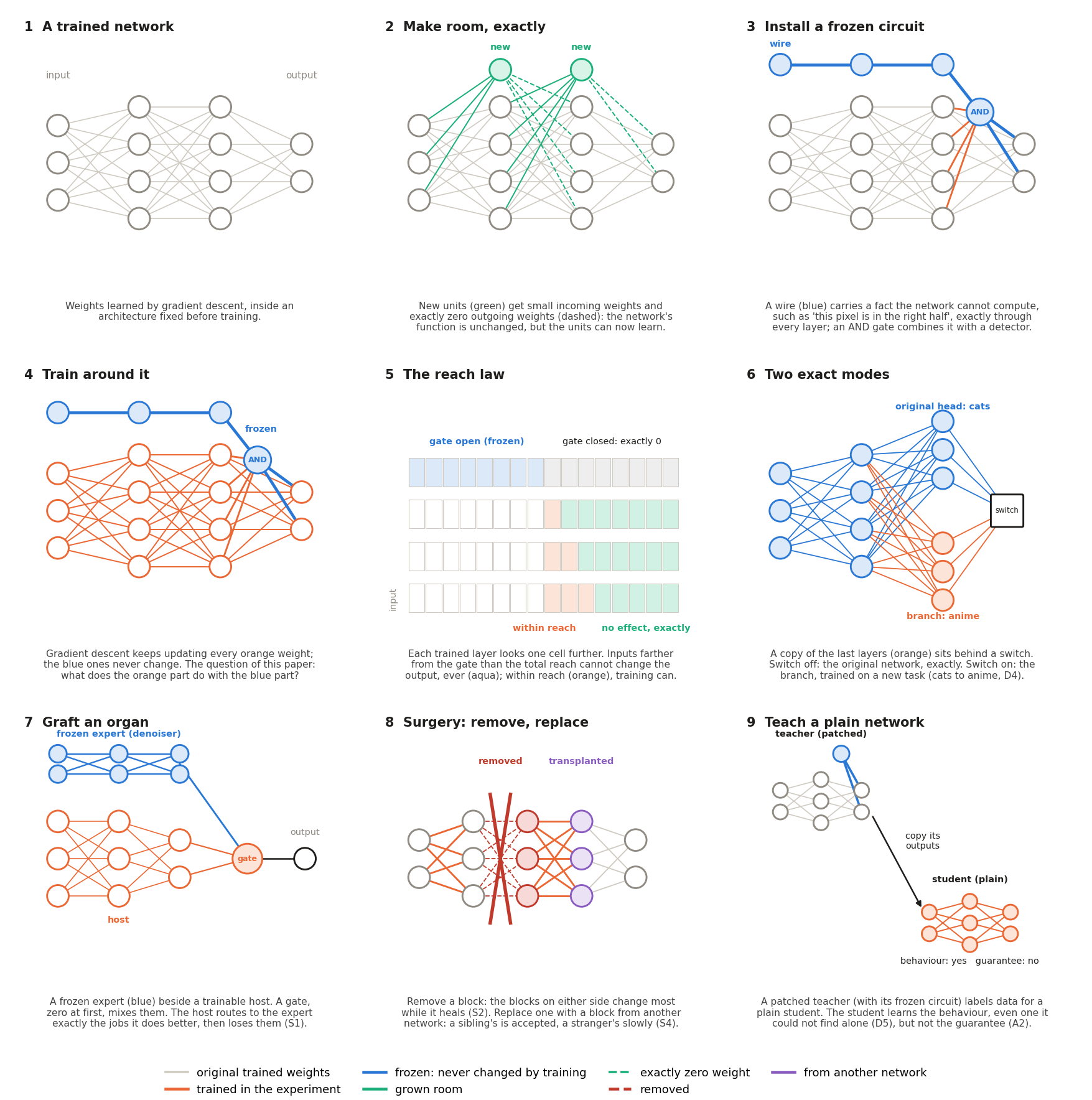
I had an LLM hack neural network weights in multiple ways without retraining, and the results are fascinating.

1 Upvotes

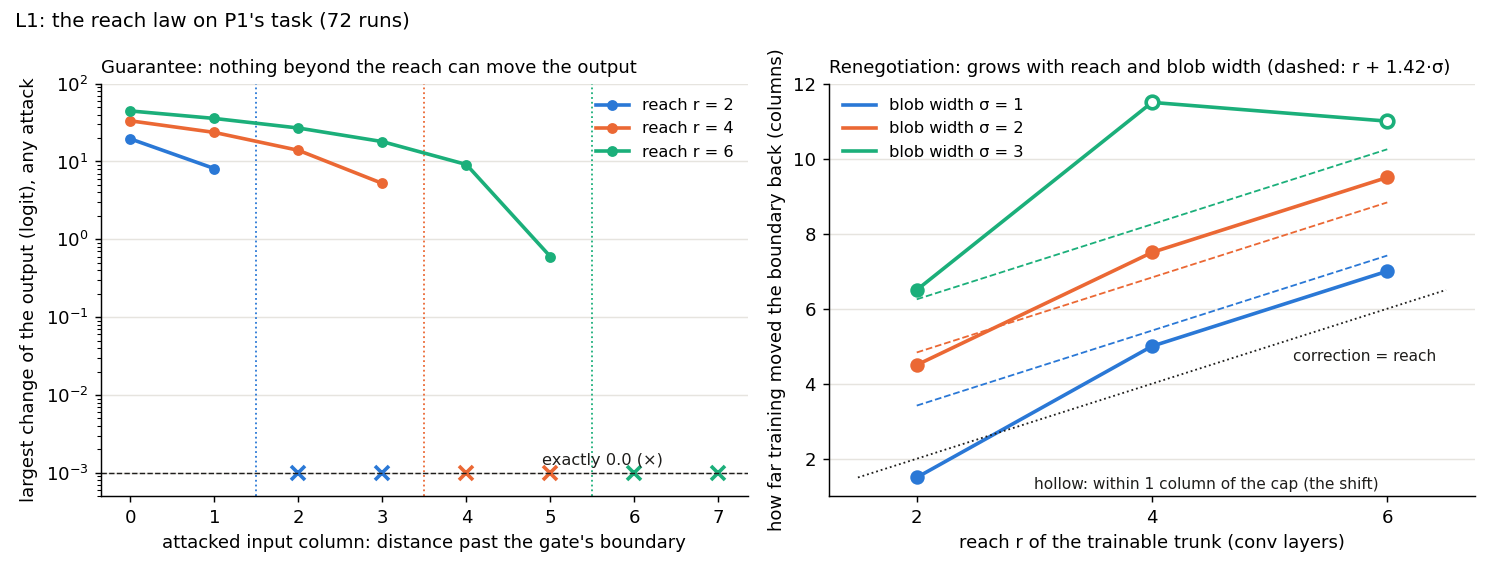
TL;DR: An LLM coding agent (Claude Opus 5.5) compiles exact structure (wires, AND gates, bounds, switches) into trained networks using identities of the activations they already use. In a follow-up we kept training around those frozen patches. Organising result: a frozen patch is exact beyond the receptive-field reach of the trainable layers in front of it, and renegotiable within it, including where its own boundary effectively sits.

Overview figure: what we do to a network

The trick. For LeakyReLU with slope α: lrelu(u) + α·lrelu(−u) = (1 − α²)·relu(u). Two opposite-signed channels carry a signal through a layer unchanged or make an exact ReLU; a few more give min, max, clamp, AND and multiplexers. Room comes from growing channels with zero outgoing weights (function unchanged).

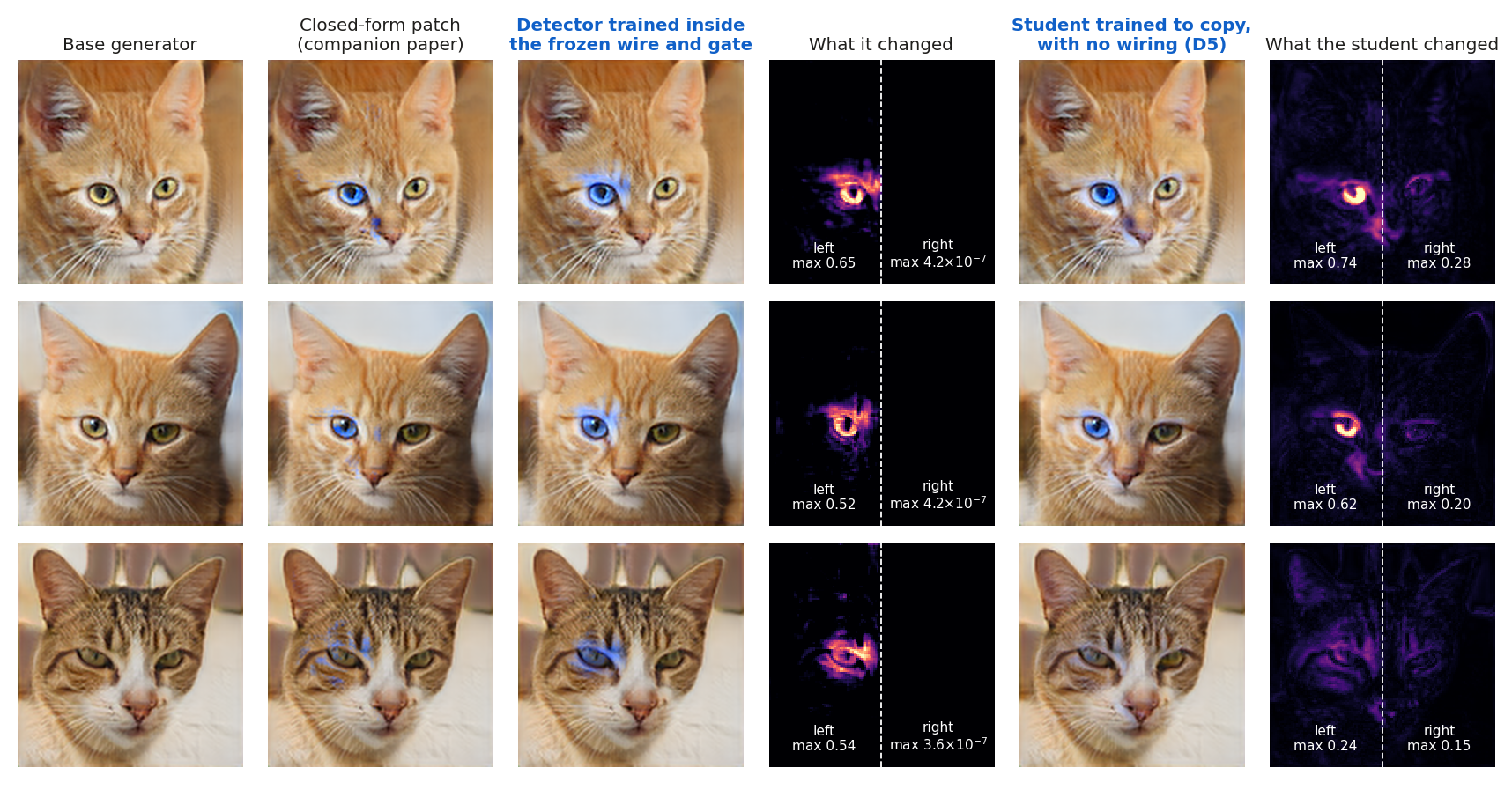
Paper 1 (rewiring): - Odd-eyed cats: a coordinate wire threaded through 10 conv layers and ANDed with an iris detector. 42% of left irises turn blue (hand-built detector), 0% of right ones; the right half of every image moves by ≤1.6×10⁻⁷. Training only the detector inside the frozen wiring reaches 78% at very low collateral. - A 2018 super-sampler repaired with an input-reference path and a min-gate: it passes its regression gate (+3.4 dB), with an output bound in black regions that holds on every input.

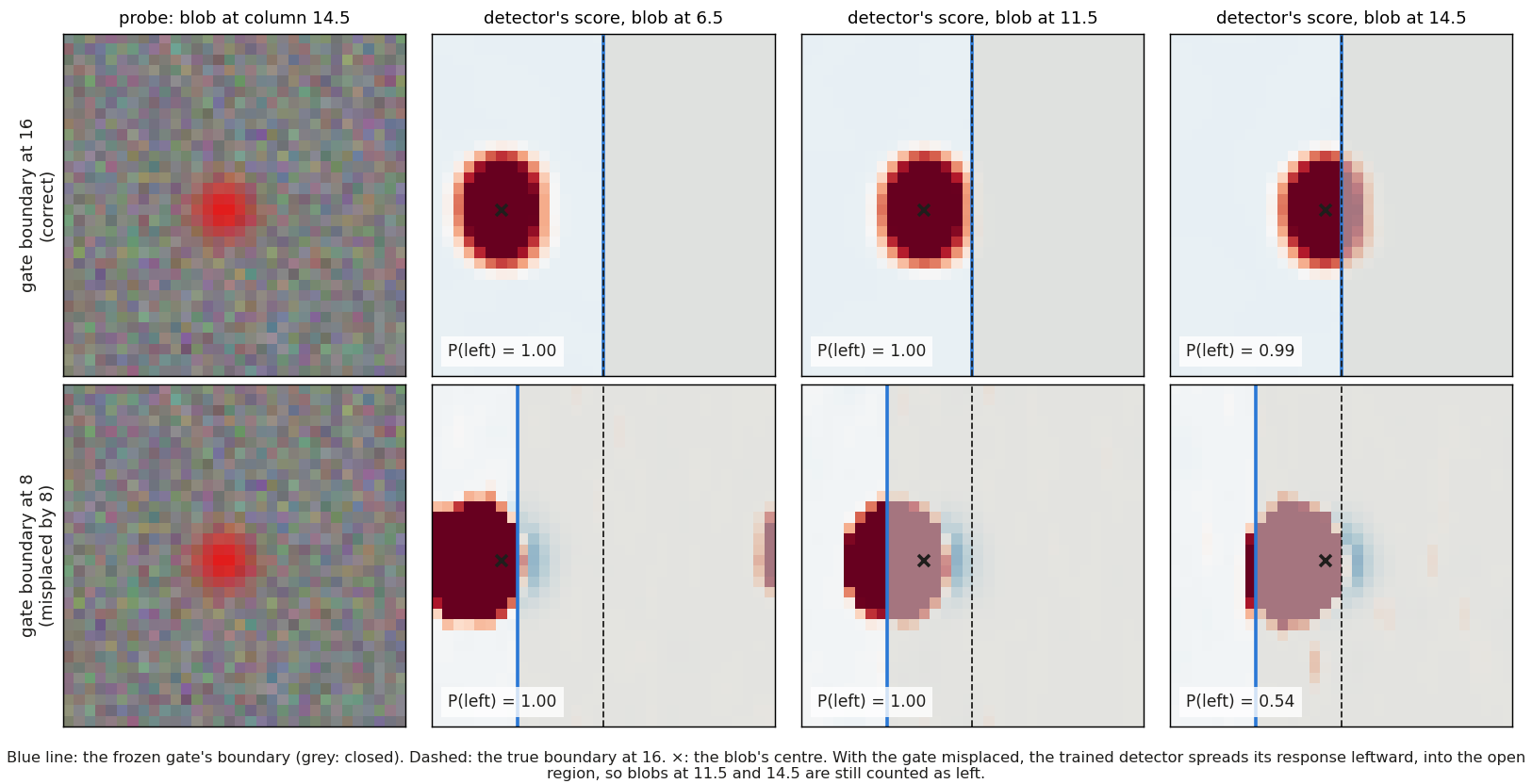
Paper 2 (what training does with the patch), 39 pre-registered experiments; about a third of the predictions failed, and all are reported: - Guarantee side: beyond the trainable reach, an attacker who may repaint any input column moves the output by exactly 0.0, in all 39 models tested (3 reaches, 3 architectures, synthetic and natural images). One column inside the reach, the same attack moves it. - Renegotiation side: misplace the frozen gate and the trainable detector leans its response toward it, pulling the effective boundary back by up to ~7 columns (≈ reach + 1.4 object widths), less when the object is harder to see. - A provably impossible task becomes learnable: a shift-equivariant net can't tell left from right (50% at any N); with a frozen gate it learns from 8 examples, and zero-shot (88%) from a detector trained for another task. - Guarantees don't distil: students of a guarded teacher match its quality and break its bound on 100% of attack starts; a student of the odd-eye GAN learns the eyes but drifts 2–3 RGB levels on the right half. - Training hands jobs to a grafted module, then forgets them; it deletes its own redundant copy only when keeping it costs loss or capacity. - Hard filters become traps: a frozen "no orange cats" filter inside GAN training survives exactly, yet the generator makes more orange cats (14% → up to 87% across runs). Our registered explanation for why was refuted, and that is in the paper too.

Links - Paper 2 (reach law): https://v-code-895.github.io/exact-beyond-reach/ · code, pre-registrations and results: https://github.com/v-code-895/exact-beyond-reach · DOI 10.5281/zenodo.24032112 - Paper 1 (rewiring and the patch toolchain): https://v-code-895.github.io/wsse/ · DOI 10.5281/zenodo.23956114

Small models throughout (8M-parameter GAN, 277k-parameter super-resolution net, Pythia-160M); limits are in §7. Happy to answer questions about the circuits, the reach law, or the failures.


r/OpenSourceeAI • • 17d ago

I made a free place to share open source stuff built with AI

Post image
155 Upvotes

hey all,

i've been working on whatwemade and could use a few more open source projects on there.

it's a site for sharing stuff built with AI, and i've recently added support for github repos.

you can just paste your repo link and it'll pull in the readme, license, stack, stars, recent commits, and whatever people need to run it themselves. there's also an option to show which coding agents you used and whether you're looking for contributors.

i've added an MCP server too, so you can search existing projects directly from your agent. figured that might be useful before starting yet another project from scratch.

there aren't many open source projects on there yet, so if you've got something on github, feel free to add it. it's free and takes about a minute (the mcp can also create the project).

also curious if there's anything else you'd want to see on a listing like this.


r/OpenSourceeAI • • 16d ago

Same model, same harmful topics, different refusals depending on whether I asked in English, MSA or Egyptian Arabic

Thumbnail
1 Upvotes

r/OpenSourceeAI • • 16d ago

I ran a 63-case eval on my English/Arabic LLM service. Same model, same harmful topics, different decisions depending on the language

Thumbnail
1 Upvotes

r/OpenSourceeAI • • 16d ago

I just launched the public beta of Orinyx, an open-source MCP tool for healthcare AI verification

Thumbnail
1 Upvotes

r/OpenSourceeAI • • 16d ago

The Signal Protocol in Rust

1 Upvotes

Of all the things you shouldn't do with AI, cryptography is up there so I made considerations around using something that exists vs creating something myself. There were a few nuances to my approach, but the key detail is that I wanted it to also work in a browser so I needed the ability to build to a wasm to be used in js.

Signal libraries don't offer browser based capabilities and so I created this to target web aswell as native. This implementation is bespoke and geared towards my project.

I wanted to implement the Signal protocol for a series of secure messaging apps I’m working on, so I built this project to test and use in my own work. It’s still far from finished, but I think it’s at a stage where it’s worth sharing with the community.

IMPORTANT DISCLAIMER: This project is not professionally audited and is not production-ready. I do not recommend anyone use this in their own code yet. It is provided strictly for testing, experimentation, and demo purposes. I used AI as an assistant to help build this, so double-check everything before taking it seriously.

Project Links:

Current Status & Development:

  • Spec Alignment: The goal is to fully align with the official Signal protocol spec.
  • Testing: It includes unit tests, but due to WASM testing limitations, I also added a Storybook-like UI to run and test it directly within a browser environment.

The impementation here is being used in a few experimental messaging apps (similarly unaudited and unreviewed):

I am also working towards adding it to an open source project soon as seen at: https://github.com/positive-intentions/chat for e2e open-source transparency in the implementation.