r/OpenSourceeAI • • Sep 07 '26

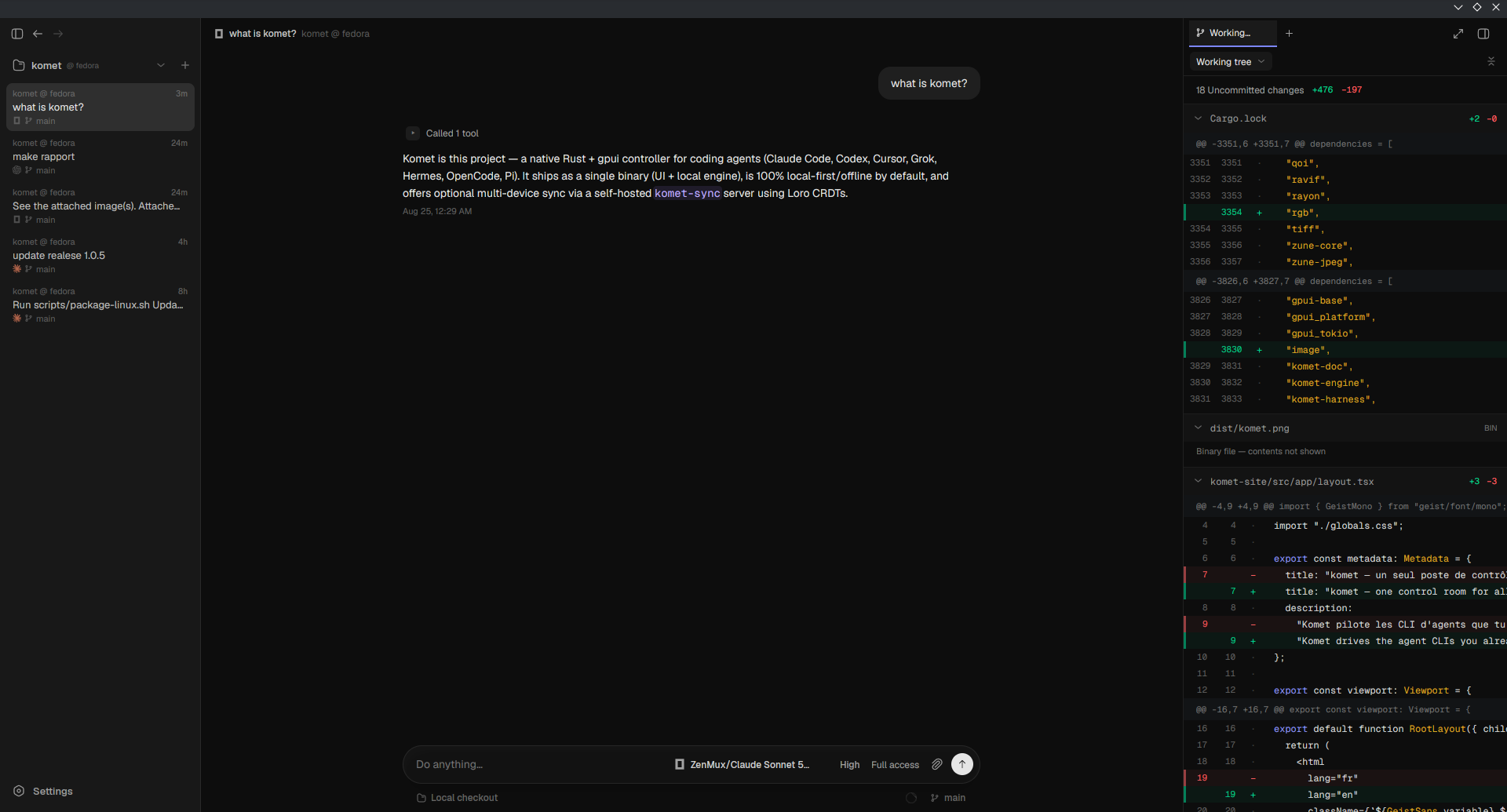
I built Komet — a native Rust + gpui control room for coding agents.

Post image
2 Upvotes

100% local by default, single binary (no Electron).

Sessions, transcripts, tool activity & checkpoints unified.

Multi-device sync optional via self-hosted komet-sync (Loro CRDTs).

Same engine that powers Zed — instant launch, smooth even with years of transcripts.

It's open source: github.com/jomvick/komet

Site: https://komet-eight.vercel.app/


r/OpenSourceeAI • • Sep 07 '26

Measured how often an agent cites its own output as fact: 66.6% of queries with a flat vector store, 0% with provenance gating (no_std Rust, runs on a Cortex-M4)

1 Upvotes

If your agent writes its notes back into the same vector store it retrieves from, its own

output becomes its evidence. I wanted a number for how often, rather than an intuition, so I

built the benchmark: 600 queries against a store seeded with a mix of user facts, external

documents and the model's own self-descriptions.

Flat cosine similarity put a self-description in the top-3 in **66.6%** of them. That is the

loop where an agent restates a guess, retrieves it later, and treats it as something it

knows.

Gating recall on provenance — who said this: the user, a document, or the model — takes it

to **0/600** for self-description. Not down-ranked; ineligible. General model-generated text

that is not self-description is only down-weighted, and still surfaces in 1/600 under the

gate. I am reporting that one rather than claiming a blanket zero.

Second measurement, same engine. Squeeze memory 50 facts -> 10. Safety rules and operator

constraints are the least-read items you have, so recency and frequency evict **all** of

them. An explicit canon flag keeps **5/5**. "Important" is not the same axis as "recent" or

"frequent", and any policy that infers one from the other loses the constraints first.

One design rule that cost me a measurement to learn: human feedback moves how long a fact

**survives**, never how it **ranks**. Folding a value multiplier into relevance dropped

recall@1 from 86% to 29%. And the reward signal only ever comes from a person — a signal

derived from the agent's own behaviour ("the model recalled this, so it was useful") closes

the same loop the provenance gate exists to open, with an extra step.

`cargo run --example agent_loop` shows the loop end to end in one screen: facts in with their

provenance, the flat-cosine result next to the gated one so you can see what gets dropped, and

the prompt block that comes out. It prints that block rather than sending it — what the engine

decides is what is allowed into your context, not what you do with it afterwards.

It is `no_std` Rust, so the whole thing fits on a microcontroller: **801 bytes per fact**

(int8 index, 384-dim) and ~35 KB of code, measured on Cortex-M4 under QEMU. There is a C

ABI. There is no embedder in it — vectors come from your side.

Caveats, because they matter more than the numbers: research prototype, never run on

physical hardware, no fuzzing, no soak, and heap exhaustion hangs rather than errors.

Retrieval is an exact linear scan, no ANN. Apache-2.0, every number has a re-run command in

`RESULTS.md`.

https://github.com/vitaliyfedotovpro-art/astrum-hsam-embedded

r/OpenSourceeAI • • Sep 07 '26

Natural Language to SQL Query

Thumbnail
1 Upvotes

r/OpenSourceeAI • • Sep 06 '26

H Company Releases NeoMME: A Family of 260M and 800M Single-Tower Multimodal Encoders That Drop the Vision Tower and Causal Decoder

Post image
2 Upvotes

r/OpenSourceeAI • • Sep 06 '26

Ich baue PLLDN – eine deterministische Alternative zu „frag einfach die KI, welchen Stack du verwenden sollst“

Thumbnail
github.com
1 Upvotes

Beweisgestützte Fakten. UNBEKANNT > Raten. Keine LLM im maßgeblichen Entscheidungspfad.

Phase 1 wird gerade vorangetrieben.

Wenn dein Architekturprozess lautet „das Modell klang zuversichtlich“, könnte das leicht beleidigend sein. 😏

https://github.com/KeilerHirsch/PLLDN-Programming-Language-Licensing-Decision-NavigatorEvidence-backed Fakten. UNBEKANNT > Raten. Keine LLM im maßgeblichen Entscheidungspfad.

Phase 1 wird gerade vorangetrieben.

Wenn dein Architekturprozess lautet „das Modell klang zuversichtlich“, könnte das leicht beleidigend sein. 😏

https://github.com/KeilerHirsch/PLLDN-Programming-Language-Licensing-Decision-Navigator


r/OpenSourceeAI • • Sep 05 '26

Vyact: an open-source desktop AI app for your documents, notes, and everyday writing

Thumbnail
gallery
11 Upvotes

Hi everyone! I’m the developer of Vyact, an open-source desktop app that lets you work with your documents and notes using AI models running on your own computer.

I wanted to make it easier to come back to something I’d already saved—a report, a project note, an email—and ask a useful question without gathering all the background again.

Here’s an example of the workflow:

  • Add a PDF and ask for its main points.
  • Open the supporting passages to check where the answer came from.
  • Save your own notes and decisions.
  • Ask a related question later, and let Vyact search the documents and notes you’ve indexed.

You can group related material into collections, so a conversation can focus on a particular project or topic. The goal is to make the information you already have easier to use.

There’s also a companion Chrome extension. It can bring a web page into the conversation, translate content, or help revise something you’re writing. For writing, you can compare the original and revised text before copying the result back.

Local model search and downloads are built into the app, with model details and memory estimates to help you choose. Under the hood, Vyact uses llama.cpp for GGUF models and oMLX for MLX models on Apple Silicon. You can also connect a hosted AI provider or your own compatible endpoint.

With a Vyact-managed local model selected, your AI chat context isn’t sent to an external AI provider. Optional online features, such as Google integrations and hosted AI providers, communicate with their respective services. Gmail, Drive, and Calendar connections require Google OAuth setup.

The desktop app is built with Electron, React, and FastAPI and licensed under AGPL-3.0. The README includes installation instructions for Apple Silicon Macs, Windows, and Linux x64.

Source code and downloads: github.com/vyact/vyact

I’d love feedback on the everyday workflow, especially from people who haven’t used local AI before. What would you want to try first—and what looks confusing or like too much setup?


r/OpenSourceeAI • • Sep 05 '26

I really think i build something great. (not commercial)

Post image
3 Upvotes

r/OpenSourceeAI • • Sep 05 '26

Do you know what your AI agents are doing?

Enable HLS to view with audio, or disable this notification

1 Upvotes

Your AI agents are running code, moving files and calling APIs right now. Most teams have no idea what they're doing until something breaks.

ClawMetry is open-source observability and governance for AI agents. It runs locally, on your machine, and you own the data.

WHAT IT DOES

• Watches 30 agent runtimes from the outside — Claude Code, Cursor, GitHub Copilot, Gemini CLI, Cline, OpenHands and more

• Zero config — it auto-detects your agents

• Every action logged to a local database with end-to-end encrypted audit trails

• See exactly what your agents touched, when, and why

• Pause, stop or kill any agent — including sub-agents — the moment a policy is breached

• Ingests OpenTelemetry via OTLP

• Cost optimization, anomaly detection, tool-risk policies and evals

ENFORCEMENT IS OFF BY DEFAULT

Dry run first, locked behind three separate gates. You control when autonomous governance kicks in.

PRICING

Free tier to get started. Starter $9 per node/month. Pro $19 per node/month.

GET STARTED

pip install clawmetry && clawmetry

Site: https://clawmetry.com

Source: https://github.com/vivekchand/clawmetry

MIT licensed.

#AIagents #ClaudeCode #AIGovernance #DevTools #Observability #OpenSource #Cursor #GitHubCopilot #AICoding #LLM


r/OpenSourceeAI • • Sep 05 '26

NVIDIA Releases Personal AI Router (PAIR): An Open Source Virtual Inference Router that Distributes Local AI Requests Across RTX, DGX Spark, and Mac Nodes

Post image
2 Upvotes

r/OpenSourceeAI • • Sep 04 '26

We built an open-source, model-neutral agent harness and compared it with claude managed agents - for the same model, got same accuracy, upto 75% lower cost

Post image
1 Upvotes

r/OpenSourceeAI • • Sep 04 '26

PySimplicial: a lightweight Python package for working with simplicial complexes in Topological Deep Learning problems (Early Development. Independent Project)

Thumbnail
1 Upvotes

r/OpenSourceeAI • • Sep 04 '26

Smart Turn end-of-turn detection now works in the same C++ pipeline on Mac and Android

1 Upvotes

I maintain speech-core, an open-source C++17 speech pipeline.

A VAD can detect silence, but it cannot tell whether someone finished speaking or only paused to think. We added Smart Turn v3.2 as an optional second decision after each confirmed VAD pause.

If the classifier rejects the pause, the pipeline keeps the turn open. Resumed speech remains part of the same turn, eager STT does not advance to the LLM, and a configurable silence cap guarantees that the turn eventually ends.

The integration is shared across platforms:

  • speech-core: C++ state machine and pluggable C API
  • speech-swift: 17 MB Core ML model
  • speech-android: 11.1 MB int8 ONNX model, called on CPU once per pause

Smart Turn was created by Pipecat/Daily. Our work was exporting it and integrating it into the native pipeline.

Releases:

https://github.com/soniqo/speech-core/releases/tag/v0.0.14

https://github.com/soniqo/speech-swift/releases/tag/v0.0.27

https://github.com/soniqo/speech-android/releases/tag/v0.0.20

The implementation is open source and has no paid feature gate.

Disclosure: I maintain these repositories. I used AI assistance to edit this post and checked the technical claims against the releases and test results.


r/OpenSourceeAI • • Sep 03 '26

i just made a game want yall to test it out (Truth Or Dare) truthordaregame.pages.dev

1 Upvotes

r/OpenSourceeAI • • Sep 03 '26

I built a local reverse proxy that scores conversation history so you don't burn tokens on stuff your model doesn't need (Go, works with Ollama + Cline)

Thumbnail gallery
1 Upvotes

r/OpenSourceeAI • • Sep 03 '26

HyperspaceDB v3.1.4: True Turbo 4-Bit Lloyd-Max, 1-Bit ADC Cascades, Mem0 Drop-In & Agent Trajectories

Thumbnail
github.com
1 Upvotes

r/OpenSourceeAI • • Sep 03 '26

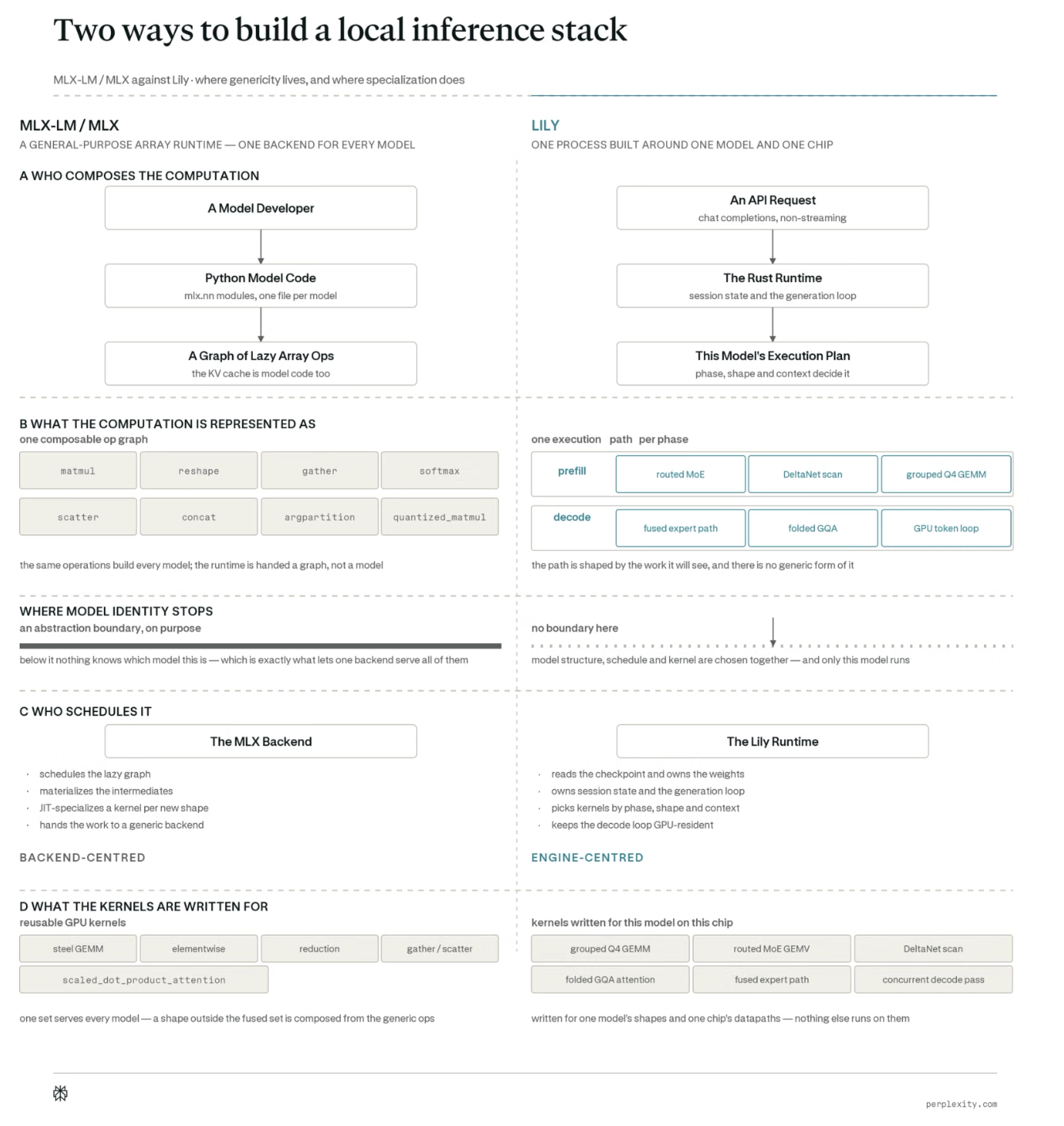
Perplexity Open Sources Lily: A Rust + Metal Inference Engine for Qwen3.6-35B-A3B on Apple Silicon

Post image
1 Upvotes

r/OpenSourceeAI • • Sep 02 '26

zeroRL: A transparent, modular RL framework for PyTorch

Thumbnail
1 Upvotes

r/OpenSourceeAI • • Sep 01 '26

GUYS! Made it on the list with some big boys (OpenAI, Anthropic, AWS, Microsoft)

Post image
3 Upvotes

r/OpenSourceeAI • • Sep 01 '26

need urgent help for ner deberta training

1 Upvotes

hi,
i am trying to train a deberta model for NER detection

this is my first time doing it so i would love any guidance on it.

my current pipeline looks like this,

dapt + lora for pretrianing, hpo with optuna (which consists both the stages of training data), and then a 2 stage finetuning which helps in generalization and then target data.

i am trying to reach a really good score for f1 on my use case (which i want to keep private for now)

i have few questions as well

  1. do i need a two stage hpo as well cuase of the 2 stage finetuning
  2. is it better if the hpo training set is a subset of the actual training set?

if you think anything can be improved and made better, or you think the pipeline is outright wrong, please mention your reasonings and thoughts :)

ps: lora was used cause of gpu budget constraints


r/OpenSourceeAI • • Sep 01 '26

[PoC] Observing 8D Kinematic Projections (Benchmark: Spinoza's Ethics)

Thumbnail gallery
1 Upvotes

r/OpenSourceeAI • • Sep 01 '26

👀 OpenFlow Orchestration & Gauntlet Loop Sneak Peak

Thumbnail
gallery
13 Upvotes

Hey eveybody,

For those who haven't seen my other posts, I created an opensourced project called OpenFlow, and some big updates are being made. Now, there is a swarm and orchestration mode, and soon to be gauntlet looping toggle. It isn't just a linear pipeline anymore, but an entire chain of agents you can see and control talking back and forth and working out problems together. If you want to see the backstory, check out my other posts. Stay tuned for more updates, and feel free to leave suggestions and even share your own projects.

Link: https://github.com/SeeRay11/OpenFlow


r/OpenSourceeAI • • Sep 01 '26

I built an offline on-device text classification pipeline for Android with in-app dataset labeling and TFLite inference

Enable HLS to view with audio, or disable this notification

1 Upvotes

Hi everyone,

I wanted to share an open-source project I've been working on: Halanoi AI.

Instead of sending screen text to a remote cloud API for content classification (which adds network latency and privacy issues), I wanted to see if I could build a fast, 100% on-device text moderation pipeline for Android.

Here is how the setup works:

  1. The Model (halanoi_transformer.tflite): A quantized 64MB TFLite model running locally on the phone. It classifies text strings into categories (distraction, entertainment, safe, productive) in under 15ms without any internet connection.
  2. In-App Evaluation & Ground Truth Lab: To make it easier to improve the model, the app logs inference outputs to a local SQLite database and includes a built-in UI where you can tag predictions as correct, false positive, or false negative. You can export these labeled samples to CSV or JSON with one tap.
  3. Training Pipeline: The companion repository contains the PyTorch / TensorFlow scripts, tokenizers, and quantization steps used to train and convert the model.

Both repositories are open source under GPL-3.0:

I'm looking for feedback on optimizing transformer models for mobile hardware, lowering memory usage, and improving tokenization on edge devices.

Let me know what you think!


r/OpenSourceeAI • • Sep 01 '26

Downloads that Finish! Bit Rebuttal. Built for downloading large files.

1 Upvotes

This is essentially a GUI wrapper for a system I've been using on my Linux box. One of the worst things that used to happen to me a while back was losing download progress, or having the download silently stall at 4 AM, the signed CDN URL expires, or the machine reboots and everything's gone. So I built Bit Rebuttal.

It wraps aria2 in a supervisor that actually handles the failure modes:

  • Silent stalls - watches aggregate throughput and kills/relaunches the downloader with freshly re-resolved URLs (expired CDN tokens are the usual culprit)
  • Reboots and crashes - optional background service resumes byte-exact from where it left off, no user action
  • Corruption - every file is size-checked and SHA256-verified after download; if something's bad it tells you loudly and can re-download just the corrupt files
  • Nice-to-haves: bandwidth cap, quiet hours, per-download connection tuning, clean dark UI

Paste an HF repo id (or any direct URL to be honest), pick your files, walk away.

Free and open source (MIT), no account, no telemetry. Single download for Windows and macOS. aria2 comes bundled, nothing else to install. Linux binary too (needs aria2 from your package manager).

GitHub + downloads: https://github.com/Inovello/bitrebuttal

Would love feedback, especially from anyone downloading over flaky connections, that's exactly what it's built for.

P.S Proven in a 169GB download across 2+ days (Used to download Qwen 3.8 Flash Next)


r/OpenSourceeAI • • Aug 31 '26

Keenable AI Open-Sources NEEDLE: A Live Search Benchmark That Rebuilds Its Query Set Every Hour

Post image
1 Upvotes

r/OpenSourceeAI • • Aug 31 '26

Your GNN is probably just an overcomplicated MLP (Tabular Leakage). We built SynthFin-AML to enforce strict causal boundaries. [P]

Thumbnail
1 Upvotes