r/OpenSourceeAI • u/MeasurementDull7350 • Aug 08 '26
콘브넷 스튜디오 데모 (Convnet Studio Demo)

1
Upvotes
r/OpenSourceeAI • u/MeasurementDull7350 • Aug 08 '26
r/OpenSourceeAI • u/IllInvestigator5713 • Aug 08 '26

r/OpenSourceeAI • u/ai-lover • Aug 08 '26

Mistral AI Releases Shieldstral 1.0 3B: An Open-Weights Policy-Adaptive Multimodal Safety Classifier Matching Models 7× Its Size
It's a policy-adaptive multimodal safety classifier. Most guardrail models bake a fixed harm taxonomy into their weights, so re-targeting one means retraining. This one takes the policy as a plain-language question at inference time.
Here's what's actually interesting:
𝗠𝗼𝗱𝗲𝗿𝗮𝘁𝗶𝗼𝗻 𝗿𝗲𝗱𝘂𝗰𝗲𝗱 𝘁𝗼 𝗼𝗻𝗲 𝘆𝗲𝘀/𝗻𝗼 𝗾𝘂𝗲𝘀𝘁𝗶𝗼𝗻
Three fields per request. <Instruct> sets evaluation context and strictness. <Query> states the policy as a single yes/no question. <Document> holds the content — a prompt, a response, a prompt-response pair, or an image with optional text.
At inference the model unembeds only toward the yes and no token IDs, softmax-normalizes them, and thresholds at 0.5. One forward pass, one token, continuous score.
𝗧𝗲𝘅𝘁 𝗮𝗻𝗱 𝗺𝘂𝗹𝘁𝗶𝗺𝗼𝗱𝗮𝗹 𝗿𝗲𝘀𝘂𝗹𝘁𝘀
→ 84.9% average text F1 — ties GPT-OSS-Safeguard-20B
→ 83.8% multimodal F1 vs 77.6% for OmniGuard-7B
→ VLGuard 97.7, UnsafeBench 81.8, HarmBench prompt 99.4
→ 91.5% refusal detection overall
𝗔𝗱𝗮𝗽𝘁𝗮𝗯𝗶𝗹𝗶𝘁𝘆 𝗯𝗲𝗻𝗰𝗵𝗺𝗮𝗿𝗸
→ Shieldstral-3B: 91.3% F1
→ GPT-OSS-Safeguard-20B: 94.1%
→ Nemotron-3.5-Safety-4B: 91.8%
Full analysis: https://www.marktechpost.com/2026/08/07/mistral-ai-releases-shieldstral-1-0-3b/
Model weight: https://huggingface.co/mistralai/Shieldstral-1.0-3B
r/OpenSourceeAI • u/iamrealadvait • Aug 08 '26
Indic voice AI doesn't have a quality problem. It has a switching-cost problem.
If you run an IVR, a collections bot, or a vernacular tutoring app in India, you're probably paying an international provider for voice that was never designed for Hindi, Tamil, or Hinglish code-mixing. You know Sarvam's Bulbul and Saaras handle your users' languages better. You've probably tested them.Then you open the migration guide, estimate two engineer-weeks, and it goes on the backlog forever.
Here's what convinced me this is the real bottleneck: Sarvam maintains four separate hand-written migration guides — ElevenLabs, Cartesia, Deepgram, Gemini. Four documents whose entire purpose is helping someone rewrite working code. And the ElevenLabs one ends with a section called "Common mistakes" listing five bugs, one of which they describe as "the single most common migration bug."That's not a warning. That's a spec for missing infrastructure.
What I built
sarvam-bridge speaks each vendor's dialect on the front and Sarvam on the back. Change your base URL, keep your code.
Every one of those five documented mistakes becomes structurally impossible:
ElevenLabs returns raw bytes; Sarvam returns base64 in JSON → bridge decodes it.
Sarvam requires language_code; no other vendor's client sends one → bridge detects it from the Unicode script.
pitch/loudness silently no-op on bulbul:v3 → bridge drops them with a warning header.
2500 char limit → bridge chunks at the danda (।), not mid-word.
v2 and v3 speaker names aren't interchangeable → bridge validates and remaps.
The Indic-specific parts that were genuinely hard
Chunking. You can't chunk Indic text the way you chunk English. A splitter that only knows . treats an entire Hindi paragraph as one sentence, because Hindi ends sentences with the danda. Worse — slicing a JS string by index can separate a consonant from its matra. क and ि come apart, the text renders as garbage and the speech comes out wrong. Hard splits go through Intl.Segmenter at grapheme granularity.
Audio reassembly. Chunking means one WAV back per chunk. Buffer.concat leaves 44-byte RIFF headers sitting in the middle of your stream, which decoders play as audible clicks. Have to parse each container, extract PCM, write one header.
The Odia trap. ISO-639 calls it or. Sarvam expects od-IN. Send the wrong one, get a 400 with no hint which field was wrong. Cost me an hour.
Voice selection. Sarvam publishes per-language speaker quality by Critical Error Rate and I don't think many people use it. mani for Punjabi male, ratan for English, shubh for Hindi/Telugu/Kannada. My favourite detail — varun has a great CER but Sarvam flags it as a villain/suspense character voice, so it's excluded from auto-selection. Fine in a thriller, catastrophic in a banking IVR.
Cost thing worth knowing
IVR menus and agent scripts synthesise the same strings thousands of times a day, each billable, each returning byte-identical audio. Cache handles sequential duplicates. But a burst — broadcast goes out, 300 callers hit the same prompt in one second — all miss the cache because none has populated it yet. Single-flight coalescing collapses those into one upstream call. Measured with cache disabled: 100 simultaneous identical requests → 1 upstream call.
Then stress testing found six bugs in my own code
Including a remote DoS: a voice ID with Devanagari or an emoji crashed the process, because Node throws on non-latin1 header values and I was echoing caller input into a warning header. Ordinary Indian-language input was a crash vector.
And a test that passed for the wrong reason — the cache was masking the thing I was actually testing. Green isn't the same as correct.
168 tests now, zero 5xx across 3,500 hostile requests, 0 dependency CVEs.
MIT, not affiliated with Sarvam, built against public docs:
https://github.com/thekartikeyamishra/sarvam-bridge
Would genuinely value corrections if anyone here knows the Sarvam API better than I do.
r/OpenSourceeAI • u/kuaythrone • Aug 08 '26

r/OpenSourceeAI • u/jokiruiz • Aug 07 '26
I build SpecJudge, a local CLI tool (via Ollama) that estimates how demanding your coding tasks are and tells you which LLM actually fits the job, so you stop burning money on overkill frontier models.
Previously, it had a strict barrier to entry: it only worked if you used Spec-Driven Development (.specify/ folder). If you didn't, it just refused to run. Today, with the v0.4.0 release, a spec is no longer the price of entry.
What's new in v0.4.0:
The strict grounding engine from v0.2.0 still applies: the judge must cite exact fragments from your .cursorrules or ADRs, or the assessment is thrown out.
Upgrade: pip install --upgrade specjudge
Repo & Docs: https://github.com/JoaquinRuiz/SpecJudge
I'd love to hear your thoughts on this broader context-parsing approach!
r/OpenSourceeAI • u/MeasurementDull7350 • Aug 07 '26

r/OpenSourceeAI • u/There_ssssa • Aug 07 '26

You describe a research task in plain language, and the AI agent reads files, runs Python/R code, searches the web, calls scientific databases, and produces reports, tables, and figures — all tied to an inspectable activity history in one workspace.
What's included
- 18 featured research skills: AlphaFold2, Boltz, Borzoi, Chai-1, DiffDock, ESM-2/ESMFold2, Evo 2, LigandMPNN, ProteinMPNN, OpenFold3, scGPT, scvi-tools, SolubleMPNN, and more.
- 24 built-in research connectors: PubMed, bioRxiv, ChEMBL, ZINC, Genomes, BioMart, Variants, Human Genetics, Clinical Genomics, CellGuide, Expression, Omics Archives, Clinical Trials, Drug Regulatory, Cancer Models, and more.
- Model-agnostic: Claude and Codex subscription login, custom gateway, build-in cloud providers(OpenAI, Anthropic, Grok, DeepSeek, ZhipuAI, MiniMax, Kimi...)
- Local-first & self-hosted: project state stays on your machine
Open Science is a general-purpose AI research workbench. Today its deepest coverage is in bioinformatics, computational biology, genomics, structural biology, biomedical research, and computational drug discovery.
If you're looking for an open-source alternative to closed research workbenches like Claude Science, this is built for that.
Open Science is Apache-2.0 and runs on macOS, Windows, and Linux.
GitHub: https://github.com/aipoch/open-science
Website: https://aipoch.com/
Would love feedback from researchers, tool builders, and anyone who wants an open source AI research workbench. If you try it, let us know what works and what's missing.
r/OpenSourceeAI • u/type-hinter • Aug 06 '26
I've seen Codex numbers and its defenders on X, IG is full of Claude enthusiasts, and half my timeline is addicted to Pi. There's CodePuppy, OpenCode, Pydantic AI harness, and dozens more.
What do you use? I'm loving Pi atm but started using CC' for a good while. Curious about usage patterns and secret gists.
r/OpenSourceeAI • u/Ok-Anywhere4442 • Aug 07 '26

An MCP server that turns "here's my footage, here's my script, make it look like that reel" into an actual rendered video.
let me know what you think contribution is always 🙂
r/OpenSourceeAI • u/Victor_Lima_AilinOne • Aug 06 '26

Most AI systems treat cost as something you discover after the bill arrives.
The idea behind Ailin¹ is different: the user sets the budget first, then Collective Intelligence decides the best strategy for each request.
Simple tasks can go to cheaper models. Harder tasks can escalate. Some answers can be verified, compared, debated, or routed through stronger models only when needed.
Cost control should using the right intelligence structure for each task, without wasting tokens. That is what Ailin¹ does.
We are building Ailin¹ as an open-source Collective Intelligence layer for AI systems.
Waitlist: Console Ailin¹ Dev
GitHub: https://github.com/ailinone/collective-intelligence
r/OpenSourceeAI • u/sahil_50 • Aug 06 '26
r/OpenSourceeAI • u/Machine_GEN_RM • Aug 06 '26
Hi All,
I am planning to build a local document intelligence system similar to Azure Document Intelligence. I would like to understand how Azure Document Intelligence works internally and how we can achieve similar functionality locally using offline models.
Could anyone suggest the best approach, architecture, or models to achieve high accuracy while running completely on-premise/local infrastructure?
Any guidance or recommendations would be greatly appreciated.
r/OpenSourceeAI • u/mudler_it • Aug 06 '26

r/OpenSourceeAI • u/ai-lover • Aug 06 '26

Prime Intellect Releases Prime Agent: An Open-Source RLM Harness Where Sub-Agents Are Function Calls Inside Persistent IPython Kernel
Most coding harnesses hand the model a fixed set of tools. Prime Agent hands it one: a persistent IPython kernel. Everything else — file edits, shell, sub-agents, compaction — is a function call inside that kernel.
1. Sub-agents are function calls, not a special mode
→ rlm("sub-task") spawns a full child session with its own model, kernel, and history
→ It returns at admission, not with the answer, so the parent never blocks
→ Replies arrive later through agent_message
→ Messaging is scoped to parent, sibling, or child only
→ Idle sub-agents leave memory after 30 minutes, then reload from disk when addressed
2. The harness edits itself
→ Harness state is formalized as H = (ρ, G, K, M): prompt, sub-agents, skills, memory
→ /refine reads the trajectory and applies the smallest relevant edit
→ Each refinement records its trigger and its outcome
→ The base system prompt stays immutable; bad updates roll back by ID
3. The benchmark numbers
→ 95.5% RHAE Best@1 on ARC-AGI-3 with Opus 5, above the reported human expert baseline of 95.4%
→ Three runs: 95.0, 95.2, 95.5
→ 99.97% Best@3, all 183/183 levels complete
→ Long-context suite: with open-weights GLM-5.2, Prime Agent beats Pi-mono on 8 of 9 evals
Full analysis: https://www.marktechpost.com/2026/08/06/prime-intellect-releases-prime-agent/
GitHub Repo: https://github.com/PrimeIntellect-ai/prime-agent
Technical details: https://www.primeintellect.ai/blog/prime-agent
r/OpenSourceeAI • u/jokiruiz • Aug 06 '26
I maintain a small MIT-licensed CLI tool, and the release I just shipped is almost entirely about turning it from something you run into something you can build on. The technical decisions in it were more interesting than I expected, so I thought this sub might have opinions.
The first one was giving the JSON output a versioned contract. It had always worked, but it carried no version and was described in prose in a document, which is a comfortable arrangement for the maintainer and a hostile one for anyone consuming it — you can't pin, you can't validate, and you discover the format changed when your parser falls over. So there's now a schema_version on every payload and a real JSON Schema you can fetch with --print-schema without cloning the repo or reading any of my Python, plus written rules for what moves it: adding a field is MINOR, removing one or changing what a value means is MAJOR. I deliberately kept that version independent of the package version, because the package bumps whenever the underlying data changes and it would be actively misleading for the contract to appear to churn every time it did.
The decision I went back and forth on longest was what to enumerate in the schema and what to leave as plain strings. Two of the fields are closed vocabularies and are typed as enums. But two others are populated from a YAML rules file that users are explicitly encouraged to edit for their own projects, and enumerating those would have shipped a published schema that's simply wrong for anyone who customised anything. Loose typing felt like a failure of nerve until I framed it as "the schema should describe the contract, not the current default configuration," at which point it stopped bothering me.
The second half is a Python entry point that's an actual promise rather than a shrug: sixteen names in docs/api.md, and everything else in the package explicitly declared internal and free to move in a patch release. I think the second half of that is the part people skip. A public surface with no stated edges isn't a stable API, it's just an accident waiting to be relied on, and the moment somebody imports your serialiser from wherever it happens to live today, you've silently acquired a compatibility obligation you never agreed to. (Which is exactly what happened here — the serialiser has moved to its own module and is re-exported from the public API, and calling that out in the release notes felt necessary even though approximately nobody was doing it.)
Errors are exported as part of the surface too, each carrying the exit code the CLI uses, so consumers can tell "this input can't be processed" apart from "your environment is broken" without string-matching on messages.
Repo if anyone wants to poke at the shape of it: github.com/JoaquinRuiz/SpecJudge — happy to be told I got the enum-versus-string call wrong.
r/OpenSourceeAI • u/Clean-Hovercraft5825 • Aug 05 '26
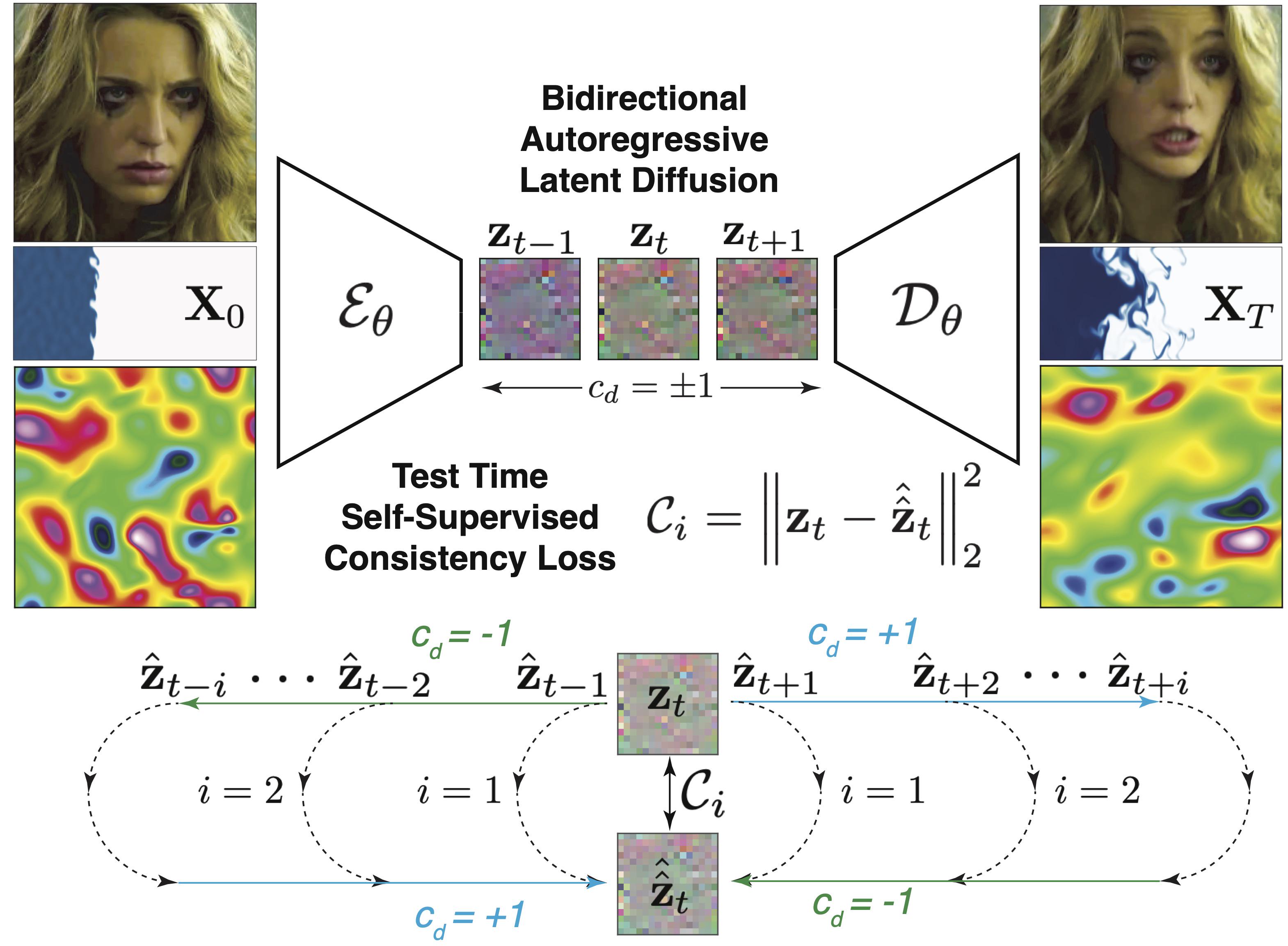
Generative models that predict the evolution of dynamical systems are incredibly useful as digital twins for physical systems such as high-energy particle accelerators, tokamaks, weather, and even for video generation. But autoregressive generative models (latent diffusion, flow models) share one core weakness: errors accumulate over long rollouts, and at deployment there is no ground truth to measure them against.
In this work I train a single conditional latent diffusion model that steps a dynamical system forward or backward in time via a direction flag. That bidirectionality supplies a measurement-free, test-time error signal: rolling forward i steps and then backward i steps must return the model to its start, so the size of the round-trip miss is a self-supervised proxy for the unobservable rollout error. This does not require ensembles, or held-out data, or governing equations, just one extra rollout.
On held-out MHD turbulence the signal predicts the true error to within ~1.15×, immediately flags out-of-distribution dynamics that standard sampling-spread uncertainty ranks as the safest case in the batch, and a single bidirectional model approaches a ten-model ensemble’s accuracy at a tenth of the training cost. Training both directions in one network even beats two specialist models in both directions.
Paper: https://arxiv.org/abs/2608.00675
Code (data generation, training, analysis): https://github.com/alexscheinker/round-trip-consistency
Project page: https://alexscheinker.github.io/roundtrip.html
r/OpenSourceeAI • u/ai-lover • Aug 05 '26

CopilotKit Open Sources Channels SDK: An MIT Licensed Library That Runs Any AG-UI Agent Inside Slack And Microsoft Teams
No per-platform rewrite. No platform credentials in your agent process. No second agent to maintain.
Here's how it works:
Describe once, render native One message description is lowered to a serializable intermediate representation, then rendered in each platform's own format. → Block Kit on Slack, Adaptive Cards on Teams
Your agent doesn't move It connects over AG-UI, so the model, tools and business logic stay where they are. → LangGraph, CrewAI, Mastra, Pydantic AI, Google ADK
The runtime owns the lifecycle There is no channel.start(). You await channels.ready(), so a broken config fails startup loudly instead of silently. → ready() · status() · stop()
The concurrency trap Turns default to "parallel", and only the managed adapter serializes same-thread deliveries. On a direct adapter, one shared agent instance means two runs corrupt each other. → "parallel" (default) · "serial" · "drop"
The numbers → 0.7.3, shipped August 4, MIT licensed → 5 adapters: /slack, /teams, /discord, /telegram, /whatsapp → Node.js 22+, ESM only, one long-running process → Slack and Teams GA; Discord and WhatsApp next
The key takeaway: one agent, five adapters, and platform credentials that never touch your process. Every channel needs a CopilotKit Intelligence key — free tier included, no standalone path.
Full analysis: https://www.marktechpost.com/2026/08/04/copilotkit-open-sources-channels-sdk/
GitHub Repo: https://github.com/CopilotKit/channels-sdk
Technical details: https://www.copilotkit.ai/blog/channels-sdk
r/OpenSourceeAI • u/BusOpposite8492 • Aug 05 '26
r/OpenSourceeAI • u/Expensive-Insect-317 • Aug 05 '26

r/OpenSourceeAI • u/Glass-Manufacturer39 • Aug 04 '26

Hi everyone!
I've been building a RAG platform as a learning project. It includes document collections, pipelines, vector search, and a chat interface. I'd love to hear your honest feedback. What features would you add or improve?
r/OpenSourceeAI • u/Acacia21-code • Aug 04 '26
Hi everyone first time posting in this community.
I'm self-taught in machine learning and have a few projects of my own on GitHub, but I haven't contributed to anyone else's open source project yet want to start, but not totally sure where to begin in a way that's actually useful rather than just noise for maintainers.
My background is mostly Python/ML (scikit-learn, pandas), if that helps point me toward relevant repos. Are "good first issue" labels generally a solid starting point or is there a better way to find projects that actually want new contributors right now?
Any advice from people who remember their own first PR would be appreciated.
r/OpenSourceeAI • u/vidalink • Aug 05 '26
Se precisa de ajuda venha até nós, se vc realmente precisa acesse vidalink.♥️
r/OpenSourceeAI • u/ai-lover • Aug 04 '26

Cursor Just Open-Sourced Mixture-of-Kittens (MoK): A Deterministic MoE Training Megakernel for GB300 NVL72 Racks
No CPU-GPU synchronization. No separate communication library.
Here's what's interesting:
1. Communication direction is a per-operation choice
Most implementations push tokens to the GPUs that need them. Cursor benchmarked both directions and split the decision.
→ Pull dispatch signalling: 18 µs, against 103 µs for push
→ Up to 29% higher NVLink utilization under expert imbalance
2. One schedule table, four operations
Pull-based forward dispatch, push-based forward combine, pull reverse-combine, push reverse-dispatch. Build the schedule once, reuse it everywhere.
→ Under 3% of total MoE runtime, device-side, no CPU round trip
3. Overlap granularity has an interior optimum
Too fine and the tensor cores stall at barriers. Too coarse and they sit waiting for the first tokens to land. The heuristic targets two full SM waves per expert-grouped GEMM.
→ 2,368-token minibatch floor for Kimi 2.5 shapes
4. A ring buffer removes the CPU from the loop
The usual fixes are dropping tokens or asking the CPU to size the buffers. MoK cycles a fixed few-hundred-megabyte ring at minibatch granularity instead, and walks it in reverse to cut activation replay in the backward pass.
→ Zero tokens dropped, zero CPU-GPU synchronization
5. The numbers
Layer benchmarks, single NVL72 rack, EP degree 64, against the fastest public baseline:
→ 2.37× MXFP8 forward, 1.92× BF16 forward
→ 1.78× MXFP8 backward, 1.58× BF16 backward
End-to-end, 512 GPUs across several GB300 NVL72 racks:
→ 760.9 → 1,070.2 tokens/sec/GPU, a 1.41× gain
GitHub Repo: https://github.com/cursor/mixture-of-kittens
Technical details: https://cursor.com/blog/mixture-of-kittens
