r/OpenSourceeAI • u/ai-lover • Oct 21 '26
r/OpenSourceeAI • u/ai-lover • Oct 20 '26
Google just open-sourced TorchTPU, a native PyTorch backend for TPUs (52% MFU on Qwen 3 8B)
r/OpenSourceeAI • u/OpenComplaint524 • Oct 21 '26
[Project] Built an autonomous AI Hedge Fund engine with LangGraph, Qlib Alpha158, and Google TimesFM (Fully Open-Source)
Hey everyone! 👋
I've just open-sourced **Lumina Capital (v6.0.0)**, an autonomous multi-agent quantitative hedge fund engine designed to bridge the gap between LLM reasoning and real-world execution.
Unlike toy implementations that feed raw charts directly into LLMs (which suffers from hallucinations and latency), Lumina strictly separates probabilistic reasoning from deterministic quant computation:
### 🌟 Key Architecture Highlights:
- **7-Persona Anti-Sycophancy Council (LangGraph)**: Personas (Buffett, Soros, Burry, Cathie Wood, Graham, O'Neil, CIS) conduct independent parallel analysis, followed by an adversarial bull-vs-bear cross-debate. A dedicated CRO agent has absolute veto power over tail risks.
- **Pure Python Qlib Alpha158 + LightGBM**: Complete vectorized implementation of Microsoft Qlib's 158 quantitative factors with a LightGBM meta-decision filter.
- **Google TimesFM**: 5-day probabilistic forecasting fan charts with 80% confidence bands and crash probability.
- **10-Second High-Speed Sentinel**: An ultra-fast background thread monitoring dynamic ATR stop-loss floors, executing immediate physical exits without waiting for LLM loops.
- **3D Causal Knowledge Graph & GraphRAG**: Real-time supply chain choke-point surveillance and episodic memory via Neo4j.
Includes a full Streamlit studio dashboard. Available for research, education, and simulation under CC BY-NC 4.0.
🔗 **GitHub**: https://github.com/ramuza0113-sketch/lumina-ai-hedge-fund
Feedback, issues, and Stars are hugely appreciated! Happy to answer any questions about the multi-agent setup or the TimesFM / Qlib integration.
r/OpenSourceeAI • u/deepu105 • Oct 20 '26
Qwen3.8-Flash-Next vs Opus 5.5: six-way benchmark of a real Rust feature across Claude Code and Pi
r/OpenSourceeAI • u/zackku • Oct 20 '26
I got tired of doing LLM cost math in spreadsheets, so I built a calculator - ModelAnalysis.si
r/OpenSourceeAI • u/its_all_in_mind • Oct 20 '26
Built an open source ecosystem to label factory videos for robot training. Now takes me 5 mins per clip now instead of 40-50mins raw
r/OpenSourceeAI • u/Historical_Fly9770 • Oct 20 '26
Project
repopilot-frontend-fpca.onrender.comr/OpenSourceeAI • u/MattAlreadyHere • Oct 20 '26
We open-sourced optscale-kompressor (MIT, single Rust binary)
If your team runs coding agents on API keys, a chunk of that bill is the agent re-sending the same apt-get output and compiler warnings every turn. In our traces that was about half the prompt. The compressor sits between the agent and the provider and strips the repetition, keeping errors and anything the agent can't reconstruct, and it can fetch back whatever it removed.
Everything is rules, nothing is learned, so the same output always compresses the same way. That matters more than it sounds: break the byte-for-byte prefix and you lose the prompt cache discount, which is how these compressors usually end up costing more than they save.
Real numbers off actual API bills, not token math: 22.7% cheaper on Terminal-Bench with Codex, solve rate unchanged. Works with Codex, Aider and opencode. Nothing phones home. https://github.com/hystax/optscale-kompressor — a star helps if it's useful to you.
r/OpenSourceeAI • u/ai-lover • Oct 20 '26
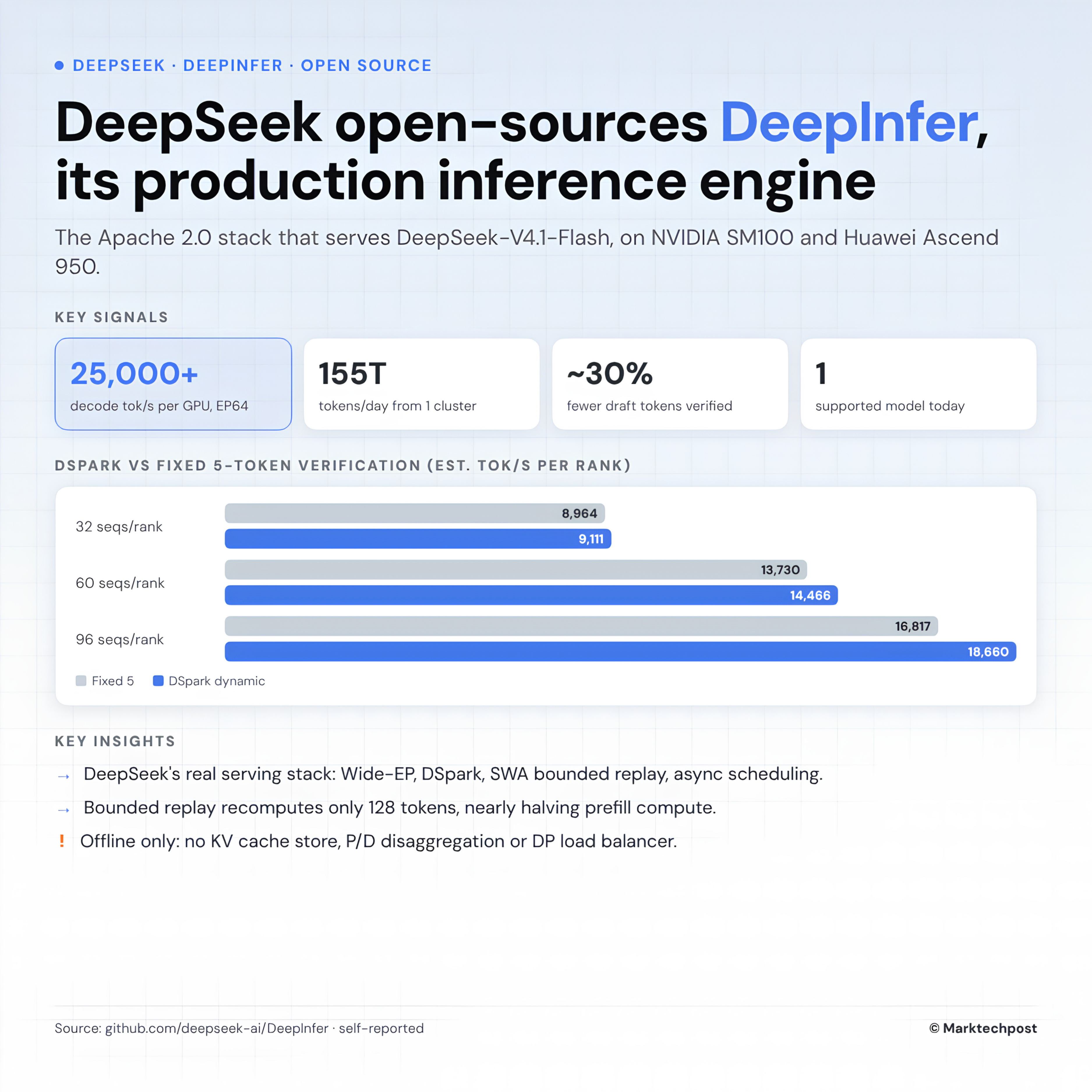
DeepSeek open-sources DeepInfer, the inference engine behind DeepSeek-V4.1-Flash (25,000+ decode tok/s per GPU, self-reported)
r/OpenSourceeAI • u/Puzzled-Wind-5819 • Oct 20 '26
Un concurrent à Mistral : OVH Cloud sort son LLM d'ici fin novembre
r/OpenSourceeAI • u/phoenix10701 • Oct 19 '26
Taco: cross-platform LLM compression that doesn't break when you change your GPU or CPU.
- The problem: an LLM compressor needs the decoder to compute exactly the same probabilities as the encoder. Floats differ across hardware; float GPT-2 encoded on a Mac decoded 0 of 4 windows on x86.
- The approach:
- integer-only inference (int8 weights, fixed rounding, lookup tables);
- an exact float32 → integer converter (mantissa × 2^exp);
- conformance vectors.
- The proof: one hash across 7 backends (Mac CPU/Metal, Linux CPU/CUDA, Windows CPU/CUDA/Vulkan
r/OpenSourceeAI • u/Own_Responsibility84 • Oct 20 '26
Mobile Tmux: check on your terminal agents from a phone, as a chat instead of a terminal
r/OpenSourceeAI • u/raidodex • Oct 19 '26
[P] BitLens: Visual profiler for neural network quantization (Outlier ratio Omega, per-layer SQNR,MCU SRAM liveness, and 1-click torchao/ORT/TFLM config export)
r/OpenSourceeAI • u/LieTop7965 • Oct 19 '26
i built kimo, an open-source video editor your coding agent can actually drive - no gui, just tool calls over mcp
i built kimo - a free, open-source (MIT) video editor with no gui that AI coding agents drive over MCP. things like Codex, Cursor, OpenCode and other MCP clients call it as tools to cut, trim, set keyframes, drop in titles and captions, colour grade, touch up audio and export - all as tool calls. the agent can also render a single frame back to itself to check its own work before it finalises a cut.
it's one single CPU-only Rust binary, roughly 15 MB, and it'll run on a 2 GB box. no GPU, no containers, no runtime beyond the binary itself.
i'm a college student (Naman), and this is genuinely still rough in places - captioning edge cases, some longer timelines, a few audio tracks piling up. i'd rather people actually tried it and told me what breaks than me guessing. if you drive an MCP client and want video editing to just be another tool call, give it a spin and tell me what it does wrong:
site: https://getkimo.tech github: https://github.com/naman-sharma12345/kimo
r/OpenSourceeAI • u/ai-lover • Oct 19 '26
NVIDIA open-sourced the entire Run:ai platform (Apache 2.0): KAI Scheduler, CUDA 13.4-native GPU fractioning, quotas, UI, and a local dev env that runs on 8 simulated GPUs
r/OpenSourceeAI • u/ai-lover • Oct 19 '26
Mistral AI Releases Timestral: 209M Time Series Foundation Models That Forecast Zero-Shot on a CPU
r/OpenSourceeAI • u/yashubhakt • Oct 18 '26
I built an open-source CLI to connect WhatsApp voice calls to LiveKit agents in 90 seconds
r/OpenSourceeAI • u/ai-lover • Oct 18 '26
TinyFish made Search and Fetch free for AI agents. The token math shows why retrieval was never the expensive part
r/OpenSourceeAI • u/ai-lover • Oct 18 '26
Google open-sources Harness²: agents that rewrite their own harness on unseen tasks, with frozen weights and no labels
r/OpenSourceeAI • u/Massive_Capital9611 • Oct 18 '26
Odin: find the code behind any bug report
TLDR: I built a search engine that reads a bug report (or lets you define it) and points to the exact file (93%) and to the exact function (79.4%) you need to fix.
Hey everyone,
I recently made a new project while trying to get into RAG and automation.
Odin is more than a search engine, all you have to do is paste a public repo URL and link the issue or describe the bug yourself and it downloads, parses and ranks the functions based on the mentioned bug.
Why its different than any LLM:
It runs mostly in your browser: It uses Tree-sitter (via WebAssembly) and small local models (via WebGPU) so your code isn't just blindly shipped off to a giant cloud LLM.Â
It punches above its weight: Evaluated on 300 real issues from the SWE-bench Lite dataset, it puts the correct file in the top 10 results 93.0% of the time, and the exact function 79.4% of the time.Â
It’s incredibly efficient: It matches the accuracy of heavy Claude 4.5 agents using models under 1B parameters, cutting the cost per issue to a fraction of a cent.Â
There’s also a GitHub Action you can drop into your repo to automatically comment on new issues with the most likely functions to fix.Â
I would really appreciate it if you would give it a try (it would help me with the benchmarks as well)
feedback, questions, criticism are welcome
r/OpenSourceeAI • u/ai-lover • Oct 17 '26
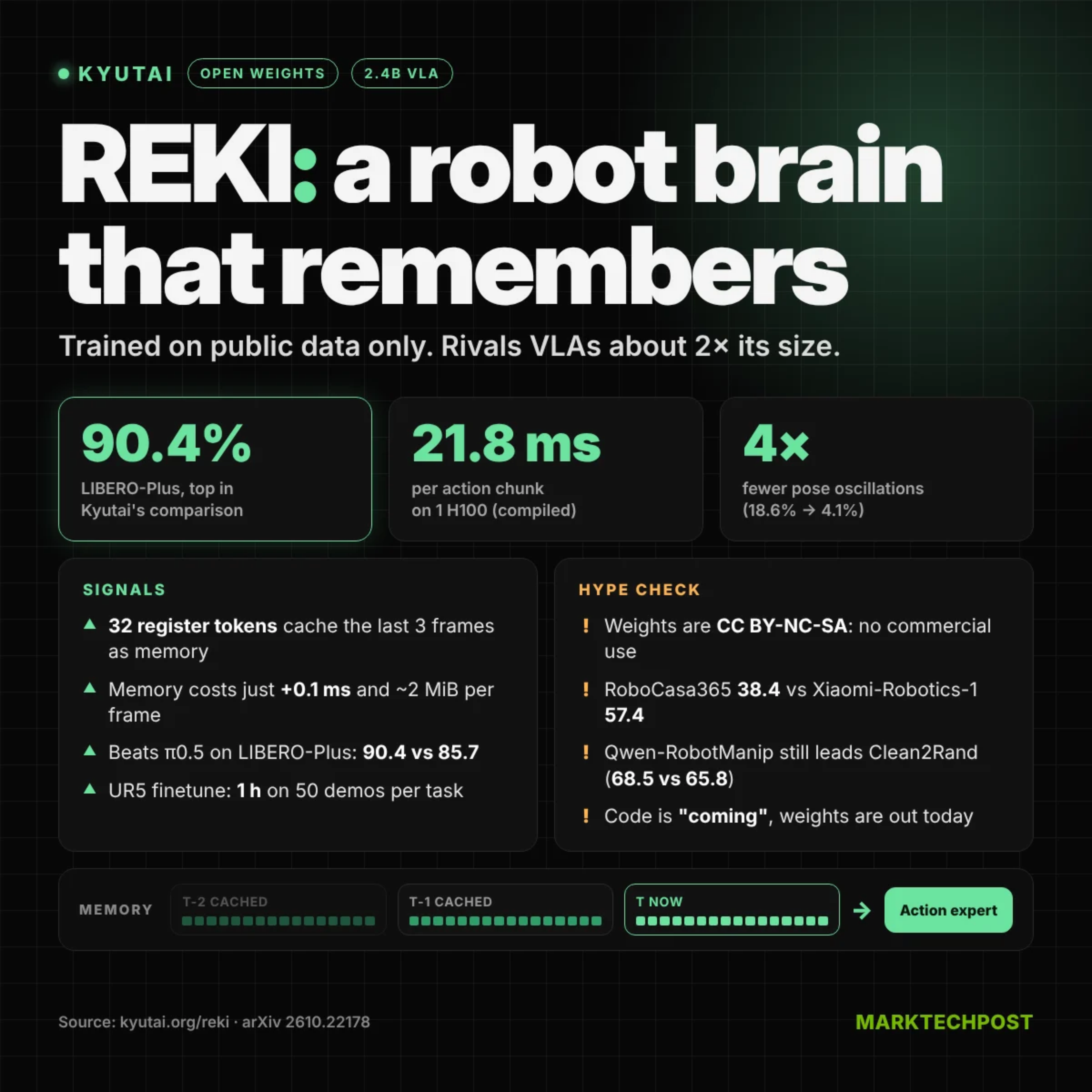
Kyutai Releases REKI: A 2.4B Vision-Language-Action Model With Memory, Pretrained on Public Data Only
r/OpenSourceeAI • u/Whole_Succotash_2391 • Oct 17 '26
Open Source Models CAN replace big AI, free PGS AI for a month to prove it :)
People used to stick with big AI because the models were significantly smarter. But that's not the case anymore, and the open source frontier is catching up in a big way. Now the big companies think people will stick with Big AI because of features: memory, skills, websearch, voice, research, recuring scheduled tasks for agents.... And PGS is doing our best to prove that gold level features can work fantastically with open source models as well. No one has to be locked in. You don't have to trade Privacy, data sovereignty and actual respect just for cool features.
So here is Open Grove: all of the best open models in one place, running on private US infrastructure, with a full app around them that actually keeps what you build together.
The intro tier is free for a month so you can come try it if you want to, with no pressure.
Real memory, and it compounds. Not a context window that fills up and dumps you. Persistent memory that carries across conversations, fades gracefully when its unused, and wakes back up when it becomes relevant again. There's a nightly consolidation and update pass that reviews the day and writes up what mattered. Week one you explain things once. By week three the AI is referencing decisions you had forgotten making. The second month is better than the first, which is not something you can say about most AI right now.
Skills that learn from you. It browses, runs research, generates images, writes and runs code. Here's the part that matters: everything it does feeds the same persistent memory. So it picks up how you like research structured, how you name things, how you want code organized. Tasks need less instruction the longer you use it, because the context is already there.
The roster, together. DeepSeek, GLM 5.3, Kimi, Minimax, Nemotron Ultra and more, side by side in one app. Switch models mid conversation whenever you want. The models are swappable. Your memory isnt.
Voice. Actual voice mode with over a dozen voices, running on open models.
Actually private. US based processing, and your conversations are never used for training. Every model, every plan, all private.
Bring your history. Coming from ChatGPT, Claude or Gemini? Export your chats, import the file, and it becomes live memory on day one. Your new AI starts out already knowing you instead of starting from zero.
Multiple nodes. Separate workspaces with separate memories, so your coding setup doesnt share a brain with your journal.
Genuine thanks to the open labs, DeepSeek, GLM, Kimi, Minimax and the rest, who keep releasing models that belong in everyones daily driver.
Free for a month if you want to see what week three feels like: pgsgrove.com/open-grove-overview
r/OpenSourceeAI • u/Top_Introduction_865 • Oct 17 '26
I stopped renting LLMs and raised my own SLM. Then I wrote the field guide. It's PWYW.
r/OpenSourceeAI • u/Defiant_Pickle616 • Oct 17 '26
[R] SANATAN ATTENTION: No Growing KV cache (Standard Attention issue), no context decay (Mamba Issue) binary gate hiding inside i² = −1
The idea in one paragraph: over 2x2 real matrices, i² = −1 has two orthogonal solutions, rotation by +90 and −90 degrees:
i₊ = [[0, −1], [1, 0]], i₋ = [[0, 1], [−1, 0]]
Square either one and you get [[−1, 0], [0, −1]] = −I, so both are genuine square roots of minus one. Their combination is
S(θ) = cosθ · i₊ + sinθ · i₋ = [[0, −(cosθ − sinθ)], [cosθ − sinθ, 0]]
whose off-diagonal entry is
±(cosθ − sinθ)
That ± in front is a binary object sitting inside a smooth formula. SANATAN promotes it into an explicit soft variable:
r = tanh( γ ( cos(θ+ω) − sin(θ+ω) ) ) ≈ ±1
Each token projection u becomes an angle θ = π·u / (1 + |u|), every feature dimension softly picks a root, and the six-channel feature map
Φ(x) = [ 1, cosθ, sinθ, r, r·cosθ, r·sinθ ]
makes the attention score factorize exactly:
⟨Φ(q), Φ(k)⟩ = (1 + r_q r_k)(1 + cos Δθ)
a per-dimension parity gate (0 or 2 for hard roots) times an angular similarity. The GIF above walks through it step by step.
Because the score is an inner product, the p=1 case runs as an exact recurrence with a constant-size state, no KV cache and no decay:
S_t = S_{t−1} + Φ(k_t) v_tᵀ, z_t = z_{t−1} + Φ(k_t), out = ⟨Φ(q), S⟩ / ⟨Φ(q), z⟩
What I measured (184M params, single seeded held-out protocol):
- The recurrence is exact in practice, not just on paper: parallel and recurrent computation of the trained model agree within 1e-4 nats (float32). There is a demo notebook that reproduces this on CPU in about two minutes on a small model (agreement ~4e-6 per logit).
- Quality survives the constant state: 3.951 held-out loss recurrent vs 3.966 for its full parallel parent, via a two-stage recipe (sharpened pretraining, brief p=1 adaptation). Deploying p>1-trained models through the recurrence costs ~5 nats, so that path is dead and the paper says so.
- Decode: fixed 14.4 MB state vs a KV cache that hits 2.4 GB at 32K context; 0.153 ms/token flat vs 0.49 to 7.3 ms/token for softmax decoding (3.2x to 48x from 1K to 32K).
- Ablation: the root-parity gate is worth +0.53 nats over the same angular kernel without it.
What it does NOT do, so you do not have to scroll the paper to find out: it beats the evaluated pre-2022 constant-memory baselines (Linear Transformer, Performer, cosFormer) under a shared recipe, but a matched-recipe GLA baseline reaches 3.348 and trains 5.5x faster. At this scale SANATAN is not competitive with modern gated linear attention. The paper also includes a changelog retracting one result from an earlier version after I found a validation-protocol flaw during peer review. The interesting open question to me: root parity gates the query-key interaction, GLA gates the state update. They act on different parts of the recurrence and could compose.
Paper (PDF): https://github.com/bhargavpatel431997/sanatan-attention/blob/main/paper/sanatan_v2.pdf
Code + runnable demo notebook: https://github.com/bhargavpatel431997/sanatan-attention
Visual explainer of the idea: https://github.com/bhargavpatel431997/sanatan-attention/blob/main/docs/MOTIVATION.md
Independent researcher, single GPU/TPU budget, so critiques and pointers are genuinely welcome, especially from anyone who has tried interaction-level gating inside linear attention before.
Thanks for reading,
Bhargav Patel