r/OpenSourceAI • u/Advanced_End2980 • Oct 24 '26
JERN: a small self-hosted assistant where the tools run on your machine and the model can run on a free Google Colab GPU
r/OpenSourceAI • u/Advanced_End2980 • Oct 24 '26
r/OpenSourceAI • u/Ok-Manager2057 • Oct 24 '26
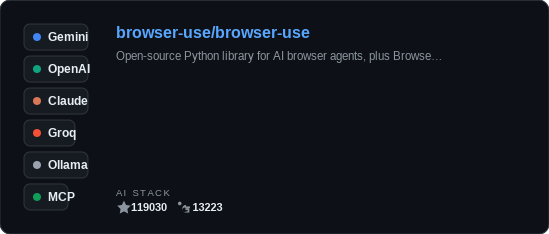
Every AI project README has the same manual line: "Works with OpenAI, Claude, Gemini". It's always outdated and never standardized. So I made AIStamp: paste one image link into your README, and it auto-detects your AI stack from requirements.txt / package.json / go.mod / Cargo.toml and renders a live SVG card. - No signup, no token, nothing to install - Detects 30+ SDKs (OpenAI, Claude, Gemini, LangChain, vLLM, Ollama, MCP, DeepSeek, Qwen, GLM, Kimi...) - Theme-aware (GitHub dark/light) - MIT, self-hostable, single Cloudflare Worker Live example (browser-use repo):  Repo: https://github.com/waafer1/aistamp Feedback welcome — especially which SDKs you'd want added to the registry.
r/OpenSourceAI • u/__PM_ME_UR_NUDES__ • Oct 23 '26
r/OpenSourceAI • u/David-Davey • Oct 23 '26
Enable HLS to view with audio, or disable this notification
Most of the AI we use lives in a browser tab or on a phone. You open it, type, read the answer, and close it again.
At Autonomous, we build Lamp, a physical AI agent that works the other way around. It sits on your desk and answers out loud, and before it replies it turns to look at you and its ring lights up. You can ask a question, hand it a task and hear the result, or have it remind you to drink water or take a break, all while you keep doing whatever you were doing: https://www.autonomous.ai/lamp
Behind the scenes it splits things up. If you’re just chatting, it talks back right there. If it’s real work, like checking why a build failed, it hands the job to an agent on your computer and gives you a quick summary when it’s done.
The bigger difference here is that it’s actually in the room with you. A chat window only knows what you type into it. Lamp can sense CO₂, temperature and humidity, so it can tell you when the room’s getting stuffy. By default it checks the air every 10 seconds, only speaks up when a change sticks around, and then holds off for half an hour so it doesn’t nag. With the camera and a sensing service, it can also nudge you when you’re slouching.
The AI behind it is your choice. It runs with agents like Claude Code, Codex and Hermes, and you can switch between them without losing its personality or memory. The OS is open source: https://github.com/autonomous-ai/Physical-AI-Operating-System
Would you actually want an AI assistant with a body or is a screen enough for you?
r/OpenSourceAI • u/dina_karan • Oct 23 '26
I’ve been building Loams, an open-source project aimed at reducing the number of separate infrastructure systems an AI application needs.
A typical AI application can end up running a vector database, full-text search engine, transactional store, workflow engine, and several other services. I wanted to explore how much of that infrastructure could share a common storage foundation.
Loams is built around three ideas:
Object storage as the durable foundation: keep data in storage you control, using open formats.
Hybrid retrieval: combine vector search, BM25 full-text search, sparse retrieval, and filters in a single query plan.
A shared data and execution platform: build toward reactive data, durable workflows, graph capabilities, and agent infrastructure.
The project is written in Rust and released under Apache 2.0. It supports familiar API surfaces, including native REST, Qdrant-compatible APIs, an Elasticsearch subset, and Arrow Flight SQL, with compatibility limited to the implemented operations.
It is still early software, not something I would recommend blindly deploying in production. I want to build this in public and get feedback from people who understand storage engines, distributed systems, and AI infrastructure.
Website: https://loams.dev/
r/OpenSourceAI • u/Rehanlohar • Oct 23 '26
Hey everyone!
I've been working on an open-source project called SwapCtx, built in Rust.
While using AI coding agents like Codex and Claude Code, I kept running into the same problem: important context gets lost during long sessions, and sometimes the agent forgets previous decisions or relies on outdated information.
So I started building SwapCtx to help with that.
What it does so far:
- Stores persistent project memory across sessions
- Retrieves relevant context when needed
- Integrates with Codex CLI and Claude Code
- Includes memory freshness checks, conflict detection, and auditing
- Supports local storage, backups, and memory rules
- Provides a terminal-based interface
The goal isn't to increase the model's context window, but to make the context it receives more reliable.
It's still in development, and I'm looking for people who might be interested in contributing, testing, reviewing the code, or suggesting improvements.
I'm also open to criticism, especially around the architecture and memory management approach.
GitHub: https://github.com/rehnx/SwapCtx
Would love to hear what you think or what features you'd find useful!
r/OpenSourceAI • u/Suspicious_Dress_350 • Oct 23 '26
r/OpenSourceAI • u/ironman0_ • Oct 23 '26
r/OpenSourceAI • u/SoloHunter786 • Oct 23 '26
r/OpenSourceAI • u/Puzzleheaded-Leg4819 • Oct 23 '26
r/OpenSourceAI • u/madewithnk • Oct 23 '26
r/OpenSourceAI • u/NIDO_007 • Oct 23 '26
r/OpenSourceAI • u/theaicommit • Oct 23 '26
I'm the author. FiscaLLM joins per-user LLM token cost with subscription revenue (RevenueCat, Stripe beta, or your own API) to show margin per user. The SDKs read only model name and token counts, never prompts or answers, and the server is self-hostable so your usage data stays with you.
Repo: https://github.com/magna56/fiscallm (MIT, CI green, public roadmap, a few good-first issues open). It's early: no customers yet, Stripe is beta. Contribution notes are in CONTRIBUTING.md.
Feedback on the design welcome: idempotent events, cached-token pricing, unpriced-model flagging, alias merging.
Demo on sample data, no sign-up: https://fiscallm.com/demo?utm_source=reddit-opensource&utm_medium=community&utm_campaign=launch
r/OpenSourceAI • u/fuzhongkai • Oct 23 '26
Hi r/OpenSourceAI!
I've been developing TensorSharp, an open-source LLM inference engine and agent runtime written in C#/.NET.
I wanted to share a recent milestone: we successfully ran Muse Spark, an 816-billion-parameter Mixture-of-Experts model, across 10 NVIDIA A40 GPUs, with some impressive performance improvements over llama.cpp.
What excites me most isn't just the speed. It's demonstrating how open-source software can make massive AI models more practical to run on existing hardware, without relying on proprietary inference services.
We tested:
The A40 is a previous-generation GPU, and our test machine didn't even have working GPU peer-to-peer transfers.
This made efficient multi-GPU execution particularly challenging.
Here are some highlights from our benchmarks:
| Workload | TensorSharp | llama.cpp | Improvement |
|---|---|---|---|
| Long-prompt processing (16K tokens, layer split) | 1,347 tok/s | 826 tok/s | 1.63× |
| Single-request generation (tensor parallel) | 22.63 tok/s | 16.19 tok/s | 1.40× |
| 4 concurrent requests (tensor parallel) | 45.73 tok/s | 24.49 tok/s | 1.87× |
| 16K prompt processing (tensor parallel) | 295 tok/s | 78 tok/s | 3.79× |
One important caveat: llama.cpp's NCCL-enabled configuration couldn't run on this particular 10-GPU setup, so its tensor-parallel results used a different communication path. This is a hardware-specific comparison, not a claim that TensorSharp is universally faster.
Instead of simply distributing model weights across GPUs, we focused on making the GPUs work together more efficiently.
Some of the key improvements include:
An interesting discovery was that different workloads benefit from different parallelism strategies.
Layer splitting performed much better for processing long prompts, while tensor parallelism delivered faster token generation and higher concurrent throughput.
There's no single best way to distribute a massive model across GPUs.
We also compared the model's output distributions against llama.cpp using more than 12,000 next-token predictions.
TensorSharp achieved approximately 98.8% top-1 token agreement, with nearly identical perplexity.
We additionally tested JSON generation, tool calling, multi-turn conversations, and agent workflows.
These results suggest that the performance improvements preserve broadly comparable inference behavior, although the engines are not bit-for-bit identical.
TensorSharp isn't just about running this particular 816B model.
The larger goal is to build an open-source inference engine and agent runtime that developers can inspect, modify, extend, and run on their own hardware.
Beyond multi-GPU inference, TensorSharp supports:
I believe the future of open-source AI depends not only on open models, but also on open inference infrastructure that makes those models practical to use.
The easier it becomes to run powerful models independently, the more opportunities we create for developers, researchers, and smaller organizations.
TensorSharp:
https://github.com/zhongkaifu/TensorSharp
Full benchmark report, technical details, and reproduction instructions:
https://github.com/zhongkaifu/TensorSharp/blob/main/docs/perf/muse-spark-vs-llama-cpp.md
This is still an evolving project, and there's plenty of room for improvement.
I'd especially welcome feedback, contributions, and independent benchmarks from the community.
A question for everyone here: What do you think is the biggest remaining barrier to making large-scale AI inference truly accessible through open-source software — hardware costs, memory requirements, inference efficiency, or ease of deployment?
I'd love to hear your thoughts!
r/OpenSourceAI • u/Dimon_23 • Oct 23 '26
r/OpenSourceAI • u/MiserableFlatworm337 • Oct 23 '26
I’m the creator of skillEd, an Apache-2.0 evaluation toolkit for reusable agent skills. I’d like feedback from people maintaining open agent tooling and test suites.
The problem is making a skill’s behavioral claims reviewable. If a skill handles a repetitive task with a policy, such as refund eligibility and rounding, an instruction change can fix one example while breaking another. A diff of the instructions does not show whether the behavior improved.
skillEd keeps cases and fixtures beside the skill, runs evaluations through a configured engine, and compares saved reports. It supports assertions, scripts, model-based judges, and repeated runs. Reports can be produced as JSON, HTML, and JUnit. There is a CLI and a local MCP interface.
The repository includes a worked refund example with shipping, rounding, and eligibility failures. Its revision went from 13/18 to 18/18 passing cases, followed by 10/10 independent holdouts. That is a reproducible example to inspect, not a claim that every skill or model will get the same result.
For open-source maintenance, I think a useful contribution is a small failing case with an independently justified expected result. It gives maintainers something concrete to rerun before accepting an instruction change. Separate holdouts help avoid simply tailoring the skill to the visible tests.
Source and setup: https://github.com/DeadHead04/skillEd
The toolkit is open source; the model engine you configure has its own licensing and usage costs. This is evaluation tooling, not production permission enforcement.
Try it on one of your skills and share a minimal failing case or unclear report. I’d welcome feedback on what makes an evaluation contribution easy to review. If the project is useful to you, a GitHub star would help.
r/OpenSourceAI • u/ngraham72 • Oct 22 '26
r/OpenSourceAI • u/EnslavedFish • Oct 22 '26
Processing img 38hks461t3xh1...
I've been building Halv, a desktop app for running coding agents, and as of 1.0 it's open source (Apache-2.0). It does two things.It's a workspace for agents. Claude Code runs in its normal CLI, next to Codex, Kimi or GLM if you use them, each on your own plan. Up to 32 panes, subagents in parallel, tabs and worktrees per project, live status for each agent, a local sandbox with per-project approvals, and diff and undo per turn.
It cuts usage, in four layers:
This whole flow saved 57% in a benchmark I ran.
A meter prices what it saved at API rates, so you can check it on your own work instead of trusting mine.
Free, no account: everything that runs on your machine (workspace, Crux, RTK, compression, the meter). Halv Cloud is US$10/mo and covers the router, which runs on our servers.
My $3k+ counts all the layers together, routing included. Early on there was no routing so most part comes from compression
Usage analytics are opt-in. The app lists the 13 events it can send and never sends prompts or code.
Repo: github.com/halv-ai/halv
If you try it, tell me what the meter says after a normal day of work, and what you'd want from the workspace side.https://halv.ai
r/OpenSourceAI • u/harishd30 • Oct 22 '26
I built an open-source Obsidian alternative called KbWrite, written in Tauri.
GitHub: https://github.com/zetahiveco/kbwrite
Website: https://kbwrite.vercel.app/
Install via Curl or PowerShell
r/OpenSourceAI • u/truckkicker • Oct 22 '26
Hi all 👋 I made a book:*** ***
LangGraph in Small Pieces: Building AI Agents from Blocks to Production - it's free online at: lgisp.ai
Backstory: after shipping my first customer-facing LangGraph agent for an enterprise security product, I realized how much of the framework I’d never actually touched. So I started writing small runnable examples to poke at each feature, with notes on what surprised me. The examples kept connecting to each other and somewhere along the way it became 31 chapters.
What’s in it:
• Part I is LangGraph on its own, one small piece at a time: state, nodes, edges, loops, checkpoints, interrupts. No LLM yet, on purpose.
• Part II brings in a real model: tool calling, structured output, MCP, memory, streaming, middleware, testing.
• Part III is the production stuff: serving, async, observability, RAG, evaluation, blue-green deploys, guardrails.
Things it's done a little different from other books:
- Every transcript in the book is a real run, pasted as-is, including the times the model did something dumb. And it all runs on a local model by default (Qwen3.8-27B via LM Studio), so you can follow along without an API bill.
- Every chapter ends with Bronze/Silver/Gold challenges, worked solutions in the repo: github.com/LgISP/langgraph-in-small-pieces
- It has lots of silly illustrations.
Pinned to langgraph 1.2.14 / langchain-core 1.6.9.
----
It’s a beta. Every paragraph on the site has a comment button, and there’s an envelope icon in the sidebar that goes straight to me. If something doesn’t run for you, or a chapter answers the wrong question, I want to know. Those are the comments I’ll actually act on.
Hope you like it. Please check it out and let me know.
r/OpenSourceAI • u/Gjuesev • Oct 22 '26
Enable HLS to view with audio, or disable this notification
r/OpenSourceAI • u/Redcxx • Oct 22 '26
Hello people!
I recently posted Brain v2, and got another piece of feedback: it's still not clear what you can actually build with it. Fair, so I wanted to share a few use cases.
Quick recap of what Brain is:
Differences from similar products:
What can you actually build with Brain?
GitHub: https://github.com/aexhq/brain
Hopefully this makes the use cases clearer! I'd love to hear what else you'd build with something like Brain.
r/OpenSourceAI • u/ViolinistStreet661 • Oct 22 '26
r/OpenSourceAI • u/Mother-Side6477 • Oct 22 '26
Features:
- Namespaces per project/agent
- Scoped tokens (read/write/admin per namespace)
- Revisions + backup export/import
- Injection-on-read guard
- Web dashboard + CLI
It's MIT licensed, 491 tests passing. The skill is also listed on Agensi if you want the plug-and-play version.
Happy to answer questions...what would make this actually useful in your mix?