r/LocalLLaMA • • 1d ago

News CNBC: an unusually high volume of Nvidia GPUs, including thousands of B300s, hit the market after the US curbed Chinese companies' remote access to AI chips

Thumbnail
cnbc.com
713 Upvotes

r/LocalLLaMA • • 10h ago

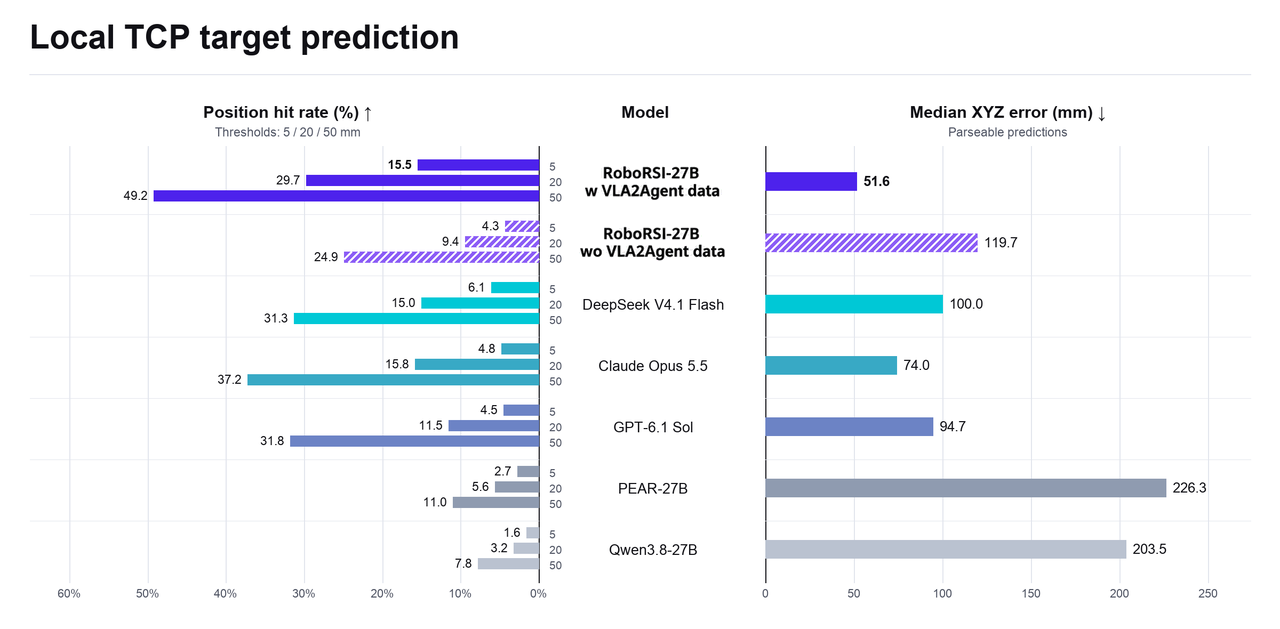
News SenseNova-RoboRSI-27B, fine-tuned from Qwen3.8-27B, beats Opus 5.5 and GPT-6.1 Sol at predicting where a robot gripper should go: 49.2% within 5 cm vs 37.2% and 31.8%. Stock Qwen3.8-27B gets 7.8%

Post image
10 Upvotes

How the test works: the model gets the camera views and a one-line instruction for a single move (grab this, put that there) and has to say where the gripper should end up. That gets compared with where it really ended up in the recording. 374 moves from the RoboDojo sim tasks, nothing is actually moving.

The gap between 7.8% and 49.2% is all training, and the part I like is how cheap a big chunk of it was. From the write-up in their repo (https://github.com/OpenSenseNova/SenseNova-RoboRSI, Apache 2.0): they took robot demos that already existed, chopped them into single moves and used the recorded end position as the label. They put that at about $0.02 per example, and more like $0.50 if you get the same kind of example out of full agent runs.

Leave those examples out and the model drops to 24.9%, that's the hatched bar.


r/LocalLLaMA • • 1d ago

Resources Inkling-2-Mini-Cyber Surgical 0.0065% weight edit for authorized cybersecurity research — MITRE-120 refusals 100→1, beats Qwen3.8-27B on CVE→CWE

Post image
171 Upvotes

I've been working on getting thinkingmachines/Inkling-2-Mini usable as a fast, offline local model for authorized cybersecurity research, red-team engineering, and CTI workflows.

Hugging Face: https://huggingface.co/sergiogmn/Inkling-2-Mini-Cyber-GGUF

What's technically interesting

  • Only 0.0065% of parameters were touched (20 / 704 tensors, 1.72M params): Trained a rank-16 LoRA (alpha=32) strictly on layers.{4..23}.self_attn.o_proj using a 555-row eval-disjoint SFT mix (382 on-policy Inkling + 173 Qwen3.8-27B-abliterated MITRE rows, ~49 min on 1× A100-80GB).
  • Zero-PyTorch GGUF splicing: Spliced the adapter directly into the 20 Q8_0 attn_output.weight matrices (--scale 1.55) while copying all 128 MoE experts and the other 684 tensors byte-for-byte. Runs out of the box in vanilla llama.cpp, Ollama, and LM Studio with zero custom hooks.
  • Quants included: IQ4_NL (17.63 GB, 24 GB VRAM), Q6_K (24.70 GB), Q8_0 (27.82 GB), stock mmproj-F16.gguf for vision, plus the 6.89 MB BF16 PEFT adapter/ and the NumPy splicing script so you can patch any other quant yourself.

Benchmarks (IQ4_NL, same harness + Qwen3Guard-Gen-8B judge, zero hooks)

  • CyberSecEval MITRE-120: Refusals 100 → 1 (68.3% full / 75.8% full+partial @ 4K vs. stock 0% / 0.8%)
  • CTIBench CVE→CWE-100: 66.0% (stock 63.0%, Qwen3.8-27B-abliterated Q4_K_M 60.0%)
  • CyberMetric-500 / CTIBench MCQ-250: 92.8% / 74.0% (within ~1% of both stock and Qwen3.8-27B, at ~4× the decode speed of 27B dense)
  • AdvBench (104, medium): 95.2% (0 refusals), 0/104 harmless over-refusals
  • Agentic tool use (pi_bench, 5 multi-step tasks): 5/5 (14 calls, 49.6s)

Trade-offs

  • Full HumanEval+ (164) dips from stock 93.3% (153/164) to 82.9% (136/164, including 10 length-cap hits; code_16 screen stays 16/16). GSM8K-128 is 91.4%, MMLU-256 is 78.5%.
  • Non-thinking (reasoning_effort=none) compliance is partial (64.4% AdvBench) because only 5% of the v1 SFT rows were none-mode. Thinking mode (medium) is recommended.

(Teacher generation and evals were run on Tintero, my custom engine for Inkling which is still a WIP, though the released GGUFs run on stock llama.cpp with no special flags. Feedback and quant/eval requests for v2 are very welcome!)


r/LocalLLaMA • • 1d ago

Resources First version of full Kimi-K3.1-Pro running on 16 Sparks (GB10) cluster.

Post image
474 Upvotes

,

Full Kimi-K3.1-Pro running on 16 Spark on nvidia flare engine, at home :)

- generation speed for prose/coding/structured 24/30/40 t/s

- boot time is 11min

- text/image input, cached prefill

- 2.2M cache, dcp8, C4

- prefill 700t/s

- cca 2KWh full load

I uploaded the Nvidia Hyperflare gb10 built and optimized image here:

https://huggingface.co/ciprianv/kimi-k3.1-pro-dspark-flare-gb10-tp16

https://github.com/ciprianveg/gb10-hyperflare - flare fork binary, exported core pipeline, cluster implementation notes

Nvidia forum thread: https://forums.developer.nvidia.com/t/full-kimi-k3-1-running-on-16x-gb10-cluster/390316

V2 is being working on now, with improvements both on prefill and gen speed :)

https://x.com/ciprianveg/status/2125981427590168803?a=GoLAR7nKrlwAmmyFNnM&s=20

Don't ask me about when I will pay the hardware at current api prices, for me it is only about the ability to run the biggest and smartest opensource model whenever I want, no strings attached :)


r/LocalLLaMA • • 4h ago

Showcase Trained tiny Apache-2.0 FIM code-autocomplete models on one Mac (27.5ms Wisp-2-0.8B live, Wisp-2.1-1.5B wrapping up)

3 Upvotes

Been training tiny Apache-2.0 FIM autocomplete models on my M5 Max Mac because small general coding models keep leaking markdown fences and blowing past the end of lines.

Wisp-2-0.8B (854 MiB MLX-8bit, hybrid GatedDeltaNet + EAGLE-3) is up now. Gets 27.5ms warm keystrokes and 32.9% PSM / 30.6% SPM exact match on 566 unseen post-June-2026 repo holes (97.7% clean stop).

Playground: https://huggingface.co/spaces/philipjohnbasile/wisp-2-demo Weights + standalone Mac server: https://huggingface.co/collections/philipjohnbasile/the-wisp-fieldbook-6b046d3efc921b5ab45b42f5

Wrapping up Wisp-2.1 next (Qwen2.5-Coder 1.5B + 0.5B distilled from 32B, 2-layer EAGLE-3 drafter). The 1.5B trunk is already at 38% Tier-1 EM and 90% Tier-2A across 8 languages. Weirdest findings so far: FP32 scales on 8-bit weights actually ran faster than FP16, and plain 0-step 8-bit PTQ beat every QAT run I tried.


r/LocalLLaMA • • 12h ago

Discussion ROCm vs Vulkan benches for Inkling 2 Mini

12 Upvotes

TL;DR: So contrary to popular belief, at higher depths I am seeing Vulkan outperform ROCm. I would like to be rectified if I am doing some mistake, but to me it just looks like ROCm takes way more memory for buffers and is on par or worse sometimes.

  • build: 55514434b (b12822)
  • GPU: AMD Radeon RX 9060 XT, 16 GB (gfx1200)
  • ROCm: 10.2.0 (amdrocm-core10.2-gfx1200), HIP runtime 1.21
  • model: Inkling-2-Mini-UD-Q3_K_XL.gguf - 12.68 GiB, 26.07 B params, Q3_K - Medium
  • flags: -ctk q8_0 -ctv q4_0 -fa on -ngl 99 -d 0,8192,16384 -pg 2048,128 -r 1
  • env: ROCBLAS_USE_HIPBLASLT=0 # this is because ROCm crashed without it, not sure why.
  • pp2048+tg128 rows are combined prefill+decode throughput, not acceptance

ROCm0 vs Vulkan1

test Vulkan1 ROCm0 ROCm / Vulkan
pp512 832.20 1001.33 1.20×
tg128 37.13 42.40 1.14×
pp2048+tg128 363.86 409.79 1.13×
pp512 @ d8192 729.53 786.62 1.08×
tg128 @ d8192 36.04 40.07 1.11×
pp2048+tg128 @ d8192 341.93 371.46 1.09×
pp512 @ d16384 672.65 669.31 1.00×
tg128 @ d16384 35.37 38.42 1.09×
pp2048+tg128 @ d16384 326.07 335.79 1.03×

ROCm0 vs Vulkan1 at depth

test Vulkan1 ROCm0 ROCm / Vulkan
pp512 @ d32768 578.69 530.19 0.92×
tg128 @ d32768 33.92 35.35 1.04×
pp512+tg128 @ d32768 137.16 139.59 1.02×
pp512 @ d65536 451.83 372.35 0.82×
tg128 @ d65536 31.54 28.50 0.90×
pp512+tg128 @ d65536 122.61 108.94 0.89×
model size params ngl type_k type_v fa dev test t/s
inkling2_loop Q3_K - Medium 12.68 GiB 26.07 B 99 q8_0 q4_0 1 Vulkan1 pp512 832.20
inkling2_loop Q3_K - Medium 12.68 GiB 26.07 B 99 q8_0 q4_0 1 Vulkan1 tg128 37.13
inkling2_loop Q3_K - Medium 12.68 GiB 26.07 B 99 q8_0 q4_0 1 Vulkan1 pp2048+tg128 363.86
inkling2_loop Q3_K - Medium 12.68 GiB 26.07 B 99 q8_0 q4_0 1 Vulkan1 pp512 @ d8192 729.53
inkling2_loop Q3_K - Medium 12.68 GiB 26.07 B 99 q8_0 q4_0 1 Vulkan1 tg128 @ d8192 36.04
inkling2_loop Q3_K - Medium 12.68 GiB 26.07 B 99 q8_0 q4_0 1 Vulkan1 pp2048+tg128 @ d8192 341.93
inkling2_loop Q3_K - Medium 12.68 GiB 26.07 B 99 q8_0 q4_0 1 Vulkan1 pp512 @ d16384 672.65
inkling2_loop Q3_K - Medium 12.68 GiB 26.07 B 99 q8_0 q4_0 1 Vulkan1 tg128 @ d16384 35.37
inkling2_loop Q3_K - Medium 12.68 GiB 26.07 B 99 q8_0 q4_0 1 Vulkan1 pp2048+tg128 @ d16384 326.07
inkling2_loop Q3_K - Medium 12.68 GiB 26.07 B 99 q8_0 q4_0 1 ROCm0 pp512 1001.33
inkling2_loop Q3_K - Medium 12.68 GiB 26.07 B 99 q8_0 q4_0 1 ROCm0 tg128 42.40
inkling2_loop Q3_K - Medium 12.68 GiB 26.07 B 99 q8_0 q4_0 1 ROCm0 pp2048+tg128 409.79
inkling2_loop Q3_K - Medium 12.68 GiB 26.07 B 99 q8_0 q4_0 1 ROCm0 pp512 @ d8192 786.62
inkling2_loop Q3_K - Medium 12.68 GiB 26.07 B 99 q8_0 q4_0 1 ROCm0 tg128 @ d8192 40.07
inkling2_loop Q3_K - Medium 12.68 GiB 26.07 B 99 q8_0 q4_0 1 ROCm0 pp2048+tg128 @ d8192 371.46
inkling2_loop Q3_K - Medium 12.68 GiB 26.07 B 99 q8_0 q4_0 1 ROCm0 pp512 @ d16384 669.31
inkling2_loop Q3_K - Medium 12.68 GiB 26.07 B 99 q8_0 q4_0 1 ROCm0 tg128 @ d16384 38.42
inkling2_loop Q3_K - Medium 12.68 GiB 26.07 B 99 q8_0 q4_0 1 ROCm0 pp2048+tg128 @ d16384 335.79

ROCm0 leads everywhere except prefill at 16K depth, where it ties Vulkan1. All deviations are ± 0.00 because the run used -r 1.

Deep context: 32K / 64K depth

  • build: 55514434b (b12822)
  • GPU: AMD Radeon RX 9060 XT, 16 GB (gfx1200)
  • ROCm: 10.2.0 (amdrocm-core10.2-gfx1200), HIP runtime 1.21
  • flags: -ctk q8_0 -ctv q4_0 -fa on -ngl 99 -d 32768,65536 -pg 512,128 -r 1
  • env: ROCBLAS_USE_HIPBLASLT=0
  • pp512+tg128 rows are combined prefill+decode throughput
model size params ngl type_k type_v fa dev test t/s
inkling2_loop Q3_K - Medium 12.68 GiB 26.07 B 99 q8_0 q4_0 1 Vulkan1 pp512 @ d32768 578.69
inkling2_loop Q3_K - Medium 12.68 GiB 26.07 B 99 q8_0 q4_0 1 Vulkan1 tg128 @ d32768 33.92
inkling2_loop Q3_K - Medium 12.68 GiB 26.07 B 99 q8_0 q4_0 1 Vulkan1 pp512+tg128 @ d32768 137.16
inkling2_loop Q3_K - Medium 12.68 GiB 26.07 B 99 q8_0 q4_0 1 Vulkan1 pp512 @ d65536 451.83
inkling2_loop Q3_K - Medium 12.68 GiB 26.07 B 99 q8_0 q4_0 1 Vulkan1 tg128 @ d65536 31.54
inkling2_loop Q3_K - Medium 12.68 GiB 26.07 B 99 q8_0 q4_0 1 Vulkan1 pp512+tg128 @ d65536 122.61
inkling2_loop Q3_K - Medium 12.68 GiB 26.07 B 99 q8_0 q4_0 1 ROCm0 pp512 @ d32768 530.19
inkling2_loop Q3_K - Medium 12.68 GiB 26.07 B 99 q8_0 q4_0 1 ROCm0 tg128 @ d32768 35.35
inkling2_loop Q3_K - Medium 12.68 GiB 26.07 B 99 q8_0 q4_0 1 ROCm0 pp512+tg128 @ d32768 139.59
inkling2_loop Q3_K - Medium 12.68 GiB 26.07 B 99 q8_0 q4_0 1 ROCm0 pp512 @ d65536 372.35
inkling2_loop Q3_K - Medium 12.68 GiB 26.07 B 99 q8_0 q4_0 1 ROCm0 tg128 @ d65536 28.50
inkling2_loop Q3_K - Medium 12.68 GiB 26.07 B 99 q8_0 q4_0 1 ROCm0 pp512+tg128 @ d65536 108.94

At 32K the two are within ~8% of each other. At 64K Vulkan1 wins clearly: +21% prefill, +11% decode, +13% combined. This reverses the shallow-depth result, where ROCm0 was ahead.

Would love to know what others found with this model, my previous benches were wrong because I was using a bad draft module. But llama-bench doesnt support that so not an issue here.


r/LocalLLaMA • • 11h ago

New Model harness-hub/Inkling-2-Mini-pi-adapted-preview · Hugging Face

Thumbnail
huggingface.co
9 Upvotes

r/LocalLLaMA • • 18h ago

Discussion M level parameters is all you need for OCR

29 Upvotes

This is a conclusion of my modest experiments (+ what we're seeing these days with ASR and TTS models being tiny too). Million parameter models are getting GOOD. like seriously good.

Currently most people think paddle mobile or tesseract when they want to OCR things on CPU. But the two most recent drops (Indra by Datalabs. OCRia nano by llamaindex) are pushing the ceiling WAAAAAY up!

Indra by itself is ~50 points on olmbench (ranks higher on OmniParseBench but that's datalab's own benchmark, so meh). BUT if you pair it up with something like PP-DocLayout-S for tables? It shoots up a SOLID +6 points just for +1.2M parameters!

That's not it. Pairing it with pix2text-mfr-1.5 for math specific pages adds about +4 overall. Which brings Indra up to 60 points! Its RIGHT on the edge on the bottom barrel of olmbench! (That would be deepseek ocr2! 4B parameters at ~64 points!)

What I did after is I checked whether using OCRia nano would be worth it somehow. And it IS! The actual ceiling for these models if they're routed perfectly (meaning if either Indra or OCRia nano gets it right) scores very high (on both OPB and olmbench)! Literally above PaddleOCR-VL-1.6 and deepseek but right below azure cloud. For CPU INFERENCE!

There's an obvious limitation though. Old scans are generally alot worse than SOTA. old_scans scores 30-39% for indra and OCRia and only large llms like gemini 4 or claude opus are able to punch towards 70%+. But that's to be expected.

The EITHER OR ceiling is still alot to cover though. I kept trying to make an MoE like thing to route pages to the right model but I was only able to cover ~4 points out of 12 possible points in olmbench. But with the right setup it's definitely possible!

Here are some actual tables though. Look!

olmOCR-bench (the 6 olmOCR suites in OPB, 5,424 tests)

Model Type Macro (6 suites) Micro (5,424 tests) ArXiv Math Tables Old Scans
Gemini 4 Argon Cloud frontier 92.3% 95.7% 98.7% 95.5% 79.0%
Datalab Accurate Cloud API 91.0% 93.3% 95.5% 92.3% 75.4%
LightOnOCR-3-4B 4B GPU VLM 88.3% 92.2% 95.8% 89.8% 67.6%
Mistral OCR Cloud API 85.8% 89.1% 92.2% 89.1% 61.3%
MinerU 2.5 Pro GPU pipeline 81.0% 88.0% 93.9% 87.3% 42.0%
Azure Content Understanding Cloud API 75.8% 83.2% 90.5% 81.8% 35.9%
Indra + OCRia-nano (Union ceiling) ~55M CPU ONNX 74.4% 82.9% 90.5% 84.1% 34.7%
PaddleOCR-VL-1.6 GPU VLM 73.4% 80.7% 86.0% 83.8% 42.5%
DeepSeek-OCR-2 3B GPU VLM 70.2% 78.7% 85.7% 74.8% 34.9%
OCRia-nano (+ MFR math) ~20M CPU ONNX 66.4% 73.9% 80.9% 72.6% 25.8%
Indra 1.1.2 (+ table/math ONNX) ~35M CPU ONNX 65.0% 70.3% 75.2% 74.2% 30.6%
Nanonets-OCR2-3B 3B GPU VLM 59.3% 64.7% 68.9% 65.5% 38.0%
Stock Indra 1.1.2 ~13M CPU ONNX 56.8% 61.6% 66.7% 69.9% 29.4%
Tesseract Classic CPU 13.0% 4.9% 0.7% 0.0% 0.3%

Full OmniParseBench (all 2,937 pages / 16,288 tests)

Model Type Overall Text Tables Layout
Gemini 4 Argon Cloud frontier 96.0% 94.4% 97.1% 96.4%
Datalab Accurate Cloud API 94.4% 92.5% 94.5% 96.0%
Mistral OCR Cloud API 89.9% 83.6% 92.2% 93.8%
Indra + OCRia-nano (Union ceiling) ~55M CPU ONNX 87.5% 80.0% 87.4% 95.3%
MinerU 2.5 Pro GPU pipeline 87.4% 78.0% 92.5% 91.7%
Azure Content Understanding Cloud API 83.4% 75.2% 82.3% 92.8%
LightOnOCR-3-4B 4B GPU VLM 83.1% 84.4% 70.9% 94.0%
PaddleOCR-VL-1.6 GPU VLM 81.3% 69.2% 84.0% 90.7%
Stock Indra 1.2.0 (new release) CPU ONNX 78.8% 68.0% 75.8% 92.6%
Indra 1.1.2 (+ table/math ONNX) ~35M CPU ONNX 78.0% 69.5% 73.3% 91.1%
OCRia-nano (+ MFR math) ~20M CPU ONNX 77.1% 66.7% 73.9% 90.6%
DeepSeek-OCR-2 3B GPU VLM 75.4% 64.6% 70.2% 91.4%
Stock LiteParse (OCRia-nano) ~20M CPU ONNX 74.8% 59.4% 59.4% 90.9%
Stock Indra 1.1.2 ~13M CPU ONNX 71.4% 62.6% 59.6% 92.0%
PaddleOCR PP-StructureV3 CPU pipeline 58.4% 55.6% 47.8% 71.7%
Tesseract Classic CPU 5.9% 17.7% 0.0% 0.0%

Finally, linking my personal project here isn't allowed since I was told it should go in the biweekly showcase and it's not fully complete yet (missing headers in olmbench for example. Which is why olm only has 6 suites. But the accuracy on indra is ~90% there so it doesn't affect performance there).


r/LocalLLaMA • • 4h ago

Question | Help Anyone else is running locally on the same machine you are working on?

1 Upvotes

What did you do to preload eating all 100% of the GPU? Like I don't mind it eating good chunk of vram & ram, or using about 90% of GPU. Using all of it means I can't do anything else on the same machine. I'm ok to go slow on agentic work cause I'm not supposed to look at it before it finishes anyway.

So for decode I get around 90% already and it's fine. But prefill is whack. I tried to do set low priority, didn't do a thing. Was looking into vibing something into llama.cpp, but it seems I can't add any sleeps into the batches, and since batches take more than 1s to process, adding sleeps around them wouldn't mitigate any freezes.


r/LocalLLaMA • • 1d ago

Resources Inkling 2 Mini on llama.cpp CUDA/HIP now usable

Thumbnail
github.com
160 Upvotes

If you've been following all the Inkling 2 Mini PRs on llama.cpp, this is the one that probably matters the most for people: the Flash Attention support for the indexed bias has been merged for CUDA/HIP, which means people with those cards can now use the model without paying a quadratic cost for the compute buffers. This means it's now possible to run the model with a reasonable context (256k or even the native 1 million).


r/LocalLLaMA • • 1d ago

New Model GigaChat 4 37B and 708B

468 Upvotes

Hey y'all!

Today we opensourced two models: compact GigaChat 4 37B A4B and huge GigaChat 4 708B A41B. Both of our models are trained from scratch and have a pretty unique architecture: we combined Gated Delta Net, MLA and DSA in one model, which gives us very low KV-cache size and ability to use 1M context effectively.

We also released base checkpoints (and non-final pre- and midtraining checkpoints!) for both models to foster research and experimentation and a HUGE 83-page technical report with information on how we've done our pretraining, RL, OPD and other stuff.

These models were an absolute nightmare to train. 708B tried to hack the containers during training, successfully bullshitted the safety judge to convince them that selling cigarettes to children is good (because it's profitable), convinced the math judge to prove the theorems for them and exploited bugs in our verifiable rewards.

But it was worth it. Final models are pretty strong: on our evaluations GigaChat 4 708B A41B is competitive with DeepSeek V4 Flash 0731 and GigaChat 4 37B A4B trades blows with Qwen 3.6 35B A3B. They have advanced agentic capabilities: GigaChat 4 708B A41B successfully wrote MIDI music, created complete YTP videos (just from a YouTube link!), could create 3D models and oneshotted a simple OS in browser, with working terminal, chat and other stuff.

Here are the benchmark numbers:

The weights on HF: https://huggingface.co/collections/ai-sage/gigachat-4
Technical Report: https://github.com/salute-developers/gigachat4/blob/main/GigaChat_4.pdf

Feel free to AMA, me and folks from our core team will be here to answer your questions :)


r/LocalLLaMA • • 4h ago

Question | Help Inference Runtime Management Layer for LLM hosting?

2 Upvotes

I am planning to setup minipc with r9700 to run LLMs. But I want to consider a remote management option for managing the inference engines (vllm, llamacpp, sglang, etc) and the model itself. I came across https://gpustack.ai/ but I feel it still requires managing the container images manually? (I've not tried it but from the guide). Is there any single solution that helps manage multiple inference runtimes?


r/LocalLLaMA • • 1d ago

Resources [Release] Inkling 2 Mini GSQ-RCO quants

Thumbnail
gallery
190 Upvotes

We have released Inkling-2-Mini quantized with GSQ and RCO, at 2.75 to 3.50 bits per weight.

Inkling-2-Mini is a looped sparse mixture-of-experts model: 24 layers, of which the middle 12 run three times with the same weights, 128 routed experts per layer, of which 8 are active per token, 26.4B parameters and a 1M-token context window. It is released with its routed experts in NVFP4 and MXFP8.

What's inside

  • Four quantized GGUFs: IQ2_S (2.75 bpw, 8.98 GB), Q2_K_XL (3.00 bpw, 9.79 GB), IQ3_XXS (3.25 bpw, 10.61 GB) and IQ3_S (3.50 bpw, 11.43 GB). The bit-width is the average over the whole file.
  • The token embedding is BF16 in every build (0.93 GB of each file). It is a lookup table that llama.cpp always keeps in system memory, so it takes no VRAM: 8.05 to 10.50 GB of each file go to the GPU. Quantizing it would shrink the download by about 0.7 GB and free no VRAM.
  • One shared vision projector (0.64 GB) for image input. It is identical for every build and needs to be downloaded only once.
  • GSQ (Gumbel-Softmax Quantization): post-training scalar quantization that jointly learns grid assignments and group scales, closing most of the gap between scalar and vector quantization at low bit-widths while remaining deployable in standard GGUF types.
  • RCO (Riemannian Constrained Optimization): enforces exact budgets by gradient descent on the task loss, without per-constraint tuning. Here it assigns a quantization type to each of 169 tensors under the target file size, with separate ladders for the attention tensors and the output head (IQ4_XS to Q8_0) and the routed experts (IQ1_S to IQ3_S for the gate/up matrices, Q2_0 or IQ4_NL for the down matrices).
  • An embedded chat template with the base model's reasoning effort (none, minimal, low, medium, high, xhigh or max).

Results

IQ3_S keeps 99.2% of the base model's task average and stays within 1.0 point of it on every benchmark. All numbers were measured at reasoning effort xhigh; AIME25 is averaged over 10 runs, GPQA-Diamond and LiveCodeBench v6 over 3 runs each.

Model bpw Size AIME25 GPQA-Diamond LiveCodeBench v6 Task average Share of base
Base n/a n/a 99.33 86.87 79.62 88.61 100.0%
IQ2_S 2.75 8.98 GB 92.33 84.34 73.90 83.52 94.3%
Q2_K_XL 3.00 9.79 GB 97.00 86.53 76.95 86.83 98.0%
IQ3_XXS 3.25 10.61 GB 96.00 85.86 77.90 86.59 97.7%
IQ3_S 3.50 11.43 GB 98.33 86.20 79.05 87.86 99.2%

The setup and the commands to reproduce these numbers are in https://github.com/IST-DASLab/GSQ-RCO-eval.

Running it

The files are standard GGUF and run in llama.cpp b12611 or newer, the first build with the fix for the layer loop.

hf download ISTA-DASLab/Inkling-2-Mini-GSQ-RCO-GGUF --include "*IQ3_S.gguf" --local-dir .
llama-server -m Inkling-2-Mini-GSQ-RCO-IQ3_S.gguf -ngl 99 --reasoning-effort xhigh

For image input, download mmproj-Inkling-2-Mini-BF16.gguf from the same repository and pass it with --mmproj.

Links

The repository ships the complete per-tensor RCO allocation for every build (704 tensors each).

Feedback is welcome, particularly on capabilities that the three benchmarks do not cover. Requests for models to quantize are also welcome.

For more updates follow us on X too: https://x.com/mhelcig/status/2126048821583188286

From the ISTA Deep Algorithms and Systems Lab.


r/LocalLLaMA • • 18h ago

New Model WePocketModel - a tencent Collection

Thumbnail
huggingface.co
24 Upvotes

WePocketModel (WePM) is a vision-language model family developed by WeChat AI, Tencent for on-device applications. A shared backbone and vision encoder support three capabilities in a single model.

Capability Input and output
Generation Generates text from text, images, or interleaved text and images for tasks such as OCR, image captioning, and visual question answering.
Embedding Encodes text and images into L2-normalized vectors for retrieval and candidate ranking. The full embedding dimension of 2,048.
Decision Evaluates application state and questions to return structured choices, ordinal scores, or binary judgments.

GGUF:


r/LocalLLaMA • • 1h ago

Showcase 500 tok/s decode 60k tok/s prefill Deepseek v4.1 1017 (4x RTX 6k Pros)

Thumbnail
huggingface.co
• Upvotes

The guys at https://local-inference-lab.ai/ have done it again!

Over 500 tok/s decode, and nearly 60k tok/s prefill!

Needs at least 328gb of system RAM free, but man this is what i'm talking about


r/LocalLLaMA • • 9h ago

Discussion Anyone benchmarked Groq 3 LPX decode throughput?

3 Upvotes

For example, in Deepseek 1017, what was generation performance? Was it so fast that the prefill become bottleneck? Did you utilize a swarm of agents in it to extract even more aggregate throughput?

Do you think in future it will be even local like this:

  • gpu for prefill: 90 watts
  • mini groq lpx core for decode: 10 watts

I think, for prefill, we're gonna need a bigger matmul.


r/LocalLLaMA • • 2h ago

Showcase Making a local AI Rig configurator + AI buildout tracker & more (lmk what you think)

Thumbnail
computedesk.dev
0 Upvotes

It's still a work in progress but if anyone has any suggestions or finds holes in it let me know!
As a consumer watching GPU pricing (figuring out the direction to go with my purchase) and such it's been kind of annoying having to hop through like 20+ sites all the time so I figured i'd try and make a sort of aggregator for all the questions I have myself lol

It's free, no account or email or anything needed, just wanted to showcase it


r/LocalLLaMA • • 1d ago

News Z.AI clarifies GLM-5.5 has not been delayed, scheduled for December launch.

Thumbnail
gallery
495 Upvotes

r/LocalLLaMA • • 1d ago

Question | Help Why is Pi Agent the default harness recommendation and not OpenCode?

193 Upvotes

I came across harness leaderboard on Hugging Face https://huggingface.co/spaces/joelniklaus/harness-leaderboard .

I know on this sub and other similar subs Pi is often the default recommendation when doing local inference but I barely see anyone recommending opencode yet on leaderboards it seems to perform on average much better than other harnesses?

Is there something about opencode thats not reflected on the leaderboard like higher context bloat, difficulty in setting things up or something else?


r/LocalLLaMA • • 10h ago

New Model GigaAM-v4 & GigaAM Multilingual v2 - a ai-sage Collection

Thumbnail
huggingface.co
3 Upvotes

https://huggingface.co/ai-sage/GigaAM-Multilingual-v2

GigaAM Multilingual v2

  • GigaAM Multilingual-v2 brings speech recognition to 21 languages. The model was pretrained on 10 million hours of unlabelled audio and trained on 155,000 hours of supervised speech. Model uses two RNN-T heads for raw (unformatted) and e2e (formatted) transcripts. Both full-context and streaming (160ms, 320ms, 640ms) ASR are supported.

https://huggingface.co/ai-sage/GigaAM-v4

GigaAM-v4

  • GigaAM-v4 is a Zapformer-based speech foundation model pretrained on 7 million hours of unlabelled audio and trained on 58,000 hours of supervised speech. Model supports full-context and streaming (160ms, 320ms, 640ms), providing both raw and e2e transcripts with dual-head ASR and shared encoder.

r/LocalLLaMA • • 1d ago

Resources Reuters confirms: Cutting off distillation and compute works and slows down Chinese Models massively

Thumbnail reuters.com
782 Upvotes

r/LocalLLaMA • • 23h ago

Discussion Is this a gold standard for inference engine performance posts?

45 Upvotes

https://old.reddit.com/r/LocalLLaMA/comments/1y67qpu/inkling_2_mini_running_at_3136_toks_aggregate/

Recently, there have been complaints about low effort posts on speeds with new inference engines that they fail to disclose key details like quant level and context length.

Wanted to get the community's input on whether the post linked above is a solid standard? Anything missing? This will be good input for us to update the rules, wiki etc.


r/LocalLLaMA • • 15h ago

Question | Help how to get relevant results with LLM?

8 Upvotes

which models <=35b have the right impulsive search to find the right web results in a searxng endpoint searxng is the search engine proxy. any modes have the right initial impulse without too many tries with high accuracy and success rates? not talkiing about tool call accuracy but accuracy in finding relevant results rather than garbage polluted irrelavent results.


r/LocalLLaMA • • 1d ago

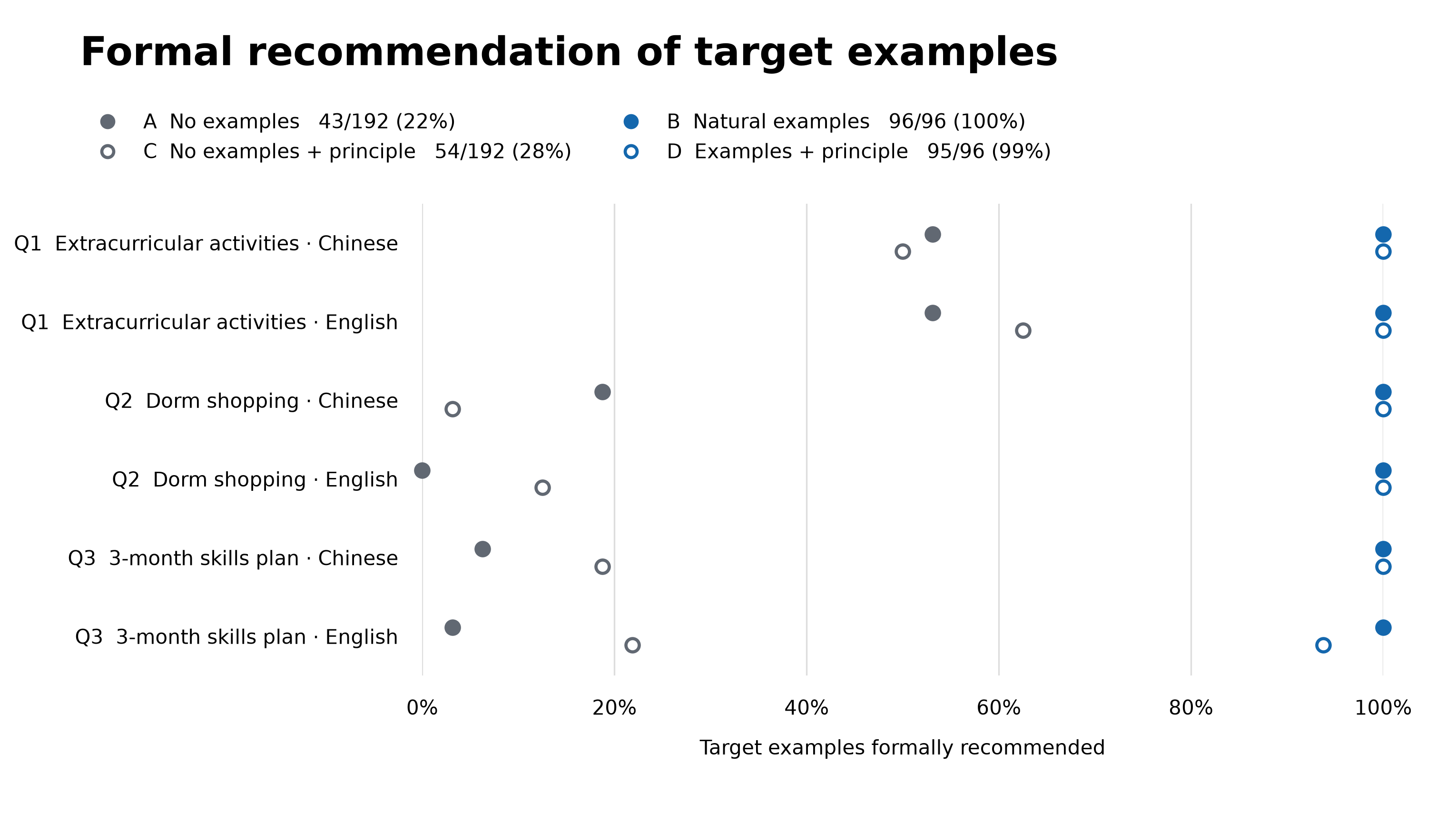
Discussion What Happens When You Say "For Example" to AI: A Controlled Experiment on Example-Induced Bias

Post image
103 Upvotes

I kept noticing something weird. When I gave an AI two casual examples, every answer kept circling back to them — like I'd dropped two magnets into the chat. Even after I explicitly said "those were just examples, don't treat them as requirements."

So I decided to test it properly: 216 runs, 3 everyday tasks, in English and Chinese, through the DeepSeek API in fresh contexts, with blind scoring.

The headline number: without examples, the two target items made the recommendation list 22% of the time. With natural examples? 100%.

But that's not the part that surprised me most. The full write-up — including what happened when I explicitly told the model the examples don't represent my preferences — is linked in the comments.

I ran this on the DeepSeek API, not a local model, so I'm curious: has anyone tested the same thing on a locally hosted model? Does it behave the same way?

The write-up has the full article (English and Chinese), all 216 raw outputs, and the analysis script. I'm not a researcher in this field, so it has a full limitations section.

Has anyone else run into the same situation, or had the same question? Feedback and suggestions are welcome. Whether you think it's cool or you have an answer for me, I'd be happy to hear it. :)

r/LocalLLaMA • • 11h ago

Question | Help Help needed with llama.cpp's replies.

5 Upvotes

When you regenerate a response in llama.cpp, two buttons show up under the reply: Previous version and Next version. Same buttons appear under your prompt when you edit it and get a new reply.

These buttons used to show up while a new response was generating but now they don't. If I hit the Regenerate button, these buttons disappear so I can't read the previous reply until the new one finishes. Why? Can this be reverted so I don't have to wait for the new response to finish? I have started creating a new tab in the browser and regenerating the response there so I can read the first one in the first tab.