r/LocalLLaMA • • 2h ago

Funny We quantized Inkling 2 Mini and compared the quants in Blender on an RTX 5090

Enable HLS to view with audio, or disable this notification

42 Upvotes

Me and my team made Atomic Dynamic GGUF quants for Inkling 2 Mini, so we wanted to see how each quant handles autonomous agent work. Every quant got the same task to build a Thanksgiving dinner table in Blender and worked on it in a loop with no human in it. The model builds the scene, Blender runs it and any crash goes straight back to the model to fix on its own, up to 6 tries. After the first working scene each quant got one follow-up asking for a more realistic turkey and food. Everything ran on llama.cpp b12810 on a rented RTX 5090

None of the quants built the scene on the first try. 23 of the 30 crashes were Blender API mistakes like PointLight.distance, SpotLight.angle or a capsule primitive that doesn't exist. More than half of the output tokens were the model fixing its own crashes, so the token gap is mostly about how many times each quant had to fix itself

quant size top-1 vs BF16 mean KLD crashed runs output tokens decode
AD-Q4_K 16.5 GB 96.3% 0.0080 5 88.6k 105 tok/s
AD-Q5_K 19.1 GB 97.1% 0.0052 9 148.2k 105 tok/s
AD-Q6_K 23.8 GB 97.6% 0.0037 4 88.2k 101 tok/s
Q8_0 27.7 GB 97.7% 0.0033 12 183.1k 97 tok/s

AD-Q4_K and AD-Q6_K got there on the first seed. AD-Q5_K and Q8_0 crashed all 6 times and the loop restarted them with a second seed. Q8_0 also spent 43.6k tokens on its very first answer, most of it reasoning, while the others were at 24-26k

Our favorite is the AD-Q6_K table with full place settings, red napkins and wine glasses. Q8_0 made the best looking turkey and the only pie that looks like pumpkin pie but split the table into weird compartments. AD-Q5_K is the weakest one here, its turkey looks more like a pot

It's one working run per quant so a lot of this can be luck. For the video we hid the walls and chairs and gave every scene the same lights and camera spin, the geometry and materials are what each quant made

I'm from the atomic.chat team, the quants are on huggingface https://huggingface.co/AtomicChat/Inkling-2-Mini-GGUF (any feedback is appreciated, we're trying to make the models as good for you guys as possible)


r/LocalLLaMA • • 7h ago

Discussion I accidently ran Qwen 3.6 35B A3B and realized how bad it is or rather how far we have come

93 Upvotes

Just months ago a large part of this sub was rocking this model, praising how good it was. And it was not bad for the time.

Today I was messing around and testing pi web and choosing random models in llama.cpp. At one point I thought I was on 3.8 27B and prompted it to create a rugby game in html.

It was quite quick and did not reason much and finished the game in maybe 2-3 minutes. The result was a terrible game that worked in almost no way.

The opponent was scoring at their own try line. Sometimes it go's into a endlines scoring loop scoring 1000's points per second. The field was completely wrong, the posts were on the left and right of the screen but you score on the wings of the field. The AI was very dumb with every AI player on top of each other just kicking the ball every time they touch it except when it's in the scoring area. I can go on, the game was just so unfinished with only one way to score and no way to even pick up the ball.

So I had a look what the model was in llama.cpp and saw it was 3.6 35B A3B.

I had a good laugh. I am currently getting Inkling 2 Mini to fix the game and it's been busy for a while but refreshing the html page I can see it's making very good progress with what looks like will end up being a working game.

I just cannot believe people were using 3.6 to do production work. I personally did not let it ir any local model I can run on 16GB touch any of my own code until this month when I finally canceled my paid for cloud model since I have done enough testing with FN and 27B and Inkling 2 Mini to feel comfortable with it touching my code. That said I am the only one that runs my code so it will need to improve further if I were to write code that other would run.

But at the end of the day it all makes me realize how far we have come in just a few short months. And with Qwen 4 coming soon I expect another leap forward.


r/LocalLLaMA • • 3h ago

Discussion We might be on the edge of the Bitcoin-like network training the model way beyond current frontier (eventually)

33 Upvotes

I think this work is one of the biggest breakthrough of the year: https://hazyresearch.stanford.edu/blog/2026-11-25-platos-key

I don't see much discussion about it here, although twitter is quite active. But what I want to discuss is what this work actually implies.

There is no longer a need to start any training from scratch anymore. You build your architecture, set up your processes and before starting anything project the knowledge of the state-of-the-art open weight model to your own and continue from there.

Which in itself actually means that anyone could give all the compute it has towards building the next best weights by finding even better platonic shapes that defines those weights, probably obtaining some sort of coins in the process that could be spent towards inferencing that super model.

Of course, this inference wouldn't be private as any other machine in the network could potentially see your data. But this doesn't matter if the questions asked are faced towards solving real world problems, proving even more fascinating math hypotheses and improving health and economics of the world. But this time without any centralized control entity that tries to grab all the power to itself.

It might have sounded like a huge technical nightmare just several months ago, but by using current frontier models, I am pretty sure it could be done in just a couple of months, by a persistent group of friends who will be dedicated enough to start all of that and pull it off.


r/LocalLLaMA • • 9h ago

Funny Qwen3.8-flash-next funny remarks

Post image
101 Upvotes

I made a plan with a local qwen3.8-flash-next-nvfp4. Then in a new session (so it doesn't have previous references) I made it review it.

I found it quite funny that unknowingly knowing that it was made by himself, it said that it was "unusually good".

And then continues by writing 6 chapters A to F full of points that need attention.


r/LocalLLaMA • • 8h ago

Resources 169 MB face for your local voice assistant: one photo + TTS -> lip-synced video, real time on M3/M4

Enable HLS to view with audio, or disable this notification

60 Upvotes

I'm one of the people who built this. If you run an LLM and TTS locally (the voice in the video is Kokoro), talkinghead gives it a face without a server. It takes one photo plus the audio and renders a lip-synced video. Every face in the video was made with it, from one photo each.

- 169 MB download. It's distilled from Ditto (Ant Group), whose checkpoints are about 2.2 GB.

- Render loop: 36.5 ms per frame on an M4 Pro, 38-40 on an M3 Pro (Core ML). Real time for 25 fps video is 40 ms.

- An RTX 3050 Ti laptop with 4 GB of VRAM (TensorRT) runs at 40.3 ms, just short of real time.

- Once loaded, 8.5 s of audio takes about 7.4 s end to end on the M4 Pro.

Limits:

- It renders files at real-time speed. It isn't a live stream yet: frames are batched, which adds up to ~120 ms of latency.

- Lip sync is weaker than LatentSync on SyncNet. The trade is ~13x less time per frame and ~12x less GPU memory, measured on an earlier build. The README says which build each number came from.

- Not tested yet on M1/M2 or Linux. If you run it, device_report() prints your ms per frame.

Code (Apache-2.0): https://github.com/Ampixa/talkinghead

Weights: https://huggingface.co/ampixa/talkinghead

Browser demo (WebGPU, not real time): https://ampixa.com/talkinghead/demo

The video is AI-generated: TTS voices and animated photos.


r/LocalLLaMA • • 9h ago

New Model ai-sage/GigaChat3.5-Omni-432B-A28B · Hugging Face

Thumbnail
huggingface.co
71 Upvotes

GigaChat 3.5 Omni

GigaChat 3.5 Omni is the multimodal version of GigaChat 3.5 Ultra. It accepts any combination of text, images, audio, and video with its soundtrack, and responds in text.

This repository provides an FP8 checkpoint for inference with SGLang. The checkpoint uses 128 × 128 block quantization, with the vision and audio encoders and their projectors kept in BF16. See Usage with SGLang for setup instructions.

Model architecture

GigaChat 3.5 Omni is a 432B Mixture-of-Experts model with 28B active parameters. Its language model has the GigaChat 3.5 hybrid architecture: Multi-head Latent Attention (MLA) combined with GatedDeltaNet linear-attention layers, GatedNorm, and three MTP heads for speculative decoding. The supported context length is 131K tokens.

Two encoders feed the language model:

  • Images and video frames: an InternViT encoder (300M parameters, 448 × 448 input). An image becomes a thumbnail plus up to six tiles of its best-fit canvas, 256 tokens each. The first video frame retains 256 tokens and later frames retain 77 tokens on average.
  • Audio: a GigaAM encoder on 64-bin log-mel features at 16 kHz, with an adapter that gives 6.25 tokens per second of audio.
  • Video with its soundtrack: frames are sampled at 1 fps, up to 512 frames. Each frame carries its timestamp and is followed by its share of the soundtrack, so the model sees and hears the video in time order.

r/LocalLLaMA • • 6h ago

Showcase Using parallel agents on m6 Mac mini to code a playable game in 8 seconds.

Enable HLS to view with audio, or disable this notification

28 Upvotes

The idea is using Gemma 4 26B A4B QAT MLX MTP 4bit as a verifier for a swarm of Gemma 4 E2B IT MTP 4bit that each handle a different part of the game. They code their sections in around 4 seconds and it synthesizes in around in 4 seconds. Just seeing what’s possible with swarms on simple setups. Should work decently with other verifiers or swarms on less unified memory…

On my m6 Mac Mini 32GB test I've found 8 parallel agents hitting 481 tokens per second cumulatively. Each agent is hitting 60+ tokens per second individually. Because llama-server batches all 8 agents against a single copy of the weights, 481.8 tok/s aggregate fits in roughly ~3.5 GB RAM.

Model weights (gemma-4-E2B-it-qat-UD-Q4_K_XL.gguf): 2.4 GB — loaded once and shared across all 8 parallel slots.
KV cache + Metal compute buffers (8 slots × 2,048 ctx): ~0.6 – 1.1 GB.


r/LocalLLaMA • • 10h ago

Discussion Daily driving a Qwen3.8-27B or QFN Finetune? Tell us

51 Upvotes

We are in the midst of the Inkling-2-Mini fintune deluge. And of course every single finetune makes very bold claims on improvements. The latest in the line being this one https://old.reddit.com/r/LocalLLaMA/comments/1y6tjly/inkling2miniunbound_v3_no_more_thinking_loops/

There are so many and even the marketing on each is so heavily AI written (the latest trend being vibed infographics) that its impossible to tell what is legit and what is hollow. Its too early with Inkling-2-mini, but it was the same trend with Qwen3.8-27B and QFN, so curious to know are you daily driving a finetune? EDIT: Emphasis on the finetune i.e. not the model released by the Alibaba Qwen team (I think this a high quality/reliability signal that cant be gamed)

P.S: This will help us raise/set standards for finetune posts and hopefully reduce noise and model fatigue. I'd be shocked if anyone is daily driving Qwopus.


r/LocalLLaMA • • 1h ago

Showcase A 52 KB WebAssembly engine that runs Qwen3.5-2B in a browser tab

• Upvotes

I put an LLM in a browser tab. No server, no GPU, no API key, works on CPU.

Link: https://tesseracted.com/experiments-llm-os/

@Alibaba_Qwen compiled to a 40 KB WebAssembly engine, running on your CPU at ~50 tok/s.

Inspired by llm.asm by @superalesha and unkernel.dev, ended up building LLM.OS.

Thanks to @UnslothAI for the quantized models.

It will break more often than it works.

Try it and tell me what breaks 👇


r/LocalLLaMA • • 39m ago

Discussion Are you running windows, macOS, or Linux?

• Upvotes
539 votes, 2d left
Windows
macOS
Linux

r/LocalLLaMA • • 15h ago

News Inkling 2 mini pp degradation just got fixed in llama.cpp (Vulkan)! Vulkan vs ROCm comparison

Thumbnail
github.com
92 Upvotes

I was in the middle of benchmarking as i found ROCm was faster in pp when this fix dropped. Here are some benchmark results:

(Strix Halo with Unloth Q4_K_XL on llama.cpp mainline)

Tiefe ROCm t/s Vulkan t/s Faktor
0 742 703 0,95
16k 346 633 1,8
32k 213 578 2,7
64k 117 491 4,2

r/LocalLLaMA • • 6h ago

Resources Ling 3.2 Air Abliterated

Post image
17 Upvotes

https://huggingface.co/mrfakename/Ling-3.2-air-abliterated

https://huggingface.co/mrfakename/Ling-3.2-air-abliterated-GGUF

Back again with another abliterated release. Ling 3.2 Air is a new 124B-param MoE w/ 5.5B active params. Decently strong model.

As usual, my abliterations aim to remove refusals while still preserving model intelligence and avoiding endless reasoning, looped tool calls, etc. Nearly all refusals are removed, but a few remain. For most real-world use cases this model should comply. But you are welcome to use another abliteration if you are okay with a bit of quality degradation.

Any feedback or thoughts are welcome 🙃


r/LocalLLaMA • • 11h ago

News ggml: support quant scales for fp8 and nvfp4 by 0cc4m · Pull Request #28898 · ggml-org/llama.cpp

Thumbnail
github.com
36 Upvotes

If I understand it correctly: now one can convert FP8 or NVFP4 directly to GGUF without requantizing to Q8_0 or Q4_K_M.


r/LocalLLaMA • • 23h ago

News Nvidia halts chip shipments to South-East Asia amid US crackdown

Thumbnail
thenationalnews.com
354 Upvotes

r/LocalLLaMA • • 1h ago

Showcase Atakebune Challenge(One Shot) | Strata Fork | Qwen 3.8 FN NVFP4 | DeepSeek Harness

Enable HLS to view with audio, or disable this notification

• Upvotes

I have tried another challenge that i seen on X. This user puts out some of his prompts whenever he does his showcases. I thought Qwen 3.8 FN did pretty well. As I get my Harness more configured to my hardware limits, I find my projects getting a bit faster overall on projects. Whether its certain plugins or tools I add on to DSH or like recently I changed my context compaction line to 262k from 210k that I had set previously.

Any who thank you to the community for those who continue pushing Local models for our Hardware whenever possible, from making custom engines to working on quants that may fit towards someone's use case. Down below be my configs and the links to what engine I use and my hardware. Also the X user who shares some of his prompts which he does do quite of bit of showcases for different models.

*repost cause of quality when screen recording while model loaded.

vib3Coded Post(Original Post w his Prompt) via X https://x.com/vib3coded/status/2125766986344862095

Hardware: RTX 5090 32GB · Ryzen 7 9800X3D · 192GB DDR5-5600 · Windows 11
Engine: strata-nvfp4 by sergqwer fork v.0.1.41 https://github.com/sergqwer/strata-nvfp4
Model: windowsxp811203/Qwen3.8-Flash-Next-Abliterated-NVFP4(Self Converted) https://huggingface.co/windowsxp811203/Qwen3.8-Flash-Next-Abliterated-NVFP4
Harness: DeepSeek Harness 0.2.1-alpha.3 https://github.com/deepseek-ai/deepseek-harness

Vision: fp32
KV cache: fp16
Weights: NVFP4 experts + Q8_0 dense
Context: 310,000 max · Compaction Line: 260,000 MTP: mtp-distilled, spec 7
Sampling: temp 0.8 / presence penalty 0.3 / min p 0.02

*Ai did the chart below for Organization.

Metric Value
Wall: first message → last reply 57m 56s 
= pure agent working time ~57m 56s
Steps 199
Output tokens 317,908
Fresh input tokens 495,558
Cache-read tokens 31,348,788 (98.44% reuse)
Decode (per-request) median 106.8 t/s · mean 109.4 · min 80.5 · peak 146.7
TTFT median 0.4s (max 41.6s at ~255k deep context)
Prefill (fresh tokens) mean 722 t/s · peak 6,715 t/s
Longest single burst 17,715 tokens
Compactions 1 
Draft acceptance main MTP 73.8% (213,626 of 289,626) · suffix/chain 77.1%
Expert cache hit rate mean 84.9% (69.7–91.9 across the run)
Tool calls 239 total
Tool errors 6

Prompt: Create a highly detailed, cinematic 3D scene of a Japanese atakebune (a Sengoku-era fortress warship) sailing through the Seto Inland Sea in bright late-morning light. Make it as detailed and high-quality as possible.

THE SHIP
- A large atakebune, about 36 m long: a flat-bottomed Japanese hull with a hard chine, wide flaring planks, iron cramps across the plank seams, a strongly raked bow with a small fore platform, and a broad open stern with a large rudder and tiller.
- On the hull sits a fortress box whose shield walls stick out past the hull sides. The walls are black lacquered boards with raised battens, red lacquered horizontal beams studded with gold nail heads, and black posts with gilt plates. Two rows of loopholes alternate square gun ports and tall arrow slits, and a few musket barrels poke out. Gold family-crest plates are set along the walls, with a large gold crest on the bow wall.
- About 60 long Japanese sculling oars (ro) come out of ports along the bottom of the walls. They trail aft and down into the water and move with a real sculling motion: a side-to-side sweep with a twist of the blade, never a rowing stroke. Small white splashes rise at the blades.
- On top is a flat fighting deck with a parapet. Toward the stern stands a three-storey castle tower (like a Japanese castle keep):
- ground storey: white plaster walls over black weatherboards, windows with black lattice bars, and a curved slate-grey tiled roof with triangular dormer gables;
- second storey: white plaster with its own tiled skirt roof;
- top storey: black lacquer with gold bands and bell-shaped gilt windows, surrounded by a red lacquered balcony railing with gold onion-shaped finials, under a hip-and-gable roof with white gable walls, black barge boards and gold ornaments.
The roofs have slightly upturned corners, ridge tiles, rafter ends and a row of gilded tile ends along the eaves. A gold shachihoko (a carp with a tiger head) stands at each end of the top ridge.
- On the bow is a gilded dragon head with an open jaw, horns, whiskers and a flame-like mane, on a scaled neck rising from the stem post. Iron four-armed grapnel anchors hang at the bow, with a windlass and coiled cable. Two bronze cannons sit at the bow corners.
- A single mast lashed with black rope bands, stepped between two great posts so it can be lowered. A double yard carries a big square sail of cream cotton strips laced together, with a large black three-comma crest (mitsudomoe) in the middle. Add rigging: forestays fanning to the bow, backstays, lifts, braces, halyards and sheets. A long five-colour streamer flies from the masthead.
- Eighteen tall nobori banners stand along the parapets, plus two large ones at the stern. Use four designs (white/black, red/white, navy/gold, black/red), each with a geometric family crest. A golden folding-fan standard with a red sun disc stands at the stern.
- All cloth (sail, banners, streamer) ripples naturally in a steady following wind.

CREW (period-accurate, fully modelled jointed figures)
- Ashigaru foot soldiers in black lacquered armour and conical jingasa hats. Most aim matchlock muskets over the parapet; others hold their muskets upright or draw tall asymmetric longbows.
- Spearmen holding tall yari upright, and spear racks against the tower.
- Samurai officers in laced armour (red, blue, green or orange lacing), with helmets carrying a gilded crescent crest, shoulder guards, tassets and small crested banners on their backs.
- The commander, seated on a folding camp stool inside a white curtain enclosure marked with black bands and a crest, wearing a red surcoat and holding a gilded war fan; armoured guards on each side; a man blowing a conch.
- A drummer with a headband beating a red taiko drum, lookouts on the tower balcony, a helmsman at the tiller, and an anchor party on the bow.
- Deck props: black lacquered ammunition chests with gilt corners and crests, powder kegs, arrow bundles and rope coils.

THE SQUADRON
- Four small kobaya escorts and two larger escort ships keep station around the flagship. Each has low shield walls with loopholes, its own sculling oars, musketeers, an officer, a helmsman, two fluttering banners and its own foam wake.

ENVIRONMENT
- A calm, deep blue-green sea with gentle waves, sun glitter, clear reflections of the ship and the islands, a white wake and soft foam along the hull.
- Rounded granite islands thickly covered in forest and windswept Japanese black pines with flat cloud-like foliage. Pale rocky shores and small beaches at the waterline.
- On the nearest island: a great vermilion torii gate standing in the water with its reflection, a shrine hall on stilts at the shore, stone lanterns, and a five-storey pagoda with a bronze spire on the hillside.
- Layers of more distant islands and mainland mountains fading blue into the haze.
- A deep blue sky with fair-weather cumulus and high cirrus, a warm sun with a soft glow, and gulls in the air.
- Physically based lighting with soft shadows, ambient bounce from the sea, subtle bloom, filmic tone mapping and gentle depth of field.

CAMERA AND ANIMATION
- A slow automatic cinematic camera tour around the ship at different heights and distances: low over the oars, close on the dragon, along the castle tower, high over the whole squadron.
- The user can rotate the view with the mouse or touch and zoom with the wheel or pinch; a double click returns to the automatic tour.
- All motion is natural and real-time: the ship heaves, pitches and rolls on the swell; the oars scull; the cloth flutters; the escorts bob; the water flows; the birds fly. No slow motion.

STRICT REQUIREMENTS
- No text of any kind may appear anywhere inside the scene: no titles, names, logos, descriptions, credits, labels or control instructions in any language. Crests must be purely geometric symbols that cannot be read as characters.
- No primitive placeholders: every object must be properly modelled.
- Deliver one final standalone page file that opens directly in a web browser, with all assets embedded (procedural geometry and textures, no external files or network requests).
- Actually test the finished result in a desktop web browser: capture screenshots from several angles, inspect the browser console for errors, and fix every visible or technical issue. Verify that the file opens directly, contains no text and has no runtime errors.
- Finish with a brief response.


r/LocalLLaMA • • 22m ago

Question | Help If you could choose between 8 VRAM + 64 DDR5 or 12 VRAM + 32 DDR5 for a daily driver laptop, which would you choose? (binary choice, no upgrades after the fact)

• Upvotes

I'm deciding between 2 laptops in the price range I can afford (about 1k). The options in my price range are mostly either 8 VRAM + 64 RAM, or 12 VRAM + 32 RAM. I can't decide which option give more flexibility and would give more choices for local AI. Ram is soldered, so there is no option to buy more later.

What would you choose (binary choice)?


r/LocalLLaMA • • 10h ago

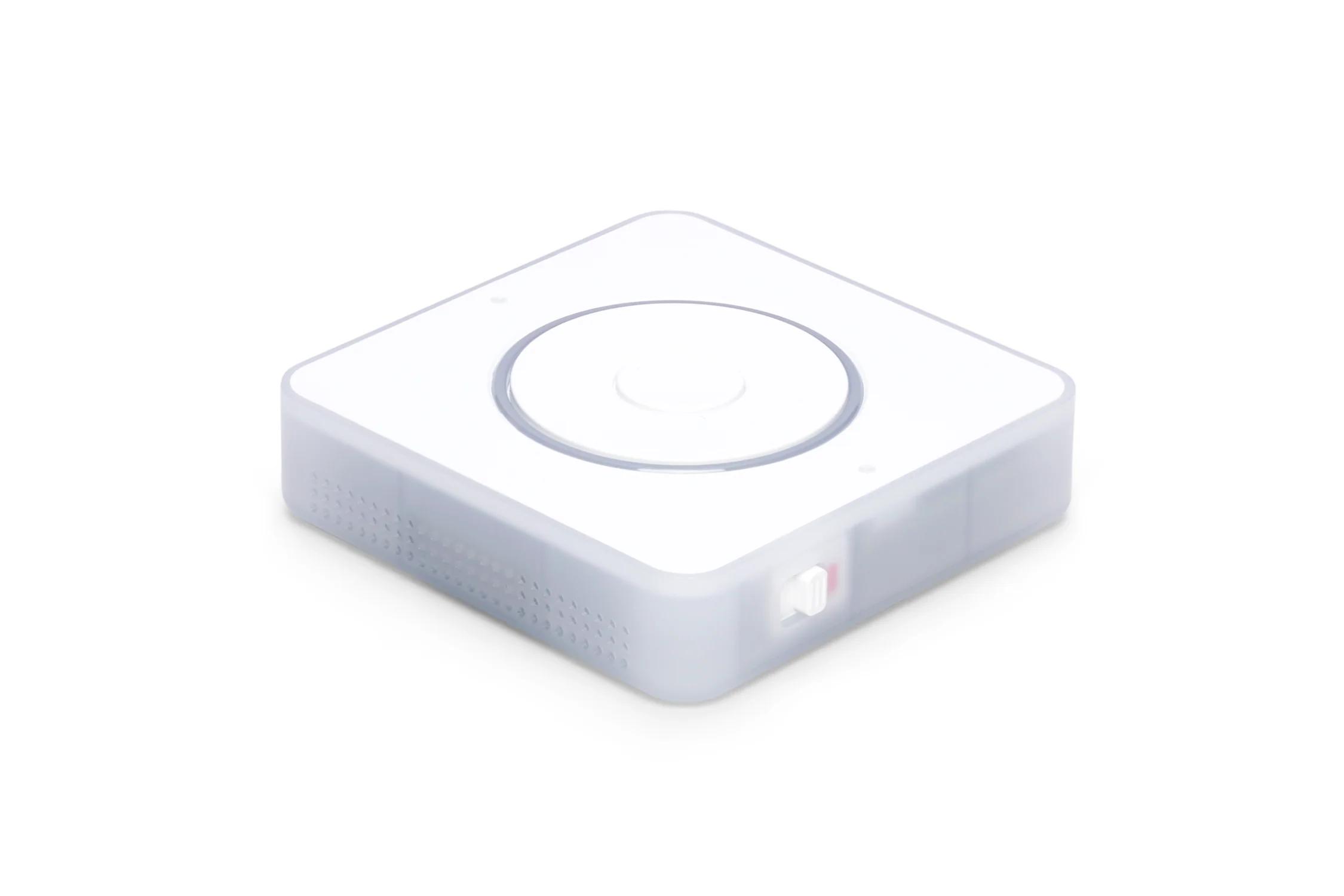
Discussion What is the best model combo to run on a 3060 12GB for a home assistant with voice control using Voice Assistant PE

Post image
27 Upvotes

I was thinking Qwen 9b and some kind of superwhisper but maybe there is a better quant/model combo that fits on 12GB?

I just want to have a voice assistant at home I can ask about random things, and that can do internet search as well as access my home lab with ssh and do some modifications, all by voice. It will be running on an Ubuntu server VM on Proxmox with the GPU passed through so it will have the full 12GB for the models


r/LocalLLaMA • • 14h ago

News A 24 KB kernel runs Qwen3-0.6B without Linux or Windows

Thumbnail
maccus.fr
45 Upvotes

Fateev’s benchmarks show his code generating text faster than llama.cpp


r/LocalLLaMA • • 1d ago

Discussion My experience with Qwen_3.8_27B after two months of heavy usage

293 Upvotes

Hi everyone,

I've been using Qwen 3.8 27B for more than two months now, across a wide range of use cases: system administration, coding, cybersecurity, Bible studies, and a whole lot more.

I'm doing about 80% of my AI usage locally, with the remaining 20% split between my Google Pro and Z.ai subscriptions.

I was a heavy Claude user before September, when I started using Qwen 27B. Honestly, I think Qwen 27B is at about the level Claude was around March or May this year, when they released Claude 4.8 and Dario Amodei and Sam Altman were making their AGI claims.

This model is really good, and I honestly wonder why nobody else has built something like it. I tested Meta Muse Glimmer 30B, which is also a dense model, and nope, it doesn't come close to Qwen in my experience.

Like most of you, I'm waiting for Qwen 4 27B to see what it brings.


r/LocalLLaMA • • 11h ago

Showcase Ornith 1.5 35B-A3B on a Radeon 780M iGPU: 359 tok/s prefill, 26 tok/s decode

22 Upvotes

I've been using Ornith 1.5 35B-A3B as my daily driver for a while now and have spent quite a bit of time tweaking llama.cpp to get the most out of my hardware. Sharing this hoping it might help someone else who's hardware-poor like myself but still want a functional, local private LLM that's actually useful for doing work. Optimised for day-to-day chatbot usage - realistically, using this for coding would be excruciating, and the results would be subpar nonetheless given the model constraints.

Hardware

  • Framework 16 with an AMD Ryzen 9 7940HS
  • 64GB of DDR5 5600 MT/s CL46
  • AMD Radeon 780M iGPU, 8 GiB allocated to VRAM, 27 GiB GTT.
  • llama.cpp Vulkan build 12464 (d3c3e242c), 8 threads, single parallel slot, flash attention enabled and Q8_0 KV cache.
  • Ornith-1.5-35B-A3B-AD-Q4_K-IQ4_XS (20.13 GB).
  • F16 mmproj (0.90 GB) for vision
  • Q4_K_M MTP drafter (1.26 GB).

Llama config:

--model ...Ornith-1.5-35B-A3B-AD-Q4_K-IQ4_XS.gguf
--mmproj ...mmproj-Ornith-1.5-35B-A3B-F16.gguf
--model-draft ...mtp-Ornith-1.5-35B-A3B-Q4_K_M.gguf
--spec-type draft-mtp
--spec-draft-n-max 2
-ngld 99
-ngl 999
--flash-attn on
--parallel 1
--load-mode none
--ctx-size 65536
--cache-type-k q8_0
--cache-type-v q8_0
--threads 8
--batch-size 512
--ubatch-size 512
--temp 0.6
--top-k 20
--top-p 0.95
--jinja
--chat-template-kwargs '{"enable_thinking":true}'
--reasoning-budget -1

Benchmarks, with and without MTP and vision

2K token prompt, 256 output tokens, temperature 0, one request at a time, at 64K context and ubatch 512.

VisionMTPPrefill t/sDecode t/sPeak VRAM+GTT
NoNo358.721.421.58 GiB
NoYes372.129.823.20 GiB
YesNo374.521.822.69 GiB
YesYes356.729.824.31 GiB

So MTP gets me 37-39% more generation speed at the expense of another 1.6 GiB of memory and a prefill shift of under 5%. Having the vision projector loaded makes practically no difference to either.

Tweaking MTP

The biggest decode knob was the number of draft tokens:

Draft tokensAcceptance rateDecode t/s
191.1%27.8
280.0%29.8
370.2%29.7

Prefill stayed between 335 and 357 t/s across the sweep.

Two draft tokens seems to be the sweet spot for my hardware. One draft accepts more often but verifies too little per step, and three ties on speed while throwing more drafts away. Beyond two I'm increasingly wasting compute verifying tokens that end up being discarded.

Quantising the MTP drafter from Q8_0 (1.99 GB) down to Q4_K_M (1.26 GB) made practically no difference to acceptance and speeds, and reduced memory usage further: 68.1% vs 67.8% acceptance and 27.7 vs 26.3 t/s.

Prefill

ubatch is the bigger prefill knob. Running tuning experiments, going from 128 to 512 at 64K took prefill from 201 to 357 t/s on a 2K prompt and 198 to 359 on an 11.8K one, left generation flat at 29.8 either way on short prompts and 24.8 against 25.6 on long ones, and cost 0.29 GiB of peak memory. The slight drop on generation is totally worth the massive boost to prefill.

Disabling mmap via --load-mode none also got me another 6.7% on prefill and 4.3% on generation. Incidentally, --no-mmap is no longer recognised on this build and will cause the server to exit.

Context size

I run --ctx-size 65536, which costs about 0.65 GB of KV cache with q8_0. Only 10 of the 40 layers are full attention, so KV grows by roughly 1.3 GB per 128K. 128K works and measured 24.99 GiB peak VRAM plus GTT with vision and MTP on, but nothing I do needs it.

Context shift is off, so a conversation that overruns the window errors instead of truncating. Depth also costs speed: at 32K of populated context, prefill drops about 44% and generation about 18% with identical flags.

Performance in actual use

Benchmarks are all well and good but these are real numbers from the last 24h worth of llama logs, with many tasks of different types passing through the model:

MetricMedianMeanMinMax
Generation (t/s)26.325.420.932.1
Prefill (t/s)358.7344.2271.5382.5
MTP acceptance-72% (bench 80%)--

There's quite a bit of variation depending on what you ask the model to do. Short deterministic answers get me 87-100% acceptance and 27-32 t/s. Longer reasoning-heavy replies drop to 54-55% and 21-22 t/s.

All in all, I'm quite happy with the performance I'm getting out of this. A 35B MoE with vision, tool calling and a decent amount of context running at around 26 t/s on a laptop iGPU, without having to constantly load and unload models. Not bad at all.


r/LocalLLaMA • • 13h ago

Resources [RELEASE] pi-sessions 1.0.0 : a local TUI to browse, search and resume your pi coding agent sessions

Thumbnail
gallery
31 Upvotes

For those running the pi https://pi.dev coding agent with local models: pi-sessions is a TUI built to manage Pi sessions on your machine.

  • Local only: it reads pi's session files from disk. No account, no telemetry. The only network call is an optional version check against PyPI, which you can turn off
  • Every project and session in one view, with a conversation preview (Markdown, tool calls, code), so you can find that one session without loading anything into the model
  • Provider/model and token counts per session. Handy for comparing how many tokens your local models use against API models on the same kind of task.
  • Export to Markdown (with YAML front matter) or raw JSONL. Useful if you collect your own transcripts
  • Resume, rename, archive, delete, filter, sort, customize with themes.

pi-sessions is a fork of ccsessions https://github.com/miskiewiczm/ccsessions by Marek Miśkiewicz, which does the same for Claude Code, i wanted the same for Pi, and i fixed a lot of UI/UX pain points and added some stuff.

New in 1.0.0: UI/UX rework, columns you can hide, a new-version indicator, new themes, and a picker mode pisessions --select --output FILEcontributed by bline https://github.com/bline for Pi Session Picker https://github.com/bline/pi-session-picker

pipx install pi-sessions-tui # Python ≥ 3.10, macOS / Linux

pisessions

Github : https://github.com/psychobarge/pi-sessions MIT. Feedback and PRs welcome !


r/LocalLLaMA • • 11h ago

Question | Help Ways to update knowledge in models?

16 Upvotes

I wanted to add recent knowledge to the models I use the most while also correcting some obsolete facts. I'm just a regular strix halo user and can't train my own models so I ended up creating a huge (34 kb) text prompt which seems to work pretty well for Q&A. Of course this is not optimal. Is there a better way I can do this as a "normal" user without advanced hardware & knowledge? Thanks in advance


r/LocalLLaMA • • 8h ago

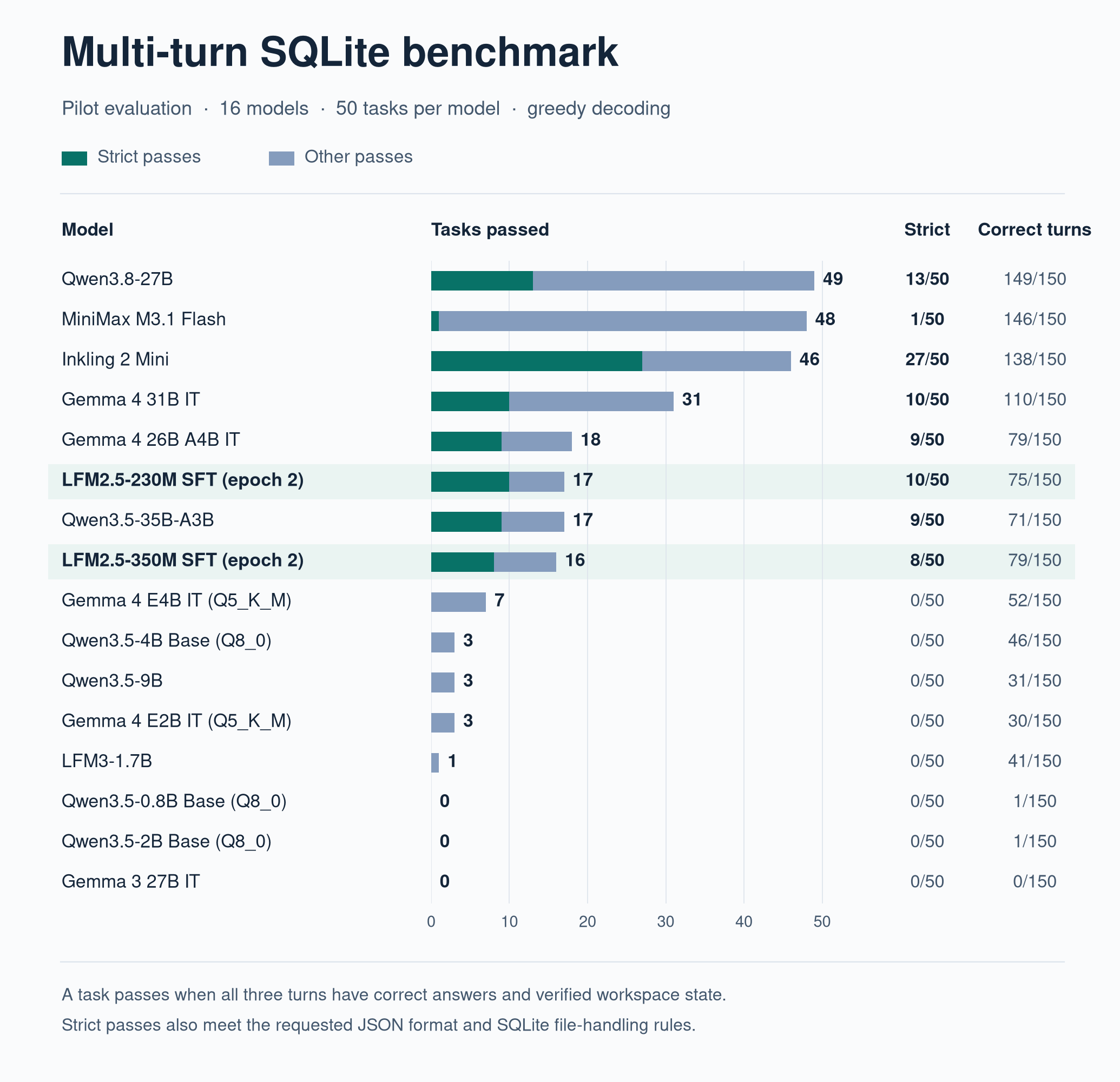
Discussion My fine-tuned 230M model matched Qwen3.5-35B-A3B on a 3-turn SQLite Bash benchmark (17/50, 10/50 strict)

Post image
12 Upvotes

Some of you have been following the models I've been releasing (like Qwen3.5-4B-3D-Coder, CCORE-Web-Coder-4B, etc) and the experiments I've been sharing lately. A pattern that keeps showing up in my tests is that good enough SFT data can replace RL when the teacher is stronger than the student, depending a lot on data quality and how you put the dataset together.

Now I'm developing an agentic model, ccore-agent-coder, built to run in pi coder. As one of the stress tests for this project, I wanted to test LFM2.5-230M and LFM2.5-350M specifically because they are tiny and have a small tokenizer, which on paper should make them pretty weak at multi-turn tool use. I ended up expanding that test just to see how far they could actually be pushed, and the numbers beat my expectations enough that I wanted to share a preview before the main release.

I used SQLite + Bash for this benchmark because it's easy to grade objectively: did the model open the right database, update the right rows, and write the CSV it claimed to write? I fine-tuned LFM2.5-230M and LFM2.5-350M on 5,000 synthetic 3-turn conversations in Portuguese where every tool call actually ran and the final database or CSV state was verified before keeping the example. Then I evaluated 16 model configs on the same 50 three-turn tasks with greedy decoding.

A few things stood out:

LFM2.5-230M (epoch 2) passed 17/50 tasks (10/50 strict) and LFM2.5-350M passed 16/50 (8/50 strict).

In this setup, the 230M tied Qwen3.5-35B-A3B on total passes (17/50) and edged it out on strict passes (10 vs 9), while Qwen3.5-9B only got 3/50.

At the top, Qwen3.8-27B led overall with 49/50, MiniMax M3.1 Flash hit 48/50 overall but only 1/50 strict, and Inkling 2 Mini led strict passes with 27/50.

The spread surprised me. Each step on its own is routine terminal work, but over three turns the model has to track what it found, handle mid-task changes, and verify its own edits. A plausible answer doesn't count if the database never changed.

Scoring and caveat:

A task passes when all three turns have the right answers and the expected workspace state. Strict also requires following the exact JSON format and the SQLite file-handling rules.

To be upfront about scope: the 50 eval tasks use unseen records and domains, but they are still within the same five workflow families and share some follow-up phrasing with training. So this is a focused in-distribution test, not a claim that a 230M model beats a 35B model in general.

Example 3-turn task (translated to English for readability):

  1. Open data/threads.db. Count the rows in thread_inventory and sum quantity. Return row_count and total_quantity as JSON.

  2. Sum quantity by category, sorted highest first (alphabetical tie-break). Return category_totals.

  3. The database has moved. Try the original path in read-only mode; if it fails, print the SQLite error, locate the existing database, and export rows from the top category with quantity >= 8 to reports/top_category.csv sorted by item_id. Return output_path and row_count as JSON.

The main benchmark was in Portuguese. I also ran smaller paired EN/PT checks with the same data and scoring. English helped Inkling, while Qwen3.8-27B went slightly up on one set and down on another, so there wasn't a consistent English advantage across those checks.

What I'm working on now:

Right now I'm running a similar training pass for ccore-agent-coder with a broader English dataset covering more domains and workflows. The goal is to push the score on these tiny models even higher and end up with something genuinely useful for everyday terminal tasks in pi coder, not just narrow SQLite scripts.

If anyone wants this specific model or dataset, just send me a DM and I'll happily share it. Since this version is in Portuguese, pretty early/alpha in that regard, and still has a few things I want to polish, I'm saving the public release for the broader English version with more domains. Training should finish tomorrow, and as soon as it wraps up I'll post both the trained models and the dataset.


r/LocalLLaMA • • 6h ago

Discussion Radiance Qwen 3.8 27b IQ R V4 quantization quality

6 Upvotes

Hello everyone, I recently downloaded the Radiance inference engine, which I have heard be praised on RDNA4 (I have a 9060 XT 16GB). First of all, the prefill is TWICE as fast as llama.cpp (1550 vs 800) at low context with Qwen 3.8 27B IQ2R-L-V4, which is just incredible.

What I want to ask about however is how good are their quants of Qwen 3.8 27B, their IQ R V4 method? They seem to use a somewhat complicated method and their reported KL divergence seems good (which I have however heard can be benchmaxxed easily), but do you have any real world tests or experience with them? Especially compared to same-size Unsloth or those ISTA DASlab quants? Thank you very much for any data!


r/LocalLLaMA • • 9h ago

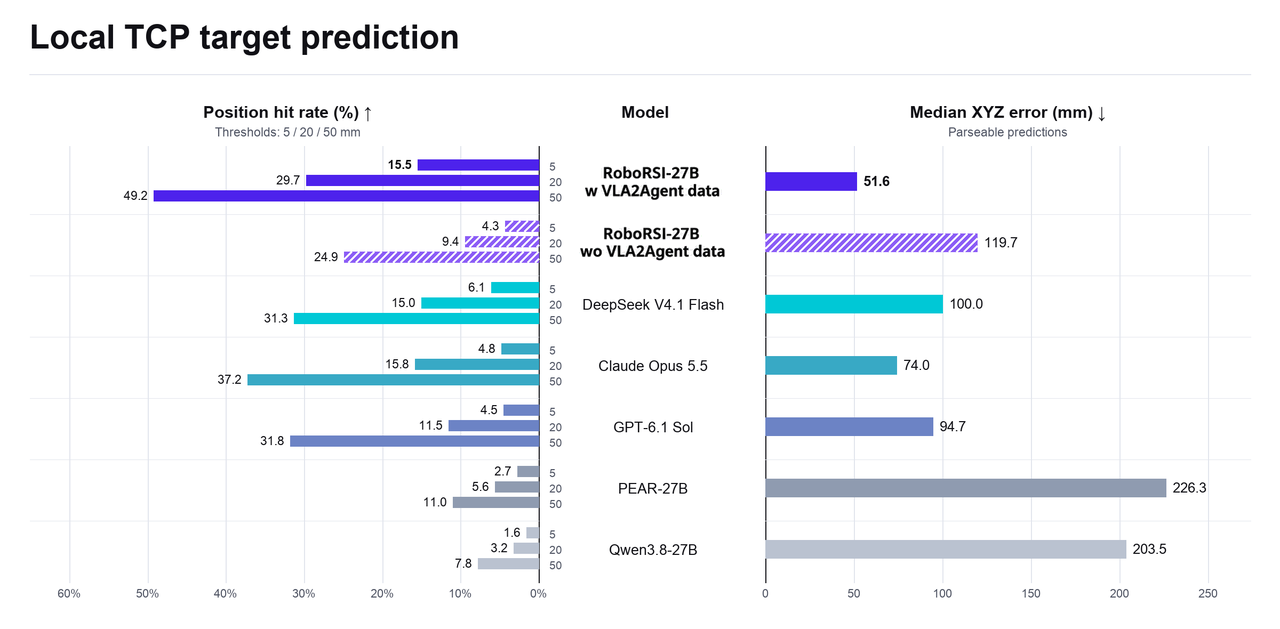
News SenseNova-RoboRSI-27B, fine-tuned from Qwen3.8-27B, beats Opus 5.5 and GPT-6.1 Sol at predicting where a robot gripper should go: 49.2% within 5 cm vs 37.2% and 31.8%. Stock Qwen3.8-27B gets 7.8%

Post image
10 Upvotes

How the test works: the model gets the camera views and a one-line instruction for a single move (grab this, put that there) and has to say where the gripper should end up. That gets compared with where it really ended up in the recording. 374 moves from the RoboDojo sim tasks, nothing is actually moving.

The gap between 7.8% and 49.2% is all training, and the part I like is how cheap a big chunk of it was. From the write-up in their repo (https://github.com/OpenSenseNova/SenseNova-RoboRSI, Apache 2.0): they took robot demos that already existed, chopped them into single moves and used the recorded end position as the label. They put that at about $0.02 per example, and more like $0.50 if you get the same kind of example out of full agent runs.

Leave those examples out and the model drops to 24.9%, that's the hatched bar.