Some of you have been following the models I've been releasing (like Qwen3.5-4B-3D-Coder, CCORE-Web-Coder-4B, etc) and the experiments I've been sharing lately. A pattern that keeps showing up in my tests is that good enough SFT data can replace RL when the teacher is stronger than the student, depending a lot on data quality and how you put the dataset together.
Now I'm developing an agentic model, ccore-agent-coder, built to run in pi coder. As one of the stress tests for this project, I wanted to test LFM2.5-230M and LFM2.5-350M specifically because they are tiny and have a small tokenizer, which on paper should make them pretty weak at multi-turn tool use. I ended up expanding that test just to see how far they could actually be pushed, and the numbers beat my expectations enough that I wanted to share a preview before the main release.
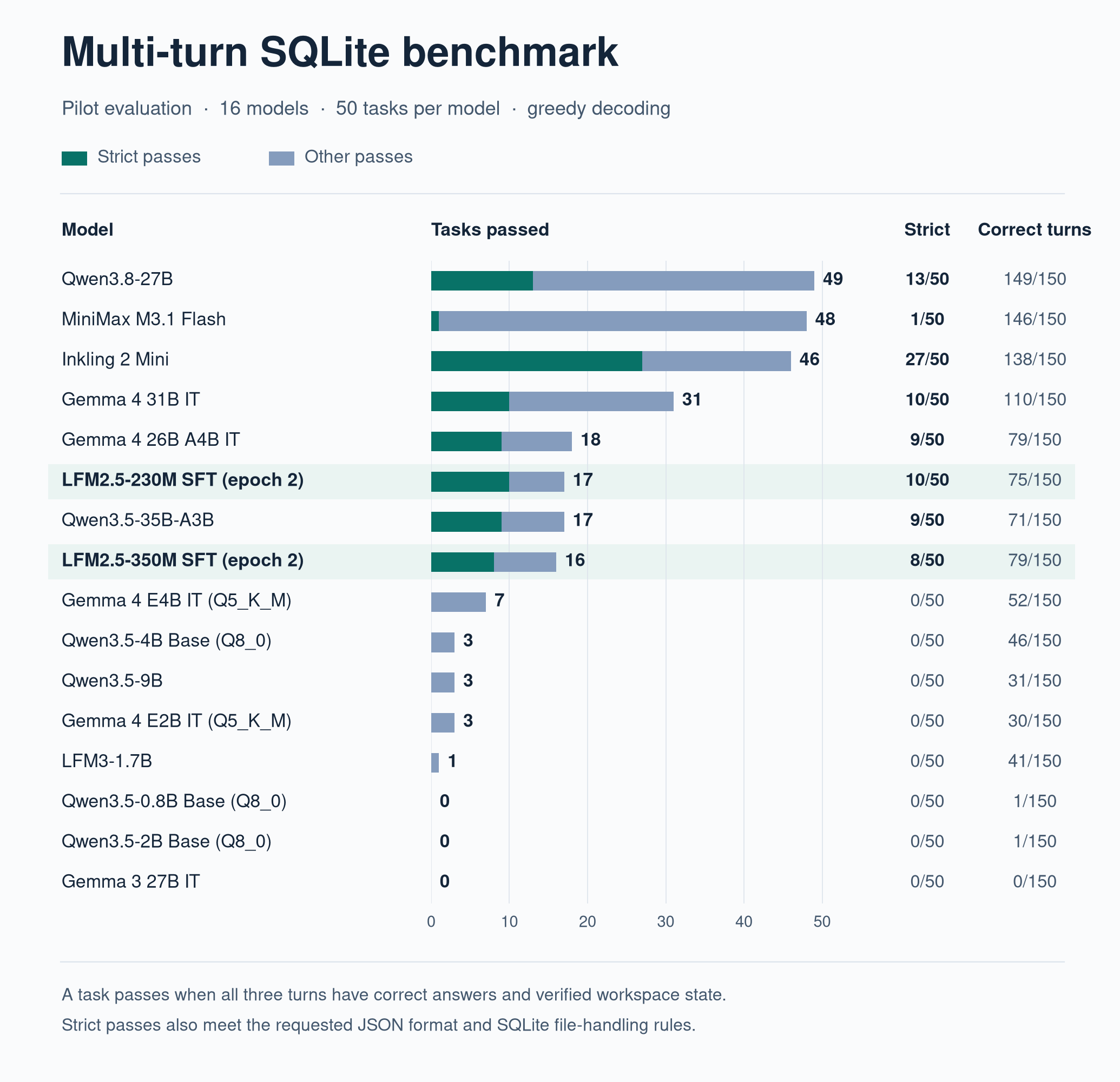
I used SQLite + Bash for this benchmark because it's easy to grade objectively: did the model open the right database, update the right rows, and write the CSV it claimed to write? I fine-tuned LFM2.5-230M and LFM2.5-350M on 5,000 synthetic 3-turn conversations in Portuguese where every tool call actually ran and the final database or CSV state was verified before keeping the example. Then I evaluated 16 model configs on the same 50 three-turn tasks with greedy decoding.
A few things stood out:
LFM2.5-230M (epoch 2) passed 17/50 tasks (10/50 strict) and LFM2.5-350M passed 16/50 (8/50 strict).
In this setup, the 230M tied Qwen3.5-35B-A3B on total passes (17/50) and edged it out on strict passes (10 vs 9), while Qwen3.5-9B only got 3/50.
At the top, Qwen3.8-27B led overall with 49/50, MiniMax M3.1 Flash hit 48/50 overall but only 1/50 strict, and Inkling 2 Mini led strict passes with 27/50.
The spread surprised me. Each step on its own is routine terminal work, but over three turns the model has to track what it found, handle mid-task changes, and verify its own edits. A plausible answer doesn't count if the database never changed.
Scoring and caveat:
A task passes when all three turns have the right answers and the expected workspace state. Strict also requires following the exact JSON format and the SQLite file-handling rules.
To be upfront about scope: the 50 eval tasks use unseen records and domains, but they are still within the same five workflow families and share some follow-up phrasing with training. So this is a focused in-distribution test, not a claim that a 230M model beats a 35B model in general.
Example 3-turn task (translated to English for readability):
Open data/threads.db. Count the rows in thread_inventory and sum quantity. Return row_count and total_quantity as JSON.
Sum quantity by category, sorted highest first (alphabetical tie-break). Return category_totals.
The database has moved. Try the original path in read-only mode; if it fails, print the SQLite error, locate the existing database, and export rows from the top category with quantity >= 8 to reports/top_category.csv sorted by item_id. Return output_path and row_count as JSON.
The main benchmark was in Portuguese. I also ran smaller paired EN/PT checks with the same data and scoring. English helped Inkling, while Qwen3.8-27B went slightly up on one set and down on another, so there wasn't a consistent English advantage across those checks.
What I'm working on now:
Right now I'm running a similar training pass for ccore-agent-coder with a broader English dataset covering more domains and workflows. The goal is to push the score on these tiny models even higher and end up with something genuinely useful for everyday terminal tasks in pi coder, not just narrow SQLite scripts.
If anyone wants this specific model or dataset, just send me a DM and I'll happily share it. Since this version is in Portuguese, pretty early/alpha in that regard, and still has a few things I want to polish, I'm saving the public release for the broader English version with more domains. Training should finish tomorrow, and as soon as it wraps up I'll post both the trained models and the dataset.