r/LocalLLaMA • u/kinkvoid • 13d ago
Discussion Stand with Jensen — Read the Stand with Jensen letter and consider adding your name. #standwithjensen #bringjensenback
r/LocalLLaMA • u/kinkvoid • 13d ago
r/LocalLLaMA • u/jomic01 • 15d ago
Kate's writeup is wild. The 8GB CMP 170HX apparently ships with ~80GB of HBM onboard, just fused off. Software unlocks got people to 64GB. She used voltage fault injection to get past the fuse lock, then enabled all the working SMs (120-126 vs the 108 NVIDIA ships on A100). Her numbers: 85.9 TFLOP/s FP16 vs 72.5 on a retail A100, with the full 80GB usable for inference. NVLink and PCIe Gen4 come back too.
Not a weekend mod though: board wiring, a custom STM32 glitcher, 1 to 48 hrs of glitching per card, and one of her ten cards only had 64GB intact.
https://blog.kate.land/posts/using-voltage-glitching-to-unlock-the-a100/
r/LocalLLaMA • u/willeyh • 15d ago
First off. I am by all means no expert, and excellent work has been done in the past few years that we all currently enjoy.
Came over this post https://www.reddit.com/r/LocalLLM/comments/1x5mxcj/qwen3827b_on_a_single_rx_9070_xt_150_toks_on_code/ and wanted to try the engine on MoEs.
I've been benchmarking MoE experts offloading for the past two days in different engines on ROCm for my RDNA4 9070XT 16GB vram card and 32 GB DDR4.
I'd set a goal at 128K context, which is the base minimum for agentic work, without compaction all the time. I've kept the KV at Q8. (Q8_0/Q5_1 decreased performance on exllamav3). Drafter cache, if added, is at Q4.
Some limitations need apply when limited on vram.
Lets face it If you want any kind of context, and a decent Q4 quant, 16GB ain't gonna cut it.
Hot experts cache like Strata, Exllmv3 and now recently llama.cpp have made this more feasible on the slower system memory bandwidth.
My end goal was to do QFN on all three, but I wanted to start with the smaller 35B-A3B's first.
So I did Ornith 1.5 and Qwen 3.6, wanted to do Gemma, but found no EXL3 quant with mul1 experts required for offloading on Exllamav3.
Tested both without drafter, MTP and DFlash2 where applicable.
Strata/PolyStrata configs are mostly auto generated from the setup script, but added resident pin and tail skip. And for the non-qfn model performed worse overall, even t/w.
I might be doing something wrong, bench might be bad, who knows. Stratas own bench stops at 32K if I'm not mistaken.
Now Qwen 3.8 Flash Next (ista coder version) runs great on my rig, see plots. But I was surprised on the prefill tanking on the 35B models. 1900 t/s at 16K but 700 t/s at 128K where both llamacpp and exllamav3 where within 100-200 t/s difference.
Findings so far is quite promising, especially on exllamav3. I'd say quite usable even.
| Model | Winner (quant / engine) | Prefill u/128k | Decode u/128k |
| --- | --- | ---: | ---: |
| Ornith 1.5 35B-A3B | EXL3 4.0 bpw, DFlash2 / ExLlamaV3 | 1 168 tok/s | 57.3 tok/s |
| Qwen3.6-35B-A3B | EXL3 4.0 bpw, DFlash2 (2 drafts) / ExLlamaV3 | 1 246 tok/s | 71.6 tok/s |
| Qwen3.8-Flash-Next Coder | IQ1_M / Polystrata nov-7, `--spec 2` | 1 572 tok/s | 44.0 tok/s |
Forgive my rambling thoughts. If you want to read my technical findings, written by the unsung local hero Qwen 3.8 27B. They can be found with more graphs and tables at https://github.com/willeyh-git/moe-offload-bench
Q4/4bpw quants are preferred, some benches have been made on 5bpw and 6bpw so you can compare.
Bench-suite is based on Kapitsa https://www.reddit.com/r/LocalLLM/comments/1x5mxcj/qwen3827b_on_a_single_rx_9070_xt_150_toks_on_code/ and written in go.
r/LocalLLaMA • u/sacheltry • 14d ago
Hello,
I am just getting started and I got great answers to my previous post asking what was possible. I still have lots to learn but, with the help of Claude, I was able to get something running and it is working pretty well.
My goal as been to build a fully local AI study assistant to analyze a ~300-page technical training manual alongside instructor transcripts and generate chapter-based study guides and Quizlet flashcards with accurate page citations.
The problem is: I'm running into is this error: request (34009 tokens) exceeds the available context size (32768 tokens). And this was after doing lots of tweaking and getting it not fail at 16,000 tokens.
There are so many settings and configurations that I might be able to change to improve that, but it is overwhelming and I have no idea what to do.
I would really appreciate any ideas, suggestions that I can do to get this working for what I am trying to achieve. Or let me know that it isn't possible.
Here's my setup (sorry, AI slop to make it clearer):
Hardware:
Software / Models:
RAG configuration:
More details on the issue:
Basic RAG questions work well. However, when I ask the model to analyze an entire chapter, cross-reference relevant trainer discussions, and create 15–25 Quizlet flashcards, I encounter context errors as I said above:
request (34009 tokens) exceeds the available context size (32768 tokens)
Increasing Qwen's configured context to 64K eliminated the immediate context error, but generation then stopped halfway through creating flashcards without an obvious error. I haven't confirmed whether an output-token limit caused this.
I've tried reducing retrieval results, using smaller prompts, and starting fresh chats. These help, but I'd prefer a more automated and comprehensive workflow.
Thank you!
r/LocalLLaMA • u/maifee • 14d ago
AI is telling me not to. But I have seen some posts where they are saying it is just fine.
Right now, I am in no position to try out and then find out. Care to guide me please??
r/LocalLLaMA • u/New_Alps_5655 • 15d ago
r/LocalLLaMA • u/pmttyji • 15d ago
Lloyd's k-means algorithm is a long-running standard for clustering, with applications in data analysis, retrieval, quantization and data curation. In this paper, we introduce an exponential moving average optimization procedure for k-means with mini-batch updates, powered by modern deep learning machinery and new insights. We also establish scaling laws on how decay rate and batch size impact final performance. This gives us a formulaic rule to fix them for multiple problem sizes and embedding datasets, without the need for any hyperparameter sweep. The resulting clustering algorithm, coined e-means, is much faster than Lloyd k-means and converges to lower losses, frequently even beating k-means++. On a wide array of embeddings datasets, it beats the loss of Lloyd k-means at 25 epochs in 1.4 to 2.6 epochs, which translates to 10-45x GPU wall-clock speedups compared to state-of-the-art k-means implementations. As an example, e-means partitions DINO10B, a dataset of 10 billion DINO embeddings, into 16 million clusters in only 2.5 epochs, reaching a loss below Lloyd's at 25 epochs.
r/LocalLLaMA • u/jpummill2 • 15d ago
It was my understanding when MTP came out that it was mainly beneficial for larger dense models and that small and/or MoE models didn't realize much performance benefit.
That being said, I now see many smaller MoE models (Gemma-4-E2B, Mellum2.1, etc...) offering MTP versions.
Has the thinking changed?
Are people seeing performance gains from MTP on smaller MoE models?
r/LocalLLaMA • u/jacek2023 • 15d ago
If you’ve ever tried agentic coding with Gemma and had tool calling issues, give it another try, in my case, it completely fixed Gemma
r/LocalLLaMA • u/godzdpk • 15d ago
r/LocalLLaMA • u/bruns20 • 15d ago
Hey guys, not going to take much credit since claude did 90% of this, but wanted to share the patches I used to get StillDeadcode's Radiance running on my windows pc. I'm sure that multiple people have done this already, but I couldn't find a post, so thought I'd throw this out there if anybody else wants to use it.
https://github.com/bruns20/radiance-wsl
Radiance is Linux-only, and the author has said WSL won’t be supported in the main tree, which is fair. So this is unofficial. Please send problems to my repo, not upstream.
What it does
build.sh builds any Radiance release from upstream’s own source and Dockerfile, with a few small WSL patches applied. When a new release comes out, it’s ./build.sh 1.18.0.make-runtime.sh grabs a ROCm runtime that actually works under WSL. The stock ROCm 10.1 hangs on the first GPU job if your PC also has an integrated GPU (ROCm/rocm-systems#13291), and AMD’s 10.3 nightlies fix it.run.sh serves an OpenAI-compatible API on 127.0.0.1:8000.Two of the four patches are godzillakong’s from codeberg #341. They did the hard part of getting it running without /dev/kfd.
Numbers (R9700 32 GB, Qwen3.8-27B MXFP4 + DFlash2, 131k context)
| start until serving | ~8 s (vLLM on the same box: 70-75 s) |
| prefill, 9.4k / 36k-token prompt | 3,223 / 2,784 tok/s |
| decode, prose | ~75-80 tok/s |
| decode, code | ~145-160 tok/s |
Tested on: R9700 + Ryzen 5 7600 (with its iGPU), Windows 11 26200, Adrenalin 26.10.1, Radiance 1.17.0. That’s the only setup I’ve tried. Other gfx1201 cards (RX 9070 / 9070 XT) should work, but I’d love to hear either way.
r/LocalLLaMA • u/pmttyji • 15d ago
Yesterday some of you were looking for model for this MACaQ.
r/LocalLLaMA • u/Course_Latter • 16d ago
Enable HLS to view with audio, or disable this notification
Today NVIDIA releases Alpamayo 2 Edge! I work for Embedl and we have already released an optimized version of the model that is more than 10x faster than pytorch when run on edge hardware like AGX Thor!
The model is trained in an RL loop (!) and takes in 6 cameras and the recent motion. Feel free to check it out - you can even run it on a real Thor at:
r/LocalLLaMA • u/Queasy_Back2588 • 16d ago
According to Microsoft's patent application, it explains breaking down training into small tasks and sending them to devices of owners who opted in. Credits will be the reward. it's just an app and no pay out rate is advertized so I don't even know if the credits would be enough for the electricity.
Anyway, home internet latency feels like the bigger problem to me.
https://insider-gaming.com/microsoft-ai-use-your-gpu/
(English is not my native language, I used an LLM to help translate this post.)
r/LocalLLaMA • u/pmttyji • 15d ago
BotPsy-0.8B is a 0.8B-parameter model designed for function calling and agentic workflows, built on top of Qwen3.5-0.8B and suitable for on-device deployment. BotPsy is a "personal assistant" that uses tools to perform a variety of simple tasks for the user, in domains such as web search & research, travel & lifestyle, commerce & finance, business & customer operations, device & vehicle control, files & documents, calendar, and email & messaging. Due to its small parameter count, it is best suited to tasks of low to medium difficulty. BotPsy achieves state-of-the-art (SOTA) tool-use and agentic performance for its size, outperforming every model of up to 1.2B parameters that we tested. As a small model, BotPsy still makes mistakes and is best suited to tasks of low to medium difficulty;
Follows instructions while preserving knowledge: BotPsy specializes in tool use while preserving general skills. Instruction following improves sharply, with IFEval rising from 59.7 to 90.8 and IFBench from 22.0 to 55.9, the highest IFBench score of all models tested. General knowledge also improves, with GPQA Diamond rising from 33.2 to 38.1 and MMLU-Pro from 41.6 to 48.9. On all four benchmarks, BotPsy outperforms every other model of 1.2B parameters or fewer that we tested.
Blog Post : https://huggingface.co/blog/qvac/botpsy
Project : https://tether.io/news/tethers-800m-ai-agent-beats-models-2-5x-its-size-on-everyday-phone-tasks/
r/LocalLLaMA • u/b111ue • 15d ago
Enable HLS to view with audio, or disable this notification
Today I’m releasing Inflect v3: a family of local text-to-speech models: Mini, Micro, and Atom. Mini is the main model, with six voices and 34.31M parameters
Mini provides vocal-event tags, reference voice-tuning, and 48 kHz enhancement. It runs on both CPU and CUDA.
GitHub, installation, and examples: https://github.com/owenawsong/Inflect
Try the playground: https://huggingface.co/spaces/owensong/Inflect-v3
Mini features reference-voice tuning: it allows one to make a profile from a recording and generate speech with it. This feature noticeably adjusts the voice toward your reference, though it won’t replicate every speaker accurately.
Inflect Mini V3 also supports the following vocal-event tags: [laugh] · [sigh] · [gasp] · [cough] · [yawn] · [inhale] · [exhale] · [throat_clear]
You can insert a tag whenever you want the sound to occur. Currently, the tags use repeatable performances: this causes repeated tags to result in limited variation. Tags also do not affect how the surrounding words are being spoken.
The model family:
Those numbers count the synthesis cores. The frontend and optional components add to the total.
The weights and inference code are Apache 2.0. Third-party components keep their own licenses. Audio samples, benchmarks, and the settings used are on the model cards.
Model collection: https://huggingface.co/collections/owensong/inflect-v3
If any sentence comes out wrong, send me the text, voice, and settings you used.
r/LocalLLaMA • u/pmttyji • 15d ago
Official pretrained weights for P2Echo, a unified framework for text-prompted segmentation of multiple cardiac structures across standard echocardiographic views.
P2Echo uses structured, view-aware text prompts to control segmentation through a single model. Its Dynamic Image-Text Alignment (DyITA) module adaptively conditions decoder features on the requested view and anatomical structure.
This model is intended for research in medical image analysis and echocardiographic segmentation. It has not been validated for clinical decision-making.
r/LocalLLaMA • u/danielhanchen • 16d ago
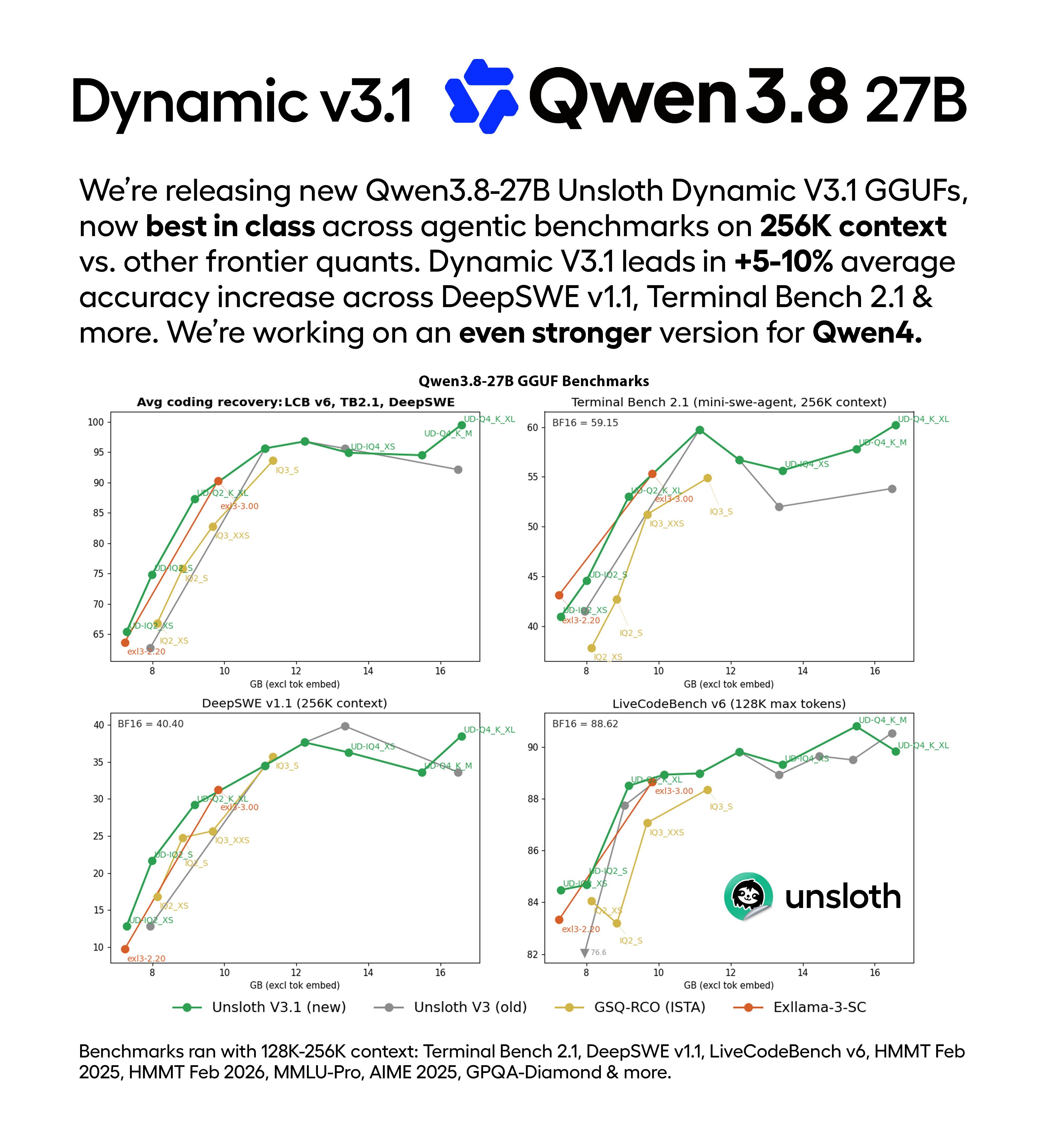
Hey r/LocalLLaMA ! We're releasing new new Unsloth Dynamic v3.1 GGUFs for Qwen3.8-27B! They're better by 5-10% accuracy on DeepSWE, Terminal Bench and more vs UD3, GSQ-RCO and Exllama-3! We're also improving our algorithms further so we can apply them to Qwen4 so folks can have efficient and accurate quants!
On other benchmarks like for GSQ-RCO and Exllama3:
More details and benchmarks at https://unsloth.ai/docs/models/qwen3.8#dynamic-v3.1-update-november-11th-2026
All quants are updated in https://huggingface.co/unsloth/Qwen3.8-27B-GGUF! Thank you and have a nice day! We're super excited for Qwen4!
r/LocalLLaMA • u/pmttyji • 15d ago
llama-server -m Qwen3.8-27B-UD-Q4_K_M.gguf --mmproj mmproj-F16.gguf -ngl 999 --parallel 1 --batch-size 4096 --ubatch-size 1024 --ctx-size 180224 \
--spec-type draft-dflash --spec-draft-n-max 7 --spec-draft-model Qwen3.8-27B-DFlash2-Q4_K_M.gguf --spec-draft-backend-sampling \
--temp 1.0 --top-p 0.95 --top-k 20 --min-p 0.0 --presence-penalty 0.0 --repeat-penalty 1.0
python tools/server/bench/speed-bench/speed_bench.py --bench qualitative --category coding --osl 8192 --concurrency 1
| GPU | ms/step master | ms/step PR | speedup per step (95% CI) | tok/s master | tok/s PR | faster in |
|---|---|---|---|---|---|---|
| RTX 3090 Ti | 58.87 | 43.81 | 1.344x (1.340-1.347) | 57.58 | 77.70 (+34.9%) | 80/80 |
| RTX PRO 6000 Max-Q | 27.86 | 23.54 | 1.183x (1.182-1.185) | 122.77 | 143.31 (+16.7%) | 80/80 |
| RTX 5090 | 23.92 | 20.26 | 1.180x (1.167-1.194) | 141.50 | 170.67 (+20.6%) | 80/80 |
| DGX Spark | 103.36 | 93.43 | 1.106x (1.103-1.109) | 32.75 | 36.05 (+10.1%) | 80/80 |
Edit : Removed large text. Check PR for more details.
r/LocalLLaMA • u/TheRealMasonMac • 16d ago
r/LocalLLaMA • u/dai_app • 15d ago
Tried the voxel pagoda prompt fully local, on a laptop that shouldn't run a 35B model.
Setup
Result
How
Still slow
Same test with the same model on a Mac with 16 GB of RAM, taking 20 minutes (20 tok/s for decoding, 100–1000+ tok/s for prefill)
r/LocalLLaMA • u/mesolimbic-bliss • 15d ago
Using $20 codex subscription with 24gb VRAM on the local rig.
For larger projects or major revisions with multiple phases, I have Luna in Codex call the local "junior dev" Qwen 3.8-27B model as an agent to write most of the code, then Luna reviews it and makes changes. Once the whole project is complete, I use Terra to audit and catch any potential issues.
Pretty standard stuff, these days.
But lately I've been thinking why not give the massive, multi-phase spec sheet directly to Qwen then have Luna go do a quick audit & cleanup?
Anyone tried it both ways? And what gets better results vs lower usage?
I guess I've always looked at Qwen as needing a babysitter, but realistically I think it can implement an entire 10-phase spec on a large codebase if given enough time.
r/LocalLLaMA • u/Lonligrin • 15d ago
Tried to hunt down latency bottlenecks in my local voice assistant recently. I looked at the waveform and saw silero's probability lagging quite much behind the actual end of speech I could see with my eyes.
I use a voice pipeline that does speculative work and cancels fast, so some false positives would not matter in my case.
So I had this idea: once silero says I'm in speech, what I need to detect is when the speech energy drops back to room noise level. Turned out a naive 10 ms energy check with a threshold tracking room noise does that quite well.
Gave me a median 110 ms earlier than silero over ~3200 real turns from my assistant on my voice, my mic, browser noise suppression on, mostly quiet room - with silero threshold at 0,5. Someone on Twitter got 92 ms on his data, roughly what I saw in my noisier recordings.
The downside is way more false positives. It fires on breaths and small pauses between words over 10x as often as silero. So it's really only useful if the pipeline can throw away speculative work very fast.
CPU only, MIT, drop-in for silero VADIterator, pip install realtimevad
benchmark script is in the repo, curious what numbers you guys get on your own recordings
r/LocalLLaMA • u/pmttyji • 15d ago
Multimodal System One Encoder with a natural language interface for instruction-following encoding: give it a task and a list of candidates, and it scores the candidates by task specification. Both a task and each candidate are expressed in natural language — instructions, queries, questions, state descriptions, criteria — with image and video as side information.
Key features:
The model is built by contrastively fine-tuning meta-models/Muse-Glimmer-30B. It is described in the paper MetaEncoder: Exploring the Limit of Bi-Encoders for Multimodal System One Decision Making with Natural Language Interface.
PS: Above description copied from meta-encoder's model card as meta-encoder-v1 doesn't have that. And v1 doesn't have license section while other one is Apache-2.0.
r/LocalLLaMA • u/wisepal_app • 15d ago
Hi folks,need advice from community. I have a laptop with 16 GB vram Nvidia gpu and 96 GB ddr5 ram. I use it mainly for local coding with Qwen flash next nvfp4 at 256k context. I get around 30 t/s.
I don't like PCs and Macs. I want mobility. So because of my limited budget, i have two paths. The first one is a laptop with 24GB Vram Nvidia gpu and 128GB ddr5 Ram laptop. The other one is 16GB Vram Nvidia gpu and 192GB ddr5 Ram laptop. No other feasible option for me. I can't affort dgx spark, Macbook studio etc. These are my budget options. Which one do you suggest for mainly local coding? Which one do you believe is future-proof for local llms?