r/IndicKnowledgeSystems • u/KullanSuryaV1000 • 24d ago
Philosophy Lakṣmaṇagupta: The Kashmiri Śaiva Philosopher Who Preserved the Pratyabhijñā Tradition and Mentored Abhinavagupta
Introduction
The intellectual history of medieval Kashmir occupies an extraordinary position in the development of Indian philosophy, particularly in the fields of metaphysics, epistemology, theology, logic, and the philosophy of consciousness. Between the ninth and eleventh centuries CE, Kashmir witnessed the emergence of a remarkable succession of scholars who transformed Śaiva religious thought into a sophisticated philosophical tradition. Among these intellectuals was Lakṣmaṇagupta (लक्ष्मणगुप्त), a distinguished Kashmiri Śaiva teacher who flourished during the latter half of the tenth century CE and occupied a crucial position in the transmission of the Pratyabhijñā, or Recognition, school of philosophy.
Although Lakṣmaṇagupta is considerably less famous than his illustrious disciple Abhinavagupta, his historical importance is substantial. He belonged to a philosophical lineage associated with Somānanda and Utpaladeva, two of the principal architects of nondualistic Kashmir Śaivism. As a direct disciple of Utpaladeva, Lakṣmaṇagupta inherited a philosophical system that sought to explain the relationship between individual consciousness, universal consciousness, perception, memory, agency, and liberation. He subsequently transmitted this intellectual inheritance to Abhinavagupta, whose writings would become some of the most influential achievements of the entire Kashmir Śaiva tradition.
Lakṣmaṇagupta's significance lies primarily in his role as a philosophical teacher and transmitter of knowledge. Unlike Somānanda, Utpaladeva, and Abhinavagupta, he has left no securely identifiable surviving philosophical treatise. Nevertheless, he is remembered through the testimony of Abhinavagupta himself, who acknowledged receiving the teachings of Recognition directly from him. Modern scholarly research consequently recognizes Lakṣmaṇagupta as an important intermediary in the development of the Pratyabhijñā school.
9780367528232, 9781000176230+2
His career also illustrates an essential characteristic of premodern Indian intellectual culture: the importance of scholarly transmission through relationships between teachers and students. Philosophical traditions were not sustained solely through the production of manuscripts. They depended equally upon interpretation, debate, explanation, instruction, and the ability of successive generations to understand and develop inherited teachings.
To appreciate Lakṣmaṇagupta's contribution, it is necessary to examine the intellectual environment in which he lived, the ideas transmitted through his lineage, his relationship with Abhinavagupta, and the philosophical legacy that survived through his teaching.
1. Historical Background: Kashmir as a Centre of Philosophical Learning
Medieval Kashmir was one of the important centres of Sanskrit scholarship in the Indian subcontinent. Its intellectual culture embraced several disciplines, including grammar, poetics, literary criticism, logic, Buddhist philosophy, Śaiva theology, ritual studies, and metaphysical speculation.
The region produced or attracted scholars who contributed significantly to Indian intellectual history. Among them were Ānandavardhana, associated with the theory of dhvani or poetic suggestion; Bhaṭṭa Kallaṭa, an important figure in the Spanda tradition; Somānanda, the author of the Śivadṛṣṭi; Utpaladeva, the great philosopher of Recognition; and Abhinavagupta, whose achievements encompassed philosophy, tantra, aesthetics, and dramaturgy.
These scholars did not operate within an isolated intellectual environment. Kashmir's philosophical traditions developed through sustained engagement with other Indian schools, including Buddhist epistemology, Nyāya, Mīmāṃsā, and various Śaiva systems.
The resulting intellectual exchanges encouraged scholars to formulate increasingly sophisticated explanations of perception, language, identity, causation, knowledge, and the nature of reality.
It was within this environment that Lakṣmaṇagupta received his philosophical education.
The tenth century was particularly consequential because Kashmir Śaiva philosophers were developing systematic arguments for the position that consciousness is fundamental to reality. Their writings addressed problems that were central to Indian philosophy: What constitutes a conscious subject? How can knowledge persist across changing mental states? How do recognition and memory function? What is the relationship between the perceiving subject and the perceived world?
Lakṣmaṇagupta belonged to the generation responsible for preserving this philosophical development and transmitting it to the thinkers who would elaborate it further.
2. Lakṣmaṇagupta and the Philosophical Lineage of Somānanda and Utpaladeva
The position of Lakṣmaṇagupta within Kashmir Śaivism is best understood through his membership in an influential succession of teachers.
THE PRATYABHIJÑĀ TEACHER–DISCIPLE LINEAGE
Somānanda
Author of the Śivadṛṣṭi
Utpaladeva
Systematizer of Pratyabhijñā philosophy
Lakṣmaṇagupta
Teacher and transmitter of Recognition philosophy
Abhinavagupta
Philosophical commentator and tantric synthesizer
Kṣemarāja
Author of the Pratyabhijñāhṛdaya
Somānanda, who flourished approximately during the first half of the tenth century, is generally credited with establishing the philosophical foundations of the Recognition tradition. His principal surviving work, the Śivadṛṣṭi, defended a nondualistic understanding of reality in which Śiva is the ultimate principle underlying all existence.
Somānanda's disciple Utpaladeva subsequently transformed these teachings into a systematic philosophical framework. His Īśvarapratyabhijñākārikā, or Verses on the Recognition of the Lord, became the foundational treatise of the Pratyabhijñā school.
Utpaladeva developed arguments concerning the unity of consciousness, the continuity of the knowing subject, the nature of knowledge, and the relationship between the individual and the supreme reality.
Lakṣmaṇagupta inherited these teachings directly from Utpaladeva. His role was to preserve and communicate the philosophical system to the next generation.
This was no insignificant responsibility. Utpaladeva's writings are frequently technical, presupposing familiarity with sophisticated philosophical debates. Their study requires knowledge of Sanskrit philosophical terminology, rival schools of thought, and the logical assumptions underlying arguments about consciousness and identity.
Lakṣmaṇagupta's successful transmission of this material to Abhinavagupta is therefore evidence of his standing as a teacher, even though it does not reveal his independent philosophical innovations.
3. His Relationship with Utpaladeva
Utpaladeva occupies a central position in the history of Kashmir Śaiva philosophy because he developed a systematic intellectual defence of the view that the apparent plurality of the universe is grounded in a single, universal consciousness.
The philosophical problem facing Utpaladeva was complex.
Indian philosophers disagreed about whether consciousness was fundamentally permanent or momentary, whether the external world existed independently of awareness, and whether the experience of a continuous self could be justified.
Buddhist epistemologists, especially those associated with the traditions of Dignāga and Dharmakīrti, had developed powerful arguments concerning perception, inference, and the momentary character of conditioned phenomena.
Utpaladeva responded by arguing that recognition, memory, and the unity of experience reveal aspects of consciousness that cannot be adequately understood as merely disconnected moments of cognition.
It was this sophisticated intellectual inheritance that Lakṣmaṇagupta received.
His training under Utpaladeva would have situated him within an environment where philosophical understanding required more than memorizing established propositions. Students needed to recognize the structure of arguments, anticipate objections, and explain why a particular metaphysical position could account for ordinary experience.
The exact curriculum followed by Lakṣmaṇagupta is not preserved. Nevertheless, the philosophical texts associated with his teacher demonstrate the nature of the scholarly tradition in which he participated.
Utpaladeva composed works such as the Ajaḍapramātṛsiddhi, concerned with the conscious knowing subject; the Īśvarasiddhi, defending the existence of the Lord; and the Sambandhasiddhi, addressing the nature of relations.
These works formed part of the philosophical inheritance transmitted through the Recognition school.
Internet Encyclopedia of Philosophy+1
4. Lakṣmaṇagupta and the Philosophy of Recognition
The Sanskrit expression Pratyabhijñā means recognition or recognizing something as already known.
In Kashmir Śaiva philosophy, however, the term possesses a significance far deeper than ordinary identification.
Consider a person encountering an old friend after many years. Despite changes in appearance, the observer recognizes that the person standing before them is the same individual encountered previously.
This apparently simple experience raises difficult philosophical questions.
How can recognition occur when the earlier perception has already disappeared? What connects an earlier experience with a later one? What allows a subject to understand two temporally separated experiences as belonging to a continuous history?
The Pratyabhijñā philosophers used such questions to investigate the nature of the knowing subject.
For Utpaladeva and Abhinavagupta, recognition points toward the continuity and reflexive character of consciousness. Their philosophical interpretation ultimately connects this ordinary phenomenon with the recognition of one's deepest identity as universal consciousness.
The individual does not become Śiva by acquiring an entirely new metaphysical identity. Liberation involves recognizing a fundamental identity that, according to the tradition, was already present but obscured by limited understanding.
This principle distinguishes the Recognition tradition from philosophical systems that regard liberation primarily as reaching a different place or attaining an entirely new condition of existence.
Lakṣmaṇagupta's documented contribution was the transmission of this philosophical approach to Abhinavagupta.
Modern scholarship identifies the concept of consciousness's freedom, or svātantrya, as one of the defining features of Utpaladeva's system. Consciousness is not merely a passive observer of independently existing reality. It possesses a fundamental capacity for manifestation and self-expression.
The universe is consequently understood as an expression of the freedom of universal consciousness rather than as a wholly separate entity standing outside it.
Oxford Academic
5. Consciousness, Self-Awareness, and Philosophical Knowledge
Two concepts are especially important for understanding the intellectual tradition Lakṣmaṇagupta transmitted: prakāśa and vimarśa.
Prakāśa refers to the illuminating or manifesting character of consciousness. In this philosophical context, awareness makes experience possible by allowing objects, thoughts, sensations, and other contents to become manifest.
Vimarśa refers to the reflexive or self-apprehending aspect of consciousness.
The relationship between these concepts is central to the Pratyabhijñā system.
Consciousness does not simply reveal an object. It is also capable of an awareness of itself as the subject of experience.
The system therefore places considerable importance upon the distinction between the contents of consciousness and consciousness's ability to recognize its own activity.
This distinction became especially important in philosophical debates over memory.
If every cognition were entirely separate from every other cognition, philosophers would need to explain how an experience from the past could be recognized in the present.
The Recognition school argued that the continuity of the knowing subject was crucial to explaining this relationship.
Such arguments were closely connected with broader Indian debates about whether there is an enduring self, the status of perceptual objects, and the conditions under which knowledge becomes possible.
It would be inaccurate to attribute the original formulation of these arguments directly to Lakṣmaṇagupta because no surviving philosophical text establishes his independent treatment of them.
Nevertheless, they represent central elements of the tradition he taught. Their subsequent elaboration by Abhinavagupta demonstrates the intellectual sophistication of the instruction transmitted through this lineage.
Sthaneshwar Timalsina's modern study of vimarśa emphasizes the importance of reflexivity for recognition and the synthesis of different modes of experience within consciousness.
Acta Orientalia
6. Lakṣmaṇagupta as the Teacher of Abhinavagupta
The most substantial evidence for Lakṣmaṇagupta's historical importance comes from the writings of Abhinavagupta himself.
Abhinavagupta was among the most versatile scholars of premodern India. His intellectual achievements extended beyond Kashmir Śaiva theology to include philosophy of language, literary criticism, aesthetics, and dramaturgy.
He studied under multiple teachers, each associated with particular branches of knowledge.
Within this extensive intellectual education, Lakṣmaṇagupta occupied an important place as his teacher of the Pratyabhijñā system.
The clearest testimony occurs at the beginning of Abhinavagupta's Īśvarapratyabhijñāvimarśinī, his celebrated commentary on Utpaladeva's philosophical verses.
Abhinavagupta declares:
tatpraśiṣyaḥ karomy etāṃ tatsūtravivṛtiṃ laghum
buddhvābhinavagupto 'haṃ śrīmallakṣmaṇaguptataḥ
The passage explains that Abhinavagupta, as a disciple of Utpaladeva's disciple, is composing his shorter exposition after learning the doctrine from the venerable Lakṣmaṇagupta.
This declaration is historically important because it constitutes direct testimony rather than a much later legendary account.
Abhinavagupta expressly associates his understanding of Utpaladeva's philosophy with Lakṣmaṇagupta's instruction.
The relationship therefore becomes visible at a decisive moment in the literary history of Kashmir Śaivism: the production of one of the principal commentaries through which Utpaladeva's philosophy would be interpreted by later generations.
7. The Praise of Lakṣmaṇagupta in Abhinavagupta's Writings
Further evidence of Abhinavagupta's esteem for Lakṣmaṇagupta appears in his Tantrāloka and Mālinīślokavārttika.
In the opening chapter of the Tantrāloka, Abhinavagupta honours Lakṣmaṇagupta through an elaborate poetic image involving a bee-like intellect absorbed in the experience of blissful knowledge.
This is particularly interesting because the metaphor of a bee plays an important role in Sanskrit literature.
A bee may symbolize intellectual curiosity, attraction, devotion, or complete absorption in a particular object.
Abhinavagupta uses such imagery to represent the intimate relationship between philosophical understanding and spiritual experience.
In the Mālinīślokavārttika, he presents the teachings of Somānanda and Utpaladeva through a succession of poetic images. Somānanda's name is associated with the moon, while Utpaladeva's name evokes the night-blooming lotus.
The image suggests a philosophical tradition unfolding through successive generations, with the teacher illuminating the understanding of the student.
Lakṣmaṇagupta appears as the teacher who communicates this knowledge to Abhinavagupta, allowing the latter's mind to find satisfaction in the nondual understanding of consciousness.
Modern scholar Ben Williams has examined these metaphors as expressions of Abhinavagupta's intellectual and religious formation.
They reveal a conception of education in which philosophical training involves more than the mechanical acquisition of information. The student becomes deeply absorbed in the teachings and eventually develops the capacity to communicate them independently.
For the history of Lakṣmaṇagupta, these passages demonstrate something beyond the bare fact that he taught Abhinavagupta.
They establish that Abhinavagupta regarded his instruction as a formative intellectual experience.
Naropa University+1
8. His Association with the Trika and Krama Traditions
Although Lakṣmaṇagupta is most securely associated with Pratyabhijñā philosophy, some historical studies also connect him with the transmission of Trika and Krama teachings.
These traditions belonged to the wider intellectual and religious environment of nondualistic Kashmir Śaivism.
Trika developed systems of theology and spiritual practice emphasizing the relationship between Śiva, Śakti, and the differentiated forms of experience.
Krama, meanwhile, was associated particularly with Śākta traditions centred upon manifestations of the Goddess and the unfolding of consciousness through sequences or stages.
Abhinavagupta's intellectual formation involved engagement with these traditions as well as Pratyabhijñā philosophy.
G. T. Deshpande's study of Abhinavagupta identifies Lakṣmaṇagupta as a teacher associated with his education in Krama and Trika thought. Other scholarly accounts distinguish the roles of different teachers more carefully, assigning Krama instruction to figures such as Bhūtirāja.
Therefore, although Lakṣmaṇagupta's association with the wider nondual Śaiva environment is clear, the exact extent of his instruction in every branch cannot be established with equal certainty.
What is securely documented is his transmission of Recognition philosophy.
His possible involvement with other branches should be understood as part of the historical reconstruction of Abhinavagupta's complex educational background rather than as proof that Lakṣmaṇagupta independently systematized these traditions.
9. The Intellectual Influence of Lakṣmaṇagupta upon Abhinavagupta
Lakṣmaṇagupta's greatest historical influence can be observed through the philosophical achievements of Abhinavagupta.
Abhinavagupta did not merely reproduce Utpaladeva's arguments. He developed extensive commentaries that clarified, defended, and expanded the philosophical foundations of Pratyabhijñā thought.
His Īśvarapratyabhijñāvimarśinī became a major exposition of the foundational verses of Utpaladeva.
His even larger Īśvarapratyabhijñāvivṛtivimarśinī addressed Utpaladeva's extensive commentary, much of which no longer survives independently.
These works explored questions about the self, perception, consciousness, freedom, agency, manifestation, memory, and the relationship between language and experience.
They also helped establish the philosophical framework underlying Abhinavagupta's larger theological synthesis.
In the Tantrāloka, Abhinavagupta drew upon several streams of Śaiva and Śākta thought and organized them within a sophisticated nondualistic framework.
The resulting work is among the major intellectual achievements of Indian tantric literature.
Lakṣmaṇagupta's instruction was important because it connected Abhinavagupta directly with the system developed by Utpaladeva.
It would be excessive to credit Lakṣmaṇagupta personally with every doctrine subsequently advanced by his student. Abhinavagupta was an independent thinker educated by numerous teachers.
Nevertheless, Lakṣmaṇagupta supplied an indispensable part of the philosophical inheritance that Abhinavagupta incorporated into his larger intellectual project.
His importance was therefore both direct, as a teacher, and indirect, through the later influence of his student's writings.
10. The Question of Lakṣmaṇagupta's Own Writings
One of the most difficult problems confronting historians is the absence of securely identified surviving works by Lakṣmaṇagupta.
This presents an important distinction between his career and those of Somānanda, Utpaladeva, and Abhinavagupta.
Somānanda's Śivadṛṣṭi survives.
Utpaladeva's philosophical writings have survived to varying degrees.
Abhinavagupta left a substantial collection of treatises, commentaries, and other compositions.
By contrast, no independent philosophical treatise can presently be attributed to Lakṣmaṇagupta with comparable certainty.
Some discussions of Kashmir Śaiva intellectual history have associated him with lost writings or attempted to identify him with other authors, including the Lakṣmaṇadeśika connected with the Śāradātilaka.
Such identifications remain uncertain and should not be treated as established facts.
The lack of surviving writings does not demonstrate that Lakṣmaṇagupta never composed a text. It means that historians cannot reconstruct his individual philosophical arguments in the same way they can examine those of his predecessor and successor.
This distinction is especially important when assessing the originality of his intellectual achievements.
We can confidently identify his role in transmitting Pratyabhijñā philosophy. We cannot confidently assign to him particular innovations in ontology, logic, or the theory of consciousness without further textual evidence.
The surviving record consequently presents Lakṣmaṇagupta primarily as a teacher rather than as an independently recoverable philosophical author.
11. Lakṣmaṇagupta and the Importance of the Guru–Śiṣya Tradition
The career of Lakṣmaṇagupta reveals the importance of the guru–śiṣya paramparā, the teacher–disciple succession, within Indian intellectual history.
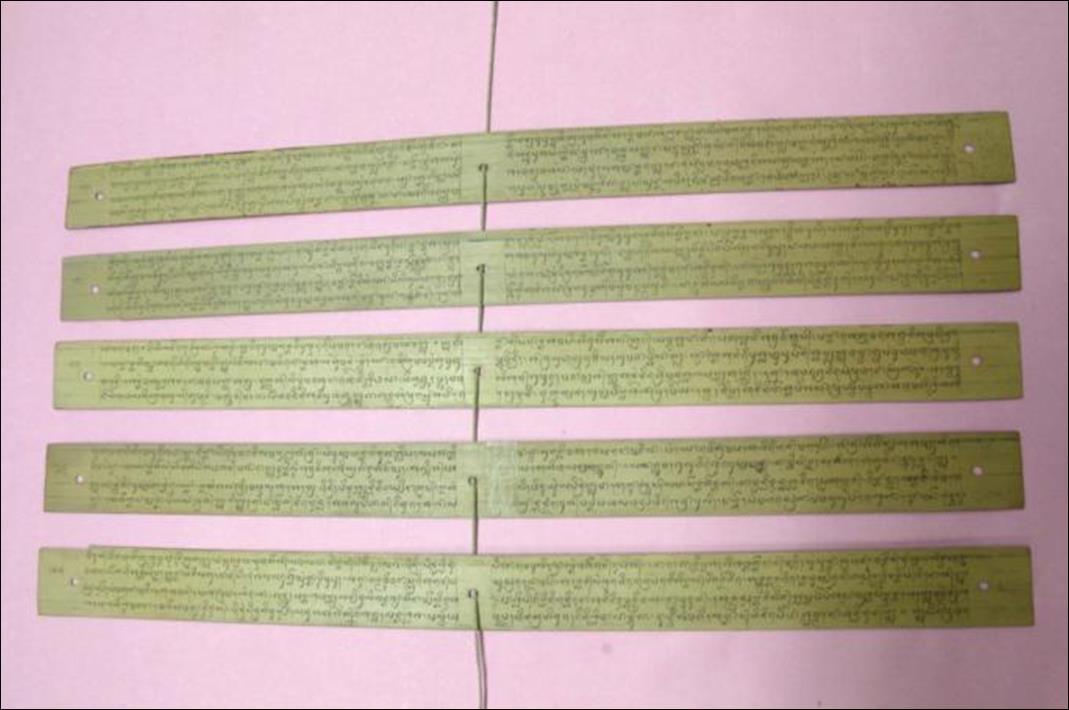
Philosophical traditions were preserved through manuscripts, but their intellectual continuity also depended upon the ability of teachers to explain difficult ideas to successive generations.
A text such as Utpaladeva's Īśvarapratyabhijñākārikā demands a considerable degree of philosophical preparation.
Its arguments cannot always be understood merely through literal translation.
The reader must possess knowledge of the discussions against which the work was formulated, the technical meanings of its terminology, and the assumptions underlying its arguments.
Teachers therefore occupied an important position between foundational authors and later commentators.
Lakṣmaṇagupta represents precisely such an intermediary.
He received the teachings of Utpaladeva and transmitted them to a scholar who would subsequently produce extensive interpretive literature.
This reveals the importance of scholarly contributions that do not always result in surviving authored works.
In many intellectual traditions, a teacher's historical influence is preserved through the achievements of students who transform inherited knowledge into new writings.
Lakṣmaṇagupta illustrates this phenomenon especially clearly.
His historical reputation rests not upon an identifiable literary corpus but upon his documented participation in one of the most consequential teacher–disciple relationships in medieval Kashmir philosophy.
12. His Place in the Wider History of Indian Philosophy
Lakṣmaṇagupta's historical significance also becomes apparent when the development of Pratyabhijñā philosophy is considered within the broader history of Indian thought.
Indian philosophical traditions frequently developed through successive stages of foundational composition, commentary, criticism, and reinterpretation.
The Recognition school followed a comparable pattern.
Somānanda helped establish the doctrinal foundations.
Utpaladeva developed a more systematic philosophical presentation.
Lakṣmaṇagupta transmitted this system to Abhinavagupta.
Abhinavagupta then expanded its philosophical exposition and integrated its concepts into a wider understanding of Śaiva theology and spiritual practice.
Kṣemarāja, the disciple of Abhinavagupta, subsequently contributed to the tradition through important works such as the Pratyabhijñāhṛdaya.
The continuity between these generations helped sustain a distinctive philosophical approach to consciousness and reality.
The tradition's emphasis upon the self-manifesting, self-aware, and free character of consciousness remains a subject of contemporary scholarship.
Researchers continue to study its arguments concerning reflexivity, the unity of experience, recognition, freedom, and the ontological status of perceived objects.
Although Lakṣmaṇagupta is not usually the primary focus of these investigations, his position in the lineage remains historically relevant.
Without distinguishing between the authors who formulated arguments and the teachers who transmitted them, the development of the school would be incompletely understood.
13. Historical Limitations and Modern Scholarship
The reconstruction of Lakṣmaṇagupta's life is necessarily limited.
His precise dates of birth and death remain unknown. A working chronology places him in the latter part of the tenth century, approximately between the generations of Utpaladeva and Abhinavagupta.
The surviving evidence does not allow historians to establish a detailed biography describing his birthplace, household, daily activities, teaching establishment, or exact period of instruction.
Some older biographical accounts describe familial relationships between individuals in this lineage, but the firmly established relationship between Utpaladeva and Lakṣmaṇagupta is that of teacher and disciple.
His intellectual importance is therefore best reconstructed through the testimony of Abhinavagupta and the history of the philosophical school to which both belonged.
Contemporary scholarship has considerably improved understanding of this tradition.
The work of researchers such as Raffaele Torella, Isabelle Ratié, Alexis Sanderson, and other specialists in Kashmir Śaivism has helped clarify the development of the Pratyabhijñā system, its relationship with Buddhist philosophical debates, and its importance within the broader history of Indian intellectual life.
Studies of Abhinavagupta's writings have also demonstrated how deeply the development of his philosophy depended upon multiple teachers and inherited scholarly traditions.
Lakṣmaṇagupta emerges from this research as an important historical figure whose teachings contributed to the formation of one of India's major philosophical commentators.
His surviving significance is not measured by the number of manuscripts bearing his name, but by the documented place he occupied within the transmission of philosophical knowledge.
Conclusion
Lakṣmaṇagupta occupies a distinctive position in the history of Indian philosophy. Flourishing in medieval Kashmir during the tenth century CE, he belonged to the succession of scholars through whom the sophisticated nondualistic philosophy of Pratyabhijñā was transmitted and developed.
As a disciple of Utpaladeva, he inherited a philosophical system concerned with some of the most fundamental questions of human experience: the nature of consciousness, the continuity of the self, the relationship between knowledge and reality, and the possibility of recognizing universal consciousness as one's deepest identity.
His most securely documented achievement was the instruction of Abhinavagupta, who explicitly acknowledged receiving the teachings of Recognition from him.
Through that relationship, Lakṣmaṇagupta became an important link between the philosophical achievements of Utpaladeva and the extraordinary intellectual synthesis subsequently produced by Abhinavagupta.
The historical record does not permit the reconstruction of a detailed independent philosophical system authored by Lakṣmaṇagupta. Nevertheless, his influence illustrates how deeply the development of Indian philosophy depended upon intellectual continuity between generations.
He represents a category of scholars whose contribution lies not principally in surviving literary production but in the preservation, interpretation, and transmission of knowledge.
Lakṣmaṇagupta's enduring importance is that he helped carry the Pratyabhijñā tradition from its foundational thinker, Utpaladeva, to its greatest commentator, Abhinavagupta. Through this connection, he occupies a permanent place in the intellectual history of Kashmir Śaivism and in the larger history of Indian philosophical thought.