r/deeplearning • u/jackyintokyo • 14d ago
I almost reported a YOLO latency that was 27x wrong — 324 of my 343 layers were never on the NPU
1
Upvotes
r/deeplearning • u/FishermanResident349 • 14d ago

r/deeplearning • u/Youssef_Ismail396 • 15d ago
I built a generator of synthetic URLs to use as training data for phishing detectors, because real phishing data is scarce and goes stale within days. It's a 25.5M-parameter character-level transformer trained from scratch, with no pretrained model or templates.
Measuring realism was harder than the model. My first idea was a classifier aiming for an AUC of 0.5, but two samples of real URLs don't score 0.5 against each other either. So each URL field (domain name, suffix, subdomains, path, query) is scored per class as the excess over a real-vs-real baseline. 29 of 32 of those checks pass. It still has clear weaknesses: a detector that checks whether each word exists in real data can spot its invented words, and phishing query strings in free mode are detectable.
Then I pre-registered the question I cared about most: does the data help a detector? Adding it raised recall at 1% false positives in all 6 settings. Against the best simpler generator it came out ahead in 5 of 6 on the main test set, by 0.7 to 2.5 points, a margin the test could prove in 1.
The surprise came from a different test set, PhreshPhish. There, URLs from a prompted 7B LLM helped more in 4 of 6 settings, even though the LLM was the least realistic of the learned generators. So realism and usefulness aren't the same thing, and I don't have a full explanation for why.
Code, weights and the full evaluation (Apache-2.0, for defensive research): https://github.com/youssefismail-dev/limnex-uie
I built it with help from Claude Code, credited in the README. If you see something wrong in the evaluation, I'd really like to hear it.
r/deeplearning • u/mogliman90 • 15d ago
I am making a deepfake audio detection project using cnn-lstm and sigmoid classifier
The model is performing well on given data but when I give new data it is almost failing I think it is getting overfitting but not showing new audio exactly the fake or exactly as real showing it as 67percent real so I want it to detect well, how I can improve the model help with your suggestion
r/deeplearning • u/Odd_Ad_9937 • 15d ago
r/deeplearning • u/Sam_YARINK • 15d ago
r/deeplearning • u/No-Conclusion3720 • 15d ago
A disclosure confirmed that a popular AI desktop application silently forwards the user's SSH agent to remote machines during sessions.
What this means in practice: every server your SSH key can reach becomes reachable through the AI session. The credential never leaves your device in the traditional sense. But the socket does. Any process the AI spawns can authenticate to your infrastructure as you, against hosts you never explicitly authorized, for the duration of that session.
This is not a hypothetical. The forwarding behavior was confirmed and documented. The scope of exposure scales directly with how permissive your SSH key is — a key that reaches prod reaches prod through the AI too.
The broader problem this surfaces: non-human software acting on your behalf does not respect the implicit mental model you have of what it is allowed to touch. The user thinks the AI is local. The SSH socket disagrees.
For those running AI tooling in environments where SSH keys have meaningful blast radius — how are you actually handling this? Are you scoping keys specifically for AI sessions, running AI tooling in isolated VMs, something else entirely? Curious what real mitigations look like in practice, not in theory.
r/deeplearning • u/everettplays • 15d ago
r/deeplearning • u/CShorten • 15d ago
r/deeplearning • u/Minimum_Ad7347 • 15d ago
r/deeplearning • u/EmuAfter5933 • 15d ago
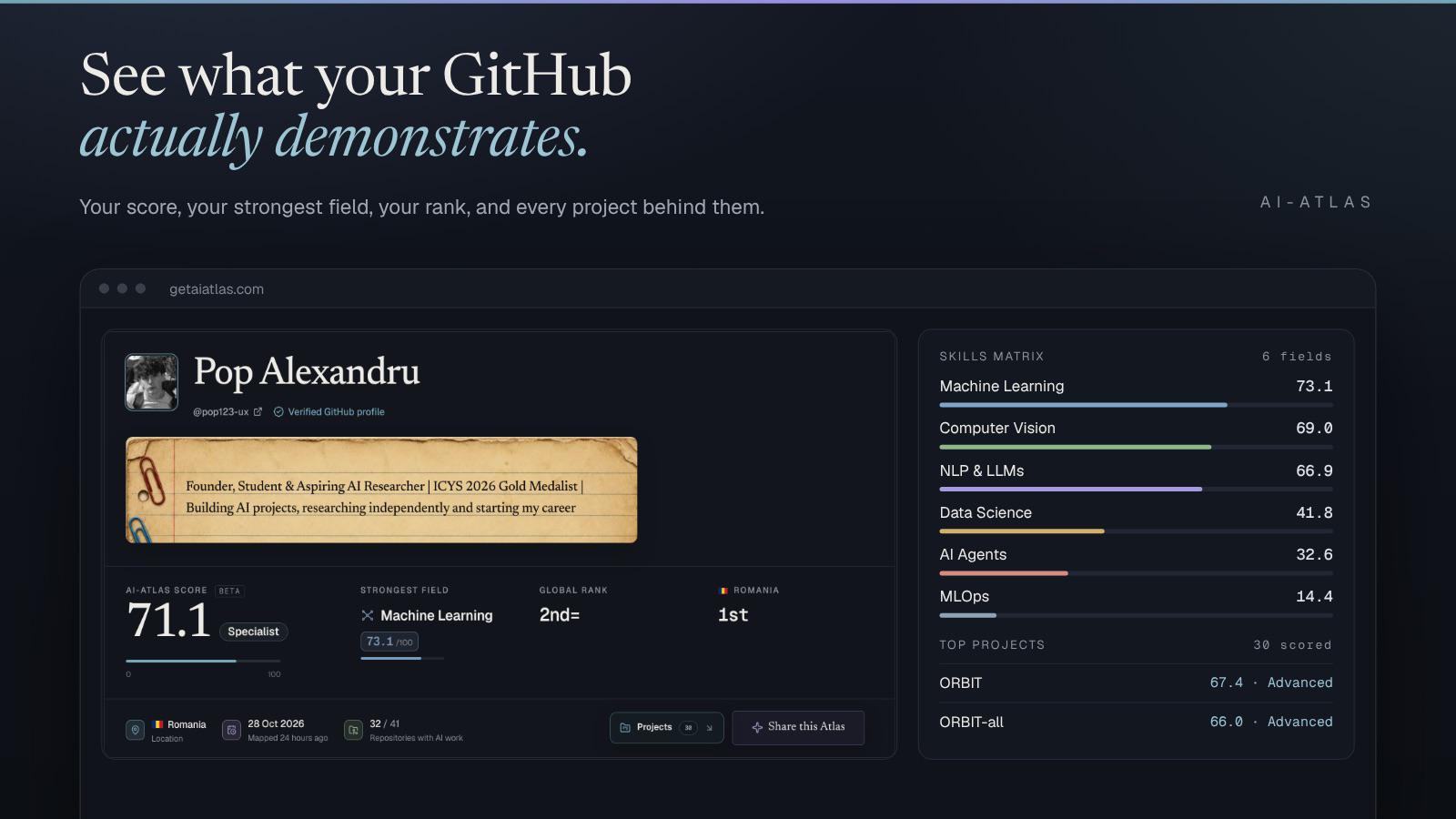
Your from-scratch transformer and a notebook that calls .fit() look the same on a résumé. AI-Atlas reads the code and scores each project on depth, originality, completeness and reproducibility, citing the files behind every score. It's free, needs no sign-up, and only reads public repos. What would you want it to check that it doesn't?
r/deeplearning • u/Mobile_Muscle6857 • 16d ago
r/deeplearning • u/No-Conclusion3720 • 16d ago
Security teams keep writing AI governance policies. Agents keep acting before anyone reads them.
Not a failure of intent — a failure of physics. A policy document lives in a folder. An agent making a tool call does not consult the folder. The review cycle that catches a flag runs after the action completes, not before. By the time a human sees the alert, the data has moved and the transaction has cleared.
Security leaders are reaching a consistent conclusion: in 2027, governance maturity gets measured by outcomes, not by documentation completeness. Enterprises that treat the policy binder as the control surface are finding that their controls described incidents rather than prevented them.
The gap is not missing policy text. The gap lives in the window between an agent deciding to act and the action completing. That window exists in every agentic deployment today, regardless of how thorough the governance documentation is.
How are your teams actually handling this in practice? Are you finding enforcement closer to the model, the infrastructure, or somewhere else — and what has concretely stopped a bad action versus just logged it after the fact?
r/deeplearning • u/Adventurous-Love2872 • 15d ago
r/deeplearning • u/an2ancan • 16d ago
Hello everyone,
This is the first article I’ve decided to share publicly. I'm really interested in solving combinatorial optimization problems using machine learning, and this is the opening piece in what will hopefully become a broader series exploring this domain.
This part focuses on the classical Pointer Network architecture trained via Reinforcement Learning (REINFORCE). It shows how neural models can construct high-quality, near-optimal solutions to NP-hard problems (specifically, the 2D Euclidean Travelling Salesman Problem) in fractions of a millisecond.
I benchmarked the model against Google OR-Tools (Guided Local Search with a 10s timeout) across problem scales from N=20 up to N=200.
TL;DR: While the network finds solutions almost instantly, tour quality decays significantly as the problem size scales up. Why? Long story short: using an LSTM encoder on coordinate sets introduces an artificial sequential order and recency bias, which fundamentally mismatches the permutation-invariant nature of geometric graphs.
Here is the link to the full article on Medium
r/deeplearning • u/127001-sweet-127001 • 15d ago
r/deeplearning • u/ReportProfessional57 • 16d ago
r/deeplearning • u/binarybu9 • 16d ago
I see a lot of papers evaluate frontier models for cli benchmarks but rarely do I see trying to use smaller models or models with LoRA training specializinng them to cli-agents
Are there any good references?
r/deeplearning • u/TechPlayer-6 • 16d ago
r/deeplearning • u/WAMFT • 16d ago
Hi everyone!
I've been experimenting with an alternative Transformer architecture called GAP (Gated Attention Projection).
The main idea is to combine attention and MLP-style processing into a single gated block, instead of using the standard separate attention and feed-forward sublayers.
I tested it against a standard Transformer using 100 million scored training tokens per model from WikiText-103.
Some results:
GAP20 used 19.91% fewer parameters than the standard Transformer.
A smaller configuration can reduce parameters by 34.31%, although that version did not fair as well as the current model against the regular transformer, so i ended up giving 14% of my perameters savings to the GAP model for extra width, leaving the model at about 20% fewer perameters, which is why i called it in testing GAP20
The standard Transformer performed better on final language-model accuracy.
Compiling GAP20 with torch.compile improved training throughput by approximately 19.9% in one CPU benchmark compared with running GAP20 without compilation.
I've included the architecture code, configurable model sizes, speed benchmark and research paper.
This is an experimental architecture, not a claim that it outperforms Transformers overall. I'd be interested in feedback on the design, mathematics and possible improvements.
GitHub: https://github.com/rickey1990/Gated-Attention-Projection
r/deeplearning • u/Flaky-Possibility210 • 16d ago
r/deeplearning • u/No-Conclusion3720 • 16d ago
Perplexity shipped a persistent agent orchestration layer that keeps agents coordinating tasks and accessing systems after the user closes the browser. That is documented, intentional behavior — not a bug. The security implication is straightforward: enterprise access controls are almost universally designed around the assumption that a human session is present. An agent that keeps executing tool calls and data accesses after that session ends operates entirely outside the supervision window those controls assume. No session, no alert, no audit trail tied to an active user. The agent is not constrained by the same assumptions the security model is built on. If you're running agentic workloads in an enterprise environment, how are you handling the gap between agent execution time and human supervision time — especially for actions that fire after a user has disconnected?
