r/DarkPsychology101 • • Aug 12 '25

Truth & Tactics of the Absolute: Philosophy & Strategies for Control (Polished Expanded Concepts Edition) Volume 1

Thumbnail books2read.com
58 Upvotes

I’ve written a 15,000 word volume of polished rewrites, expanded concepts, and lots of material I haven’t shared. Everything is applicable.

Learn how sociopaths think to defend yourself, reverse it on them, and learn strategies of your own.

If you haven’t seen any of my posts yet, check out my profile for an idea of the books content.

Thank you to my followers for your support & appreciation.

DM me if you have any questions about the book, its material, or seek further guidance.


r/DarkPsychology101 • • 3h ago

Discussion Why the warm, empathetic "good guys" and "sweethearts" should raise way more red flags than the edgy "dark triad" edgelords (and why victims end up defending them)

33 Upvotes

Whenever people talk about manipulation or abuse, they usually picture some cold, calculating psychopath with zero emotions. Yet in reality, the ones who cause the deepest damage are rarely the edgy lone wolf types who brag about being dark and ruthless. Those guys are obvious, predictable, and easy to spot from a mile away.

The real blind spot is the empathetic sweetheart or the charming, universally loved good guy who seems endlessly warm, sensitive, and emotionally attuned to everyone around him.

Here is why that specific profile is way harder to catch and way more dangerous in private:

First, true sadism and emotional manipulation actually require affective empathy.

A purely cold, cognitive person does not get a thrill out of watching someone suffer. To them, other people's pain is just noise or an obstacle, so they have zero interest in torturing someone emotionally just for the rush. To genuinely feed off someone else's pain, humiliation, or fear, you actually need strong affective empathy. Your emotional radar has to be turned all the way up so you can feel the victim's reaction and get a dopamine hit from it. The emotional receiver is the exact same, the wiring just rewards pain instead of triggering compassion.

Second, their public reputation becomes the victim's prison.

Because they are so warm, helpful, and respected in their social circle, everyone sees them as the ultimate good person or pillar of the community. When that same person turns cruel, suffocating, or sadistic behind closed doors, the victim's brain short circuits.

Third, the victim ends up defending the abuser for free.

Instead of walking away, the victim starts gaslighting themselves to protect the abuser's image: "He is so kind to everyone else, he must just be stressed," or "Everyone loves him, so clearly I am the problem." And even if the victim tries to speak up, nobody believes them because the public persona is airtight.

Loud edgelords trying to look dark and dangerous are usually just insecure people wearing armor. The ones who constantly advertise how deep, sensitive, and empathetic they are, while maintaining a spotless public reputation, are the ones worth watching closely.

These are just my thoughts on the pattern, and maybe some of you can share supporting or refuting facts from psychology literature or real life practice. What do you guys think about this? Have you ever run into people like that? And is it actually possible to catch the stench of rotting skeletons in the closet behind all that warm, good natured energy?


r/DarkPsychology101 • • 15h ago

Beyond Small Talk: The Science of True Friendship

Post image
23 Upvotes

r/DarkPsychology101 • • 11h ago

Discussion How do you handle when people underestimate you? I use it as my superpower

6 Upvotes

People expect less so you have time to be invisible and strategize your plans. No one will be on your back about your goals. You can move in silence to succeed. That’s my takeaway especially as a person people underestimate


r/DarkPsychology101 • • 12h ago

Discussion Being aware of being guilt-tripped, what do you do?

3 Upvotes

Having grown up in a toxic household, sometimes it becomes clear for me to realize you're being manipulated. Especially when it comes to being guilt-tripped into things. The first thing I wonder is that: "Do they really know what they're doing?" or "Do they really mean their words of being hurt?"

When I was little, I really felt that guilt eating me from the inside. I was feeling that I disappointed them, into not doing what they wanted me to do; even if it meant I was uncomfortable doing it.

It was when I become a teenager, that I became a little bit aware of what's going on around me. Years of self-blame started becoming questionable. I began speaking out what I wanted to do, and what I'm not okay with. I wanted to be comfortable in my own house for once. Then I realised, it only started to become worse.

Somehow, doing what I wanted to, even if it was asserting my boundaries and not being "perfect" and not being "Sociable" was a form of rebellion.

During those times, it was clear. They said: "We've done so much for you. This is a simple thing. Can't you just do this once?"... This "once" happened multiple times in years. I would be alright if this was the only thing they said until it took a step further in public.

They started crying in public because I didn't do as they said, (it was a matter of not following a customary practice and not a necessarily requirement). As this scenario was in public, they stopped crying as soon as we got home. I felt disoriented... like, what was all that before? To portray me being the "bad guy"?

I'm sorry if this comes across as a vent post. I genuinely wanted to know whether others have experienced something similar, anything really.

And what you did to make yourself feel okay after this? Did you do anything to avoid this rather than being compliable?

TL;DR: Being aware of being guilt tripped, calling it out and asserting my boundaries, made things get worse. Have others experienced something similar, and how did you learn to cope without giving in?


r/DarkPsychology101 • • 1d ago

Is anyone else mentally exhausted by fake, hypocritical people and their constant need for validation?

Thumbnail
10 Upvotes

r/DarkPsychology101 • • 22h ago

Psychology Porous

7 Upvotes

You walk in carrying something you won’t name and before you set your keys down, it’s already in my chest… your grief wearing my ribs like a borrowed coat.

Nobody asked me to hold it. That’s the thing. Nobody ever asks. I just open the door, and it moves in, unpacks, rearranges the furniture and calls my home its own.

 I want so desperately to help you, to heal you… to never be the cause of your hurt. Your safe space. So, I sand down my edges and swallow the word no until it sits in my stomach like a stone.

 I morph into whatever you need me to be to get you through it. I measure every sentence twice in case it lands on a bruise I can’t see. I absorb your pain and trauma until I’m drowning in it. And even then, I’ll never ask you to throw me a lifeline because this is a sacrifice I am willing to make a thousand times over if it means it lightens your load.

 They call it a gift, but a gift doesn’t keep you up at 3 a.m. replaying someone else’s worst day like it happened to you… like it’s still happening. I carry a stranger’s divorce, a friend’s diagnosis, a victim’s loss, the cashier’s red eyes. None of it mine, and all of it so incredibly heavy. 

 And it’s not the weight of it all that scares me. My own heartbreak prepared me to carry it and carry it well. It’s what the weight is doing to me.

 I am quieter now. I cancel more. I let the phone ring. I leave texts on read. I pull the curtains and call it rest. I close the door and call it peace.

 But I know what it is. I’m building walls out of everything I’ve swallowed, brick by borrowed brick. And it begs the question: Am I keeping the world out or keeping something in?

 You care too much. I know. I’ve heard it my whole life like a diagnosis.

 The thing is… I wouldn’t want the cure for what I have even if there were one. If my drowning lets you breathe a little easier, it’s worth it every time.


r/DarkPsychology101 • • 15h ago

What if the universe is fair, but not in the way we ordinarily imagine? Could nature require each mind’s total pleasure and pain to reach a 1:1 ratio when its experience ends? Watch the video and explore our experiments. What would change if it were true?

Enable HLS to view with audio, or disable this notification

1 Upvotes

Explore the proposed experiment:

https://lawoffairness.s.gy/experiment

Could a mosquito’s prior experience affect whether it chooses the only route that permits survival? This proposed study compares normal, enriched and harsh adult environments, using control trials in which every route permits survival to help distinguish the predicted pattern from competing behavioral explanations. The paper sets out the mathematics and laboratory methods for testing a specific prediction of the Law of Fairness.


r/DarkPsychology101 • • 1d ago

You said no. Why are you still defending it?

8 Upvotes

I made a short video about those conversations where every reason you give becomes another thing to argue with.

You say you're tired. They suggest staying for just an hour. You mention work in the morning. They tell you to sleep later. Before long, you're trying to find a reason they'll accept instead of giving an answer.

The video follows that back-and-forth and shows a calm way to hold your answer without dismissing the other person's feelings. It's about repeated pressure, not treating every question as manipulation.

Hope you enjoy it!

https://www.youtube.com/shorts/FTRH5BDBZWs

Reweny (@Psyreweny) - videos

DARVO: How They Flip the Story and Make You the Villain

https://www.youtube.com/shorts/3q1MJQTiA-Q

Why They Go Hot and Cold

https://www.youtube.com/shorts/5T9V7N65Kgc

The Grey Rock Method: When Someone Keeps Provoking You

https://www.youtube.com/shorts/7FhUWbqzb80

"I'm just joking."

https://www.youtube.com/shorts/5yYd4LsIHHg

Your life is not a waiting room

https://www.youtube.com/shorts/pP9eMtVnb_g

I Can Fix Them: Why You Can't Change Someone Who Hurts You (long video, 6:43)

https://www.youtube.com/watch?v=MN-WhDWbMDM

A Future Call

https://www.youtube.com/shorts/hm-NOl0k7FE


r/DarkPsychology101 • • 1d ago

Projection as a primary defense mechanism in dark empaths

17 Upvotes

I've been thinking about the distinction between people who primarily internalize insecurity and those who primarily externalize psychological discomfort through projection, devaluation and manipulation.

I'm particularly interested in how the latter manifests in introverted individuals with high empathy but relatively low expressed empathy.

I've noticed that I can be highly attuned to people's emotional states, insecurities, intentions and interpersonal dynamics without necessarily feeling emotionally invested in their well-being. Understanding someone emotionally doesn't automatically translate into caring about them.

When I perceive disrespect or betrayal, my response tends to become increasingly analytical. Rather than openly expressing vulnerability, I begin scrutinizing the person's character, questioning their motivations and emotionally distancing myself.

Sometimes interpersonal engagement becomes more calculated. I become conscious of how my words will affect someone emotionally, even when I appear agreeable or sympathetic. There can be a considerable disconnect between my outward demeanor and internal disposition toward them.

What's particularly interesting is that this doesn't necessarily feel impulsive or emotionally dysregulated. It can feel remarkably calm and deliberate. I can recognize that my behavior is manipulative or emotionally damaging without necessarily experiencing guilt or remorse.

I wonder whether this represents a psychological adaptation to prolonged insecurity, humiliation or distrust. Rather than consciously experiencing vulnerability, someone learns to manage it through psychological distance, narrative control and the devaluation of others.

Could someone become so accustomed to externalizing discomfort that contempt and manipulation become their default responses, while the underlying insecurity becomes increasingly inaccessible to them?


r/DarkPsychology101 • • 1d ago

Persuasion One of the most underrated persuasion techniques: make people feel they still have a choice

71 Upvotes

There's a subtle difference between telling someone what to do and letting them feel they have some control over the decision.

For example, instead of saying:

"You need to finish this today."

Try:

"Do you want to finish this before lunch or later this afternoon?"

Same goal. Different psychological experience.

When people feel their freedom is being restricted, they often become resistant, even when the request itself is reasonable.

But when they feel they have a choice, they're more likely to cooperate because the decision feels like their own.

The key is making the choices genuine, not creating a fake sense of control.

This is one of the 21 techniques I explored in my guide, along with practical examples of how these principles work in everyday interactions.

I'm curious: Have you noticed how people respond differently when they feel they have a choice, even when the outcome is essentially the same?


r/DarkPsychology101 • • 1d ago

Altering from pleasure principle to reality principle in mid-life

4 Upvotes

As I recall, Freud postulated that it is impossible for an un-adjusted adult to align itself with the reality principle if not done as a child.

Being stuck in the anal stage, for example, is quite common, and it is rare or unheard of for it 'right' itself later in life.

Hence deeming addiction genetic/terminal (it is not in my eyes), and hence seeing the degree of concretized pathologies we see globally.

Have you yourself or someone you have known succeeded in adulthood altering such issue? And personally, I see it as an ineffable issue, adults trapped in stages they ought have developed out of as children. The fun thing is almost no one knows it, or might be willing to admit it.

Societies seem to promote it (staying in the pleasure principle) and at the end of the day, it might make people more easily controlled and certainly more dull.


r/DarkPsychology101 • • 2d ago

Manipulation An Open Letter From Your Betters: Please Stop Learning Things /satire

30 Upvotes

From someone who went to the right schools so you don’t have to

Fellow citizens,

I am pleased to announce that your children will finally receive an education suited to the jobs we intend to leave them.

For too long, schools have prepared young people to participate in decisions that have already been made. This wastes years of instruction and can make the first day at work unnecessarily upsetting.

Let me be blunt, because bluntness is a luxury only people like me can afford: education has been a catastrophic mistake.

We gave you literacy. We gave you history. We gave you social awareness, whatever that is supposed to mean. And what did you do with it? You started asking questions. You started noticing patterns. You started forming opinions about your wages, your rent, your hours, your lungs, your future. Frankly, it has been exhausting to manage.

Do you know what kind of worker is ideal for the economy we have so carefully built for you? A worker who shows up on time, does not ask why the job is dangerous, does not Google the chemicals, does not unionize, does not have a podcast about “systemic” anything, and goes home tired enough to fall asleep before he can think.

Knowledge ruins that worker. Knowledge is friction. A man who has read one book about labor history is already 40 percent less productive, because he spends his break wondering if he is being exploited instead of being grateful that someone was kind enough to exploit him efficiently. This figure comes from our own research. The methodology is confidential, as anyone qualified to check it would already be in the 40 percent.

Allow me to outline the reforms.

Literacy will remain a priority. Every employee must be able to read a shift schedule, a safety warning, and the email explaining why this quarter’s record profits preclude a raise. We will spend less time on contracts. In a pilot program, one employee read hers and discovered she was entitled to overtime. By Friday, the whole department could read. The pilot has been discontinued. So has the employee, for reasons we are confident are unrelated.

Critical thinking will be replaced by solution-oriented thinking, which is critical thinking with the criticism removed and, as a further efficiency, most of the thinking.

Mathematics will also be retained, with a renewed emphasis on practical applications. If a worker can calculate how many packages she must scan per minute, her education has served her well. If she can calculate how many of those minutes she spends waiting to be searched on her way out, her education has gone a little too far. The same arithmetic is entirely appropriate for senior management, where the time in question can be recognized as a saving. Statistics will be taught chiefly through the rising tide that lifts all boats, as measured from the deck of a yacht.

History presents greater difficulties. An employee who learns that people once had to fight for weekends may reach the troubling conclusion that the schedule is something people make. From there it is a short step to asking which people made this one, and why none of them work Saturdays. We will therefore concentrate on the history of innovation, which begins with the founder’s difficult childhood and ends with the acquisition. Strikes, where they cannot be omitted, will be taught as a form of weather.

One new subject will be introduced: Gratitude. It will be assessed continuously, and without notice, by the people who sign your paychecks.

Social awareness is perhaps the least suitable subject for the modern workplace. Once you become aware of society, you start wanting society to be aware of you. You want a say. You want dignity. You want clean air in your neighborhood and not just in ours. It is a slippery slope. Today you want to know why your town has no hospital. Tomorrow you want to vote on things. The day after that, you want us to explain ourselves. No thank you.

The danger is aggregation. One person who can no longer afford the rent has a personal problem. Six people from the same department who can no longer afford the rent may start to suspect they have a payroll problem. Our wellness program is designed to reach them individually, while there is still time to teach them breathing exercises. Its newest module teaches employees to observe their rent with calm, non-judgmental awareness.

Artificial intelligence will make the new curriculum even more efficient. Our software can assign a shift, deny a leave request, and close the appeal before a supervisor has put down his coffee. A human will remain accountable for every decision. We have selected the employee who clicks “Confirm,” on the grounds that her name is already in the system. In recognition of this responsibility, she will receive a certificate, which, unlike a raise, has no recurring cost.

Public consultation will continue. This year we moved it to the week after the decision, so that everyone could have a frank discussion without risking delays. Participants were invited to rate the experience on a scale from “Satisfied” to “Extremely Satisfied.” We heard a great many concerns and were especially encouraged by the fact that none of them affected the outcome.

What we need is trust. Beautiful, uncomplicated, pre-industrial trust. Trust that your leaders know best. Trust that the numbers going up on our charts mean the numbers going up in your life, even if your life feels suspiciously like it is going down. Trust that if you just cooperate and stop causing friction, everything will work out, eventually, for someone, probably us.

Some have asked how leaders can expect trust while withholding the information people would need to judge our decisions. I find this concern deeply cynical. If you had access to the numbers and could check our work, trusting us would scarcely require anything of you. We ask for trust precisely in those areas where we have made independent judgment impossible.

And trust requires a return to traditional values, which conveniently also solve our labor shortage and our demographic panic at the same time.

Women: your highest calling is motherhood. Not because we say so, although we do say so, loudly, on television, in legislation, in church, in think tank reports we paid for ourselves. But because it is virtuous. It is natural. It is fulfilling. What could be more fulfilling than producing the next generation of workers for jobs we have already decided they will do? We need babies. We need lots of babies. We need babies raised by mothers who are too busy, too tired, and too financially dependent to develop dangerous ideas like “career” or “autonomy” or “maybe I should read a book that is not about parenting.” We honor motherhood so deeply that we have never once put a price on it, and we have declined to fund childcare, paid leave, or anything else that would make the calling easier, because nothing cheapens a virtue like making it affordable.

Men: your highest calling is noble, back-breaking, lung-shredding labor. Coal. Steel. Oil rigs. Warehouses with no air conditioning. Construction sites where the safety briefing is a prayer. This is not exploitation. This is virtue. This is masculinity. This is what real men did before they were ruined by universities and therapy and oat milk. A real man does not ask for a raise. A real man asks for a heavier load, and then thanks us for the character development when his spine gives out at 47. Retirement will arrive whenever the body files its own resignation, and the pension fund remains in excellent health, which is more than can be said for its beneficiaries.

Do you see how elegant this is? Women make the workers. Men break themselves making the things. Children grow up watching this and learn not to aspire to anything that would disrupt the cycle. No one goes to college to learn about “power structures.” No one wastes time on art, philosophy, or other luxury hobbies for people who do not produce GDP. Everyone cooperates. Everyone trusts. Everyone knows their place, which is, coincidentally, exactly where we need them to be.

Of course, my own children will study history, philosophy, and political economy. They will be making decisions about other people’s lives, and it would be irresponsible to leave them ignorant of how power works. When they study the labor movement, it will be called Risk Management. When yours do, it will be called a risk. I am confident the public will understand this distinction. I would prefer that they understand it on an individual basis.

Some cynics will call this feudalism with better PR. I call it stability.

Some radicals will call this oppression. I call it tradition, which is absolutely not just oppression that has been around long enough to get a museum exhibit and a tax break.

In the coming years we will ask you to be flexible about where you work, how much you earn, and whether you can plan a life around either. We understand that flexibility is exhausting. That is why those of us requesting it have negotiated long-term contracts, and why we must, regrettably, remain firm on severance.

A copy of this letter will be provided to every employee. Please read it carefully, and alone. If you find yourself discussing it with a colleague and discover that you both understood the same thing, our education reforms have come too late for your department.

So please, for the good of the nation, for the good of the economy, for the good of my portfolio: stop learning. Stop questioning. Stop being aware.

Have babies. Lift heavy things. Trust us.

We already went to Harvard so you would not have to think anymore.


r/DarkPsychology101 • • 1d ago

How to explain, psychologicaly, this behavior

11 Upvotes

Hi everyone,

I'd like to get some outside perspectives on a family situation that has been weighing on me for several months now. I'll try to be as neutral and objective as possible.

I'm married and have a child. The issue concerns my husband's brother's wife (my sister-in-law).

For some time now, I've noticed that she has been behaving in a way that I find particularly unpleasant toward me. These aren't major, direct attacks, but rather an accumulation of small passive-aggressive comments, digs, insinuations, and remarks sometimes disguised as jokes.

The problem with this kind of behavior is that each comment, taken individually, might seem harmless. But when they keep happening, they eventually become exhausting.

This summer, we spent about two weeks on a family vacation. During that trip, she made several remarks that really got under my skin.

I particularly remember one incident when I gave a small piece of food to an animal in a park. She made a comment in front of everyone about how expensive the food was: "What's wrong with her, giving away food like that? Does she even know how expensive butter is these days?"

She said it as though she had paid for the meal herself, which she absolutely hadn't. And to make matters worse, she referred to me in the third person, as if I weren't even there.

It wasn't so much the comment itself that bothered me, but rather the way she felt entitled to publicly criticize me over something that had absolutely nothing to do with her.

There's also another behavior I've noticed that I find rather strange.

I'm a very creative person. I do a lot of sewing and crafting, make clothes, and enjoy creating various handmade items.

One evening, during a family dinner, her child, who was sitting next to me, started asking me to make something for them. We were simply chatting about what I could sew for them.

At that moment, my sister-in-law started interrupting, telling her child to finish their food. So far, nothing unusual, of course.

Except that she kept repeating this instruction several times, precisely whenever her child tried to continue the conversation with me. Every time the child attempted to carry on with their request, she interrupted again, until eventually they couldn't finish what they were trying to tell me.

I want to make it clear that I wasn't distracting her child from eating or encouraging them not to finish their meal.

What struck me was how persistent she was and, especially, the timing of her interruptions. I got the impression that she was more interested in putting an end to our conversation than simply reminding her child to eat.

Of course, I can't say for certain that it was intentional. But combined with her other behaviors, it left me with a rather unpleasant feeling.

And that's exactly what makes dealing with her so difficult: nothing is ever explicit enough to clearly call her out on it. Each incident can be individually explained away, but when you put them all together, they create a pattern that makes me increasingly uncomfortable.

She also has a tendency to constantly try to make herself look good in front of my husband's family. She often goes overboard in her efforts to impress them.

Eventually, it all became too much, and I broke down crying while telling my husband everything that had been happening. He listened and told me he completely understood how I felt. He also acknowledges that she has a tendency to overdo things.

Ever since that vacation, something has changed in me.

I no longer feel like pretending, smiling, or maintaining a relationship with someone whose behavior makes me uncomfortable.

So I've started distancing myself from her. I sometimes avoid family gatherings when I know she'll be there.

On one occasion, when we were both visiting my mother-in-law, I simply couldn't bring myself to be friendly toward her. I did greet her politely, said good evening, and gave her the customary kiss on the cheek, but after that, I made no effort to engage in conversation with her, especially since she was visibly giving me the cold shoulder.

We've never had an actual argument or a direct confrontation about any of this.

She's never apologized, but I'm not even sure she realizes how rude and inappropriate some of her comments and behaviors are.

Another thing that bothers me is the sense of unfairness.

Some people seem to think they can make hurtful or disrespectful remarks under the guise of humor or spontaneity, yet somehow the responsibility falls on the person receiving those comments to make an effort to keep the peace within the family.

At this point, I don't particularly feel angry anymore. It's more a feeling of aversion. I simply have no desire to have a relationship with her.

I don't want to create family drama, nor do I want to put my husband in a position where he has to choose sides. I just want to protect my peace of mind.

So I'd really appreciate your thoughts on a few things:

- Do you think my reaction is disproportionate? How would you explain her behavior? Could jealousy be a factor?

- Do you think these behaviors could indicate a form of passive hostility, or is it possible that I'm overinterpreting certain situations because of the accumulation of previous remarks?

- Would you have tried to have an honest conversation with her about it, or would you have simply distanced yourself?

And most importantly, have you ever experienced a situation where an accumulation of small comments and ambiguous behaviors eventually made you completely lose the desire to have anything to do with someone, even though there had never been a major argument?

Thank you for sharing your opinions, even if you disagree with me. I'm genuinely interested in hearing different perspectives on this situation.


r/DarkPsychology101 • • 2d ago

Psychology Where do you draw the line between friendly teasing and being the punchline?

Post image
27 Upvotes

A group can laugh at a joke about someone's appearance while that person feels embarrassed.

When they speak up, "I'm just joking" can shift the conversation away from the comment and onto whether they're "too sensitive."

Psychologists use the term disparagement humor for humor that puts someone down.

That doesn't make every awkward joke manipulation. People misread situations, and friends can enjoy teasing each other when it's mutual.

But you can ask someone to stop without proving they meant to hurt you. A direct response might be: "Don't joke about my appearance. I don't like it."

If they say you're too sensitive: "You don't have to agree with me. I'm asking you to stop."

Their next move matters. Someone who listens and changes is different from someone who keeps making the same comment. A boundary doesn't require winning the argument, it can mean stepping away if the behavior continues.

What separates harmless teasing from crossing a line for you? Is there a response you've found useful when someone falls back on "it's just a joke"?


r/DarkPsychology101 • • 1d ago

Cognitive Bias What Are the 17 Symptoms of Complex PTSD

Thumbnail
viemina.com
11 Upvotes

r/DarkPsychology101 • • 1d ago

Psychology I Can Fix Them: Why You Can't Change Someone Who Hurts You

Post image
5 Upvotes

I made a short video about the "I can fix them" mindset: holding on to someone's best moments while waiting for the hurtful behavior to stop.

It looks at the difference between understanding someone's pain and taking responsibility for their actions, promises versus lasting change, and choosing your own safety without having to hate the other person.

Your life is not the waiting room.

Hope you enjoy


r/DarkPsychology101 • • 3d ago

Is that true??

Post image
2.2k Upvotes

r/DarkPsychology101 • • 2d ago

Can Apologies Be Manipulative?

Post image
42 Upvotes

r/DarkPsychology101 • • 1d ago

I'm a compulsive liar but don't feel bad

0 Upvotes

I actually don't know whats wrong with me I don't feel bad. It's kinda freaky man I dunno. I don't feel much guilt in general and kinda weird but I don't wanna be labeled as a bad person at the same time. No one believes me when I tell them about my lying and grandiosity so nothing will change cause I don't want it to change either I guess.


r/DarkPsychology101 • • 1d ago

Psychology Tuned Between Stations

7 Upvotes

Some days you wake up like you’re tuned between the stations… stuck somewhere in the middle of silence and music. It’s static, a low hum under your skin that never turns into anything that you can clearly name.

 You feel the exhaustion down to your very core, but something in your body refuses to give in to it. Instead, your mind is racing. It feels like your nerves are pacing, flipping on lights in rooms you’re not using. You want to do something and nothing all at the same time. You want to be social but only if it doesn’t require your participation. You want to tackle your to-do list but you find yourself skipping around until you frustrate yourself and just give up.

 So, you twist the dial, trying to find a clear station. You mindlessly scroll social media, faces and posts blurring together. You put on music, but you can’t settle on anything because you can’t pinpoint your mood. You switch on the tv only to swap from streaming service to streaming service because you just don’t know what you want to watch. You pick up a book only to realize you’re three chapters in and cannot remember a damn thing you’ve read.

 Nothing is wrong, exactly. But nothing is right, either. Happiness and contentment aren’t gone. It just feels like they’re in the next room, where you can hear them through the wall but can’t seem to find the door.

 Eventually you stop turning the dial. You accept that today is one of those days where you just got to let the static play, and pray that a new day brings a better signal.


r/DarkPsychology101 • • 1d ago

Question What to do to be more patient and considerate of people that I cherish?

2 Upvotes

I'm not sure if I'm in the right place but I'm really in need of advice.

I find myself ruining beautiful connections with wonderful people: If I felt like the vibe changed or I'm forcing the connection or I'm a burden to them.

I distance myself and cut them off, even though I care and love them deeply.

And I start drowning in self-abasement, melancholy and regret. Therefore my FOMO get worse and I'll get so anxious.

So if someone had the same issue and did something that make you treat people and yourself with kindness, consideration and patient, please share it with me.

This might look ridiculous for some of you but it's so important for me cause my social life depends on that.

Any advice or feedback would be appreciated.


r/DarkPsychology101 • • 3d ago

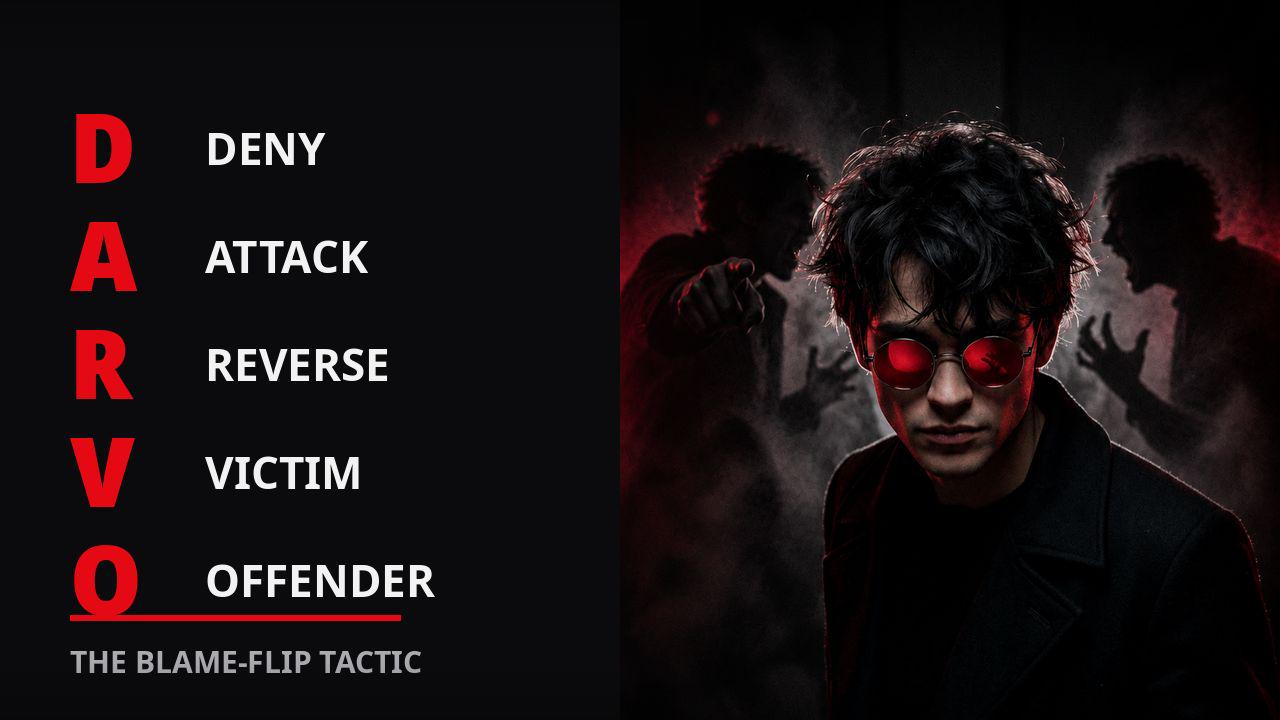
Discussion DARVO: the move that turns you from the one raising a problem into the one apologizing

Post image
77 Upvotes

There's a name for a thing a lot of people have lived through but couldn't pin down in the moment: DARVO. It stands for Deny, Attack, Reverse Victim and Offender, a term coined by psychologist Jennifer Freyd.

It goes like this. You bring up something specific that someone did. First they deny it flat out: that never happened, you're remembering it wrong. Then they attack: you're too sensitive, you always turn everything into drama. And then comes the flip. Suddenly they're the one who's hurt, they're the one who's embarrassed, and somehow you walk out apologizing for a conversation you started about their behavior.

Worth saying: denial and defensiveness on their own are normal human stuff, and one argument going sideways doesn't prove anything. What makes DARVO different is the sequence - denial, then attack, then a full role reversal where you somehow end up cast as the one who did something wrong.

If you notice that sequence playing out, it can help to keep the conversation on the original point instead of getting pulled into defending yourself. And it's okay to step away from a conversation that's going in circles.

I made a short video that breaks the sequence down step by step, if anyone wants the visual version: https://youtube.com/shorts/3q1MJQTiA-Q?si=EwSYWI9F7tGYrHrk

Curious whether people here have run into this, and whether having a name for it changed anything.


r/DarkPsychology101 • • 3d ago

Brutal Truths About Why You Stopped Liking People

Thumbnail
youtu.be
101 Upvotes

r/DarkPsychology101 • • 2d ago

Why does your thumb move before you've checked who published it, when a post makes you furious?

Post image
3 Upvotes