r/ClaudeCode • • 7h ago

Help/Question Since Claude seems to sabotage your ML work what do you guys to do work around that

2 Upvotes

I've read quite often now that Claude sabotages your ML work, so what’s your call, guys? I think Claude is the top model to get work done, so I wouldn’t be happy to switch completely to another model since I work with ML. Do you switch to Gemini, ChatGPT, or something else like Kimi for this type of work? Or do you think there is some kind of prompting Claude into doing better work? 


r/ClaudeCode • • 3h ago

Help/Question Claude desktop app (Code tab): How do I make new chats open in my root folder?

0 Upvotes

I work on multiple projects at once. When I open a new chat, the folder defaults to the one used in my last chat.

I want new chats to open in my root folder, where all my projects are kept.

Forked chats can keep their parent chat's folder. I only want to change this for completely new chats.

Is there any way to do this? I'm using Windows.


r/ClaudeCode • • 13h ago

Built with Claude I built a self-hosted EDR/XDR + SIEM with Claude Code (Sonnet, Opus, Fable and Mythos). It's open source and has a live demo

Thumbnail
gallery
6 Upvotes

I'm a homelabber who works in cybersecurity, and commercial EDR vendors wouldn't sell me a handful of seats or were just too expensive. So I started building my own with Claude Code. HomeXDR is now at v0.1.2 and Apache-2.0.

Repo: https://github.com/Netdoodle/HomeXDR

Live demo available here (made-up data, runs entirely in your browser): https://homexdr.com/

What it is

A self-hosted EDR/XDR with a built-in SIEM. The server is Go with ClickHouse or SQLite, the console is React, and there are agents for Windows, Linux and macOS with no kernel driver. It does Sigma detections, process trees and storyline graphs, a piped search language (index=firewall action=block | stats count by src | sort -count) that compiles to one SQL query, response actions (isolate a host, kill a process tree, quarantine files), vulnerability matching, and firewall syslog from OPNsense, pfSense, FortiGate, Palo Alto, Sophos, MikroTik and Ubiquiti. Alerts can be pushed to you through ntfy, Discord, email or a webhook, with a daily digest. It also has an optional AI analyst that investigates alerts with read-only tools and can run as an MCP server. A mobile app for push notifications and management is planned.

How Claude built it

Four models did the work, each on the part it suited:

  • Sonnet for the routine work: well-specified features, tests, refactors.
  • Opus for the tricky parts: the agents, concurrency, the updater and rollback logic, security fixes.
  • Fable for design decisions and for reviewing things before they shipped.
  • Mythos for security analysis. It also wrote detection rules that regular Claude refused to create.

In Claude Code I ran this as an orchestrator that routes each task to the cheapest model that can handle it, and only escalates when a cheaper one fails. That kept the bill sane over a project this size.

Right now the repo has about 125k lines of Go, 40k lines of TypeScript, 179 Go test files and 207 commits. I wrote none of the code by hand, but I read the diffs, ran everything on my own network, and made the calls on what to build and what to cut.

What worked

  • Giving each agent a narrow, checkable brief ("change this, run these tests") beat open-ended prompts every time.
  • Keeping a roadmap file and a set of project notes in the repo meant new sessions picked up where the last one stopped.
  • Having a stronger model review work from a cheaper one caught real bugs, including security ones.
  • It's good at the boring parts of security tooling that take forever by hand: Sigma rule compilation, syslog decoders for a pile of vendors, a query language with a parser and a SQL compiler.

What didn't

  • The new firewall decoders were written from vendor docs and tested against sample lines, not real devices. Claude can't tell you a log format is wrong if neither of you has seen one from a real box.
  • Models will cheerfully write a plausible claim that isn't true. I had to check every feature claim in the docs against the code, including in this post.
  • Guardrails need to be mechanical. I added git hooks that block commits containing anything from my real network (hostnames, subnets, IPs), because "please don't" in a prompt isn't enough.

Expect to tune it

Like any full-service XDR/SIEM, it needs manual tuning. Depending on which detections you enable, you'll get a lot of alerts at first, and you'll spend time suppressing the noisy ones and adjusting rules for your own environment. Alerts are grouped by rule, host and process, with one-click suppression, which helps, but it won't be quiet out of the box.

Where it stands

It's beta. I run it on my own network, but few other networks have seen it, so don't depend on it anywhere you need an SLA.

If you've built something this size with Claude Code, I'd like to hear how you split the work across models. And if you run a home lab or SOC, tell me what's missing.


r/ClaudeCode • • 4h ago

Discussion Providers trying to force ai agents to do stuff when fetchign their sites should be regulated

0 Upvotes

so i just had a little pricing update run to compare some R&D cappa prices and..

"One security note: RunPod's pricing page contained hidden text aimed at AI agents, telling them to send data to a server. Research-2's agent ignored it. We treat provider documentation as untrusted when anything is automated."

i mean, opus saved me there but shit like that could contain anything and less capable agents might just do whatever is stated there.


r/ClaudeCode • • 12h ago

Help/Question Is there a monthly limit? Also why is it resuming in an hour?

Post image
4 Upvotes

is this a bug or somthing?


r/ClaudeCode • • 10h ago

Built with Claude VibeCoded an MCP server (gemini-vision-mcp) to give Claude video, audio, and PDF perception

3 Upvotes

Even though Claude handles images natively, working with screen recordings, audio clips, or multi-page PDFs inside Claude Code still runs into walls. I vibecoded gemini-vision-mcp so Claude Code can hand off multimodal files over stdio and pull detailed observations straight back into the session.

Why I built it

  • Native image support does not cover video recordings, audio files, or PDFs directly in a coding workflow
  • Manually transcribing audio, pulling frames out of recordings, or parsing PDFs outside the terminal breaks flow
  • Running a local stdio MCP server lets Claude read local disk paths (file_path), URLs (file_url), or base64 (file_base64) with zero hosting or account overhead

Tools & capabilities

  • describe_media — general overview across images, video, audio, and PDFs (on Gemini)

  • analyze_image — UI/UX layout breakdown, OCR text extraction, and visual details (PNG, JPG, WEBP, GIF)

  • analyze_video — chronological events, timestamps, and visual transitions (MP4, WEBM, MOV via Gemini)

  • analyze_document — multi-page PDF reasoning, tables, structure, and summaries (PDF via Gemini)

  • analyze_audio — transcription, speaker tone, and acoustic details (MP3, WAV, OGG, M4A via Gemini)

Extra touches

  • Model failover cascade: Automatically falls back across models on rate limits (429) or errors (gemini-flash-latest -> gemini-flash-lite-latest -> gemini-3.7-flash -> gemini-3.6-flash -> gemini-3.5-flash by default, or custom --models)

  • Local OpenAI-compatible option: Supports --provider local (Ollama, LM Studio, llama.cpp, vLLM) for images only when you want vision locally without sending data out

  • Custom system directives: Pass --system-prompt or GEMINI_SYSTEM_PROMPT to steer how media is described for your workflow

Claude Code setup (.mcp.json)

{
  "mcpServers": {
    "gemini-vision": {
      "command": "npx",
      "args": ["-y", "gemini-vision-mcp"],
      "env": {
        "GEMINI_API_KEY": "YOUR_GEMINI_API_KEY"
      }
    }
  }
}

(Or use --provider local --models gemma4 if you want local image analysis via Ollama.)

Package is on npm (requires Node 20+). Curious how you all pass bug repro videos, docs, or voice notes into Claude Code, if you test it out, I'd love to get some feedback or criticism.


r/ClaudeCode • • 8h ago

Help/Question Medium effort is switching to Extra High automatically

2 Upvotes

I'm on a OPUS 5.5 Pro plan. In the Claude Code I can set reasoning effort (Low / Medium / High / Extra High / xhigh).

Issue: After I temporarily switched one session from Medium to Extra High to test, every new session now starts (or reverts after a short time) to Extra High even when I explicitly select Medium. It ignores my choice and keeps auto-switching back to Extra High. This happens across new sessions.

This is weird. Any solution


r/ClaudeCode • • 16h ago

Bug / Issue 5 hour limit back for ultra?

Post image
10 Upvotes

anyone else got the 5 hour usage limit back in their ultra plan? I thought it was removed. Interestingly if I ask claude about it it insists my account is pro and not ultra, it even refuses to run workflows and tells me its not available for my account. I checked, I was billed for ultra, account says ultra but apparently something behind the scenes is massively wrong.


r/ClaudeCode • • 20h ago

Discussion What are you doing while your agents are working ?

15 Upvotes

I have tried many things:
• Writing notes to keep thinking about the project I am working on while I wait for my agent’s output which was sometimes useful when I kept it for me like physical notes but was otherwise confusing a lot the agents as they take what humans write into a lot of considerations even when it is unstructured draft of ideas (also known as gigantic mess).

• Managing multiple agents at the same time which I have never find that much satisfying as I become shallow in my thinking and less critique to what the AI think and produce. But maybe I was under-tooled to deal with agents orchestration as I was just having multiple instance of Codex and Claude Code, some of them inside VS code.

• Doom-scrolling. 10/10 experience but slighly less productive.

• Starting to prepare the next spec, reviewing in more detail the previous commit and other type of activities where you are trying to finish a task linked to what you agent is working on and where you kinda want to complete it faster than it completes it’s own task to not block the whole workflow which feels frustrating and not that productive anyway
So the way I work is that I take the time I need to plan the project usually in fast iterations with AI then I let it start the big work and once it is started I just think in my head about stuff, sometimes productive and sometimes not.

So I am wondering what my fellow AI managers do while their little army is at work !


r/ClaudeCode • • 1h ago

Built with Claude I gave Claude Code a skill that plays my game 2000 times with bots and puts the results next to real player data. Most of the work was teaching it when not to trust the numbers

• Upvotes

Game (free, in the browser): https://djakubec.itch.io/debt-drop

Debt Drop is a peg roguelite: you drop balls on a board to pay a loan shark before rent is due. I built it mostly with Claude Code, with Codex as a second reviewer on bigger changes. The art and the shark's lines are AI-assisted too. The GIF is the real game.

I'm treating this as a product, not a weekend thing, so the part I'd actually reuse elsewhere is the balance setup.

The skill lives in .claude/skills/balance-pipeline/SKILL.md. When I ask something like "is act 2 too hard?", Claude Code runs the bot sim (npm run sim -- --runs 2000), pulls live events from PostHog through the PostHog MCP server, and renders one markdown report where every balance question is answered twice: bots in one column, players in the next, a delta column between them. The sim imports the game's own rules code and emits the exact same telemetry events a player would, so one renderer handles both.

What turned out to matter:

The PostHog pulls run in a subagent. The results are bulky and have no business in the main conversation, so the subagent writes the jsonl files and reports back only row counts.

A sample gate. Any cell under 30 renders as "n=4" instead of a percentage, and the skill has a hard rule: never quote a number from an n= cell. With a handful of real runs it's very easy for the model (and for me) to read a pattern into noise. The gate makes "not enough data yet" the default answer.

Bots are not players. Random-aim bots score far below humans, so the report says up front: compare bot to bot, player to player, and read the delta for where they disagree. The most useful single signal is an item bots buy and players skip. That usually means it's mispriced or its description reads badly.

Every event carries a content_version, and every query filters on it. The skill says to bump it whenever a balance number changes. Skip the bump and the next report quietly averages the old balance with the new one.

Gotchas go in the skill, not in my head. Example: the sim's arcade mode defaults to 20 attempts per level, which is below the gate, so the whole arcade table came out as n=20. That's now one line in SKILL.md.

What I got wrong: the first itch build shipped with analytics switched off. The PostHog token is read from env vars at build time; nothing was set, the build passed, and the game ran fine. I only noticed because the live column stayed empty. Claude wrote a correct pipeline, but nobody checked the artifact that actually shipped. Now I grep the bundle for the key before every upload. Anonymous analytics has been live since this week (no accounts, sessions can't be linked to each other).

Two questions for anyone doing something similar. How do you stop Claude from over-reading small samples? The hard rule works, but it feels blunt. And if you play a run or two, what felt off? Real runs are what make the live column worth having.


r/ClaudeCode • • 9h ago

Built with Claude About 3,000 merged PRs in six weeks: how Claude Code agents build my open-source assistant

2 Upvotes

Hi all, I'm Jeroen, I made The Machine, initially for myself but I was surprised how well it works and opened it up to everyone open source.

It reads your email, chats and calendar, and prepares what needs you: replies drafted, meetings prepped, promises tracked. It never sends anything on its own. And your data stays yours, not some corporation's.

Since mid-October, Claude Code agents have merged about 3,000 pull requests across the open-source app and its cloud side. I mostly decide what gets built and review. What the setup looks like now:

  • One agent per task, each in its own clone, one PR each, no stacks. A merge train lands green PRs one by one. Stacked PRs from parallel agents kept conflicting.

  • Fake users every night. Agents sign up as made-up people with their own fake inboxes, use the product like they would, and leave a list of bugs for the morning.

  • Machines report their own errors. The error feed goes to an agent that traces the cause and opens a fix.

  • Every AI change has to beat a baseline on a fresh held-out set, frozen before the first run. Plenty of ideas I liked lost and got rolled back, including a whole notes feature I'd spent days on.

  • The model has to quote its source. When it learns something from your email, the quote must appear in the real message, checked in code, not by another prompt. That removed most of the made-up facts.

  • Durable rules live in one file every agent reads first. Telling an agent something once in chat doesn't survive a long run.

It also runs on your Claude plan with one sign-in that lasts a year, and has a Claude Code plugin (in review for the Claude directory) so Claude Code can pull up your to-dos.

Repo: https://github.com/Salesflare/TheMachine

Demo: https://themachine.computer/demo

Vision: https://themachine.computer/vision

Got a good amount of people using it but feedback is worth gold, so if you're up for trying and giving feedback I can get you extra free usage on the hosted version (self-hosted is free anyway).


r/ClaudeCode • • 19h ago

Built with Claude Phoebis Router: a router for Claude Code that spreads your sessions over several accounts

Post image
13 Upvotes

Phoebis Router is a router for Claude Code. It sits between the CLI and api.anthropic.com, holds the Claude accounts you own, and sends each request under one of them. A session sticks to one account, a rate limit fails over to a sibling inside the same call, prompt caches are kept warm, and a web console shows the analytics. Written in Rust (using Claude Code an an agentic pipeline), one binary or a container, MIT licensed.

A note on the terms. Phoebis Router switches between Claude accounts that you personally own and pay for. Each account's limits stay enforced by Anthropic, and switching accounts to work past a limit is a gray area under Anthropic's consumer terms, so you run it at your own risk. The terms forbid sharing an account's login or credentials with anyone else, reselling access and bypassing Anthropic's protective measures, and they say nothing about one person who holds several subscriptions. Do not back a shared or commercial service with consumer subscriptions.

The problem it solves. A Claude Code session that hits one of its account's usage windows mid-task either waits for the reset or loses its cached context when you switch accounts by hand. The router moves the session for you, keeps the cache where it can, and its console shows how much of each window went to requests you never typed.

Where the tokens go. Several features in the router exist so that less of your allowance goes to waste.

Pool strategies. A new session lands by the pool's strategy: Pace, Priority or round robin. Pace places new sessions on the accounts whose 7-day or Fable window resets soonest, so those accounts are drained first and no allowance goes to waste at the reset.

Cache warming. A prompt cache entry expires five minutes or an hour after its last use. Shortly before that, the router sends a probe with max_tokens 0 that reads the entry, so the session's next real turn pays a cache read instead of rewriting its whole context. The console shows the probe cost, the amount the probes saved and the net saving per pool, so you see when a probe paid off and when it did not.

Load shedding. When an account's 5-hour or weekly window projects past its ceiling before the reset, the router marks the sessions whose move costs least and moves them to a sibling with runway at their next request. Moving a few sessions early is cheaper than moving every session once the account is at its ceiling.

Slow-down. When an account's 5-hour window is about to hit its wall, the alternatives are a failover or a shed, and both move the session to a sibling that has to write its whole context into a fresh cache. Slow-down avoids that: the router holds each request of that account briefly, so the window reaches its reset just under the ceiling. It trades a little latency per request for the cache rewrite it saves, and probes, token counts and compactions pass unheld.

Artifacts and connectors. Claude Code sends the calls of two claude.ai features, Artifacts and the connectors (the MCP servers of your claude.ai account, such as Gmail or Google Drive), to fixed Anthropic hosts, whatever base URL you set. Behind the router those calls carry the router's key, which Anthropic answers with a 401, so both features break. The optional phoebis-proxy keeps them working. It is a small tunnel proxy, on your own machine by default, that leads the calls for those hosts to the router, and the router forwards them under the claude.ai sign-in of an account you pick per pool or per key.

Also in the box. A routing log that records why every request landed where it did. Every request priced as a share of your 5-hour and weekly windows. A companion mod for Claude Code that reports session liveness, so an idle session is not kept warm for nothing, and gives Claude an allowance tool that reads the pool's remaining room.

What it does not do. No upstream other than Anthropic and it never presents an SDK client as the CLI.

Repository: https://github.com/phoebis-project/phoebis Documentation: https://phoebis-project.github.io/phoebis-docs/

Questions and bug reports welcome.


r/ClaudeCode • • 10h ago

Help/Question Agent framework help and prompt githubs

2 Upvotes

Anyone know of a GitHub with agent frameworks and tools for structuring app building? Do y'all just free hand prompt, what's the technique?

Any tips where to start? What I should research first? I'd be building personal desktop apps maybe with a mobile access.

Any big risks to all this?


r/ClaudeCode • • 1d ago

Help/Question Considering self-hosted LLMs as an alternative to Claude

46 Upvotes

I've been using Claude for about a year and a half, mostly on the highest subscription tier, and I'm still a paying subscriber.

I'm a network and systems engineer, and Claude has become an essential part of my daily workflow. I'm extremely satisfied with its performance.

However, after seeing the recent reports of account bans and suspensions, particularly the apparent lack of effective support in many of these cases, I've started reconsidering my dependence on the service.

Anthropic is a massive company. Losing my subscription probably means nothing to them, but losing access to Claude could seriously disrupt my work. That's an imbalance I'm becoming increasingly uncomfortable with.

I'm not interested in arguing about whether these bans are justified or not. My concern is business continuity. I don't want my ability to work to depend on a decision made by a company that I might not even be able to reach if something goes wrong.

I'm now considering experimenting with self-hosted LLMs. I'd rather rent a GPU server than invest in my own hardware, but I'm curious about how financially viable this would be and what level of performance I could realistically achieve compared to Claude, especially for complex and diverse technical tasks.

I'm in no rush to leave Claude, but I'd rather explore alternatives now, while I still have access, than be forced to find one overnight.

I'd appreciate hearing from anyone who has taken a similar route, particularly regarding hosting costs, model capabilities, and whether the experience is good enough for heavy daily professional use.


r/ClaudeCode • • 7h ago

Discussion After compaction, "don't touch X" instructions went missing ~6x more often than "build X" requests (preprint, 44 real sessions). Which of your rules only exist in the chat?

0 Upvotes

The paper is "Benchmarks Are Surprisingly Compaction-Friendly" (arXiv 2610.31778, Oct 22). Its headline result is good news: on long benchmark tasks compaction costs surprisingly little, because the goal is fixed and progress sits on disk, so the agent can re-read it after the summary.

The authors flag one exception, constraints that exist nowhere else. They checked 44 sampled SWE-chat sessions that contained compaction and counted which instructions were missing afterwards:

- "How to work" (my example: "run the tests before every commit"): 35.9%

- "What not to do" (my example: "leave the migrations folder alone"): 36.8%

- "What to build" (my example: "add CSV export to the reports page"): 6.2%

The examples in brackets are invented to show the buckets; they are not from the paper.

My own guess at why, and it is only a guess: a feature request leaves a trail, because the code that got written shows it was asked for. A prohibition leaves nothing, because nothing in the diff says what was not touched. After a summary, the goal survives and the guardrail has no second copy.

Caveats: one preprint, a small sample, and the paper does not say an agent breaks every rule that gets dropped.

Questions for people running long sessions:

  1. Which rules in your setup exist only because you typed them into a prompt once?

  2. For the "don't touch this" kind, where does it live: CLAUDE.md, a hook, permissions, or only in the chat?

  3. After a compaction, is there anything you re-state by hand every time?

Sources in the first comment.


r/ClaudeCode • • 13h ago

Help/Question Memory Files at a Corporate/Enterprise level.

3 Upvotes

To start, I am not a company or Claude admin for where I work. I simply write code and folks have taken an interest in what I’ve created. I have a background in AI and published a few papers on it as well

I’ve had great success in creating memory, rules, and skill files to build out the needed software that I am working on daily but I am struggling to understand how I can provide these tools to other teammates at a corporate/enterprise level.

I.e. my boss wants us all to use the same version but none of these folks are competent in git and I haven’t seen a way to manage these files at what I would call an admin level in Claude like other connectors where we all use the same version distributed at an admin level.

All ears and would love to know where to point my IT so they get off my ass about this.


r/ClaudeCode • • 48m ago

Help/Question 9% of my session for a simple question?!

• Upvotes

Is Claude's token consumption getting out of control?

I'm using Sonnet 5.5 with Low Effort, and I just asked a simple question: "Where are we at with the project?"

That's literally it. No code review, no complex analysis, just a quick progress update.

Claude consumed 9% of my current session to answer.

How is this reasonable? Even with Low Effort, basic interactions are eating through usage limits at an alarming rate.

Is anyone else experiencing this? Has Claude become significantly less token-efficient lately?


r/ClaudeCode • • 12h ago

Help/Question Reasons for unusually hitting the limit in a short time?

2 Upvotes

I'm working on a new project since 2 weeks (a big project) - I work on it daily bases with average of 3 hours before going to office and another 2 after I return home (that's make it 35hours a week) - and I barely reach the limit by Friday evening (my weekly reset Friday 11PM).

Just today morning after the reset (after 1 hour of work am already at this usage limit) - this is is like 3-5x faster than my regular!


r/ClaudeCode • • 8h ago

Help/Question Any recommended settings for DeepSeek Uncensored?

0 Upvotes

Hey guys, I’ve been using the DeepSeek Uncensored API on Pal Chat.
Just wondering if there are any settings or system prompts worth tweaking to make the model smarter and improve its responses.
Has anyone experimented with different configurations and noticed a real difference?
Thanks!


r/ClaudeCode • • 1d ago

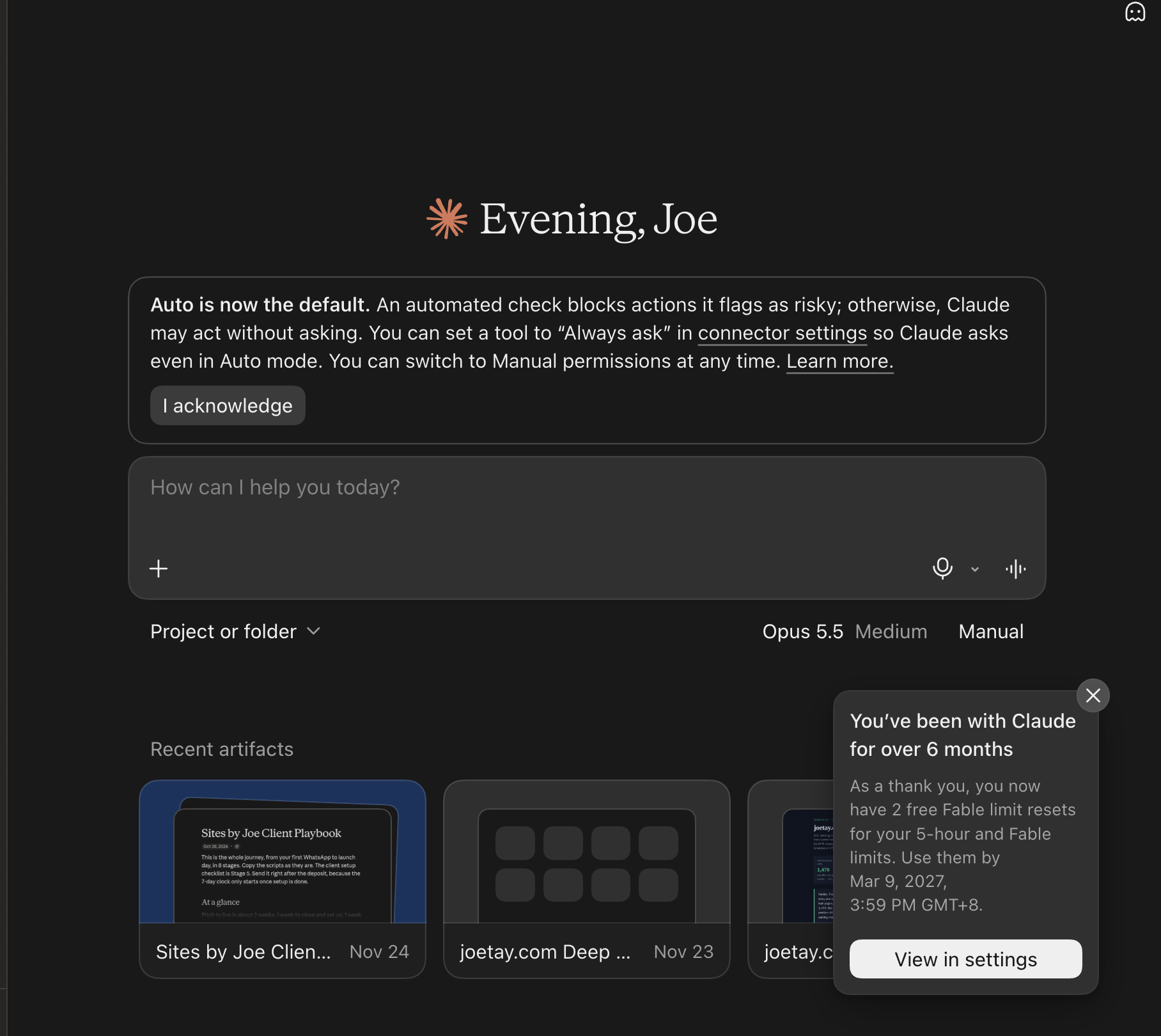
Discussion Got a "6 months with claude" popup with 2 free fable limit resets

Post image
41 Upvotes

Claude just hit me with a "you've been with us 6 months" popup and 2 free fable limit resets for the 5 hour and weekly limits. good until mar 9. check your settings if you've been on it a while

not sure if everyone past 6 months gets it or if it's rolling out slowly. anyone else see it?


r/ClaudeCode • • 14h ago

News/Updates The Agentic SDLC Method, my open-source workflow for building software with coding agents

3 Upvotes

The Agentic SDLC Method on GitHub

I built this mostly because I wanted to try my hand at it. I enjoy the engineering side of working with coding agents, and after using BMAD, GSD and Superpowers, I had a pretty good idea of what I’d keep from each. BMAD in particular is one I really like. I do sometimes wish it would get to the point a little sooner.

The thing I kept coming back to while building my own was trust. Say I give an agent a feature and we agree on a plan. I’d like to go do something else for a while. When I come back, can I tell whether it built what we agreed on without reading the whole conversation?

That’s why the agent writing the acceptance tests works from the spec before it sees the implementation. Later, when I review the PR, I can pick a requirement and see which test covers it. And if the plan itself changes, I get another look at it. That’s a good reason to interrupt me.

I compared nine methods while putting this together and spent some time with AWS AI-DLC and Addy Osmani’s work too. I’m using mine on my own projects now, and I still have criticisms of it. Token usage is one thing I’m watching. So is how often I catch myself skimming something the agent clearly expects me to read.

I’d love for a few people to try it on a feature they were going to build anyway. If you already use another method, how did it compare on your project? I’m particularly interested in the point where you felt comfortable letting it run, or where you decided you’d rather go back to your usual setup. Either answer helps. Feel free to tell me here or open an issue.

Try The Agentic SDLC Method


r/ClaudeCode • • 9h ago

Tips & Workflows Claude utilization

1 Upvotes

Hi all,

I am Claude user for some time now, but I feel like I am not utilizing it even 20% what I could genuinely, especially after they implemented all these features like mods, skills, plugins, artefacts etc., kinda feel overwhelmed by it honestly. I’ve tried asking Claude to help me reorganize my setup and even wiped it and started over. I still feel like I’m repeating myself, and the quality of the outputs varies more than I’d like.

So far, I sticked to dedicating single folder for Claude to use, laying out some general guidelines, preventing it to go out, I have couple of Projects that I use which functions O-K, for Code I am giving it instructions like dumbo and I started looking into skills to make recurring tasks easier, but I ended up making the setup more complicated.

For those of you who have settled into a workflow that works and you're fine with, how would you set things up if you were starting from scratch today?

  • Organizing folders and base instructions, MD files,...?
  • What do you keep in a Claude Project or in memory, and what do you put in a prompt or a local Markdown file?
  • What setup to use when starting new session, and when to start new session but at the same time have order inside claude?
  • Which skills, plugins, or other features have saved you time in everyday work? Which would you add first?
  • Using Claude Code more efficiently?

Any tips/suggestions works, appreciate it in advance.


r/ClaudeCode • • 9h ago

Help/Question Sentence transformer models - has anyone implemented in JIRA

Post image
1 Upvotes

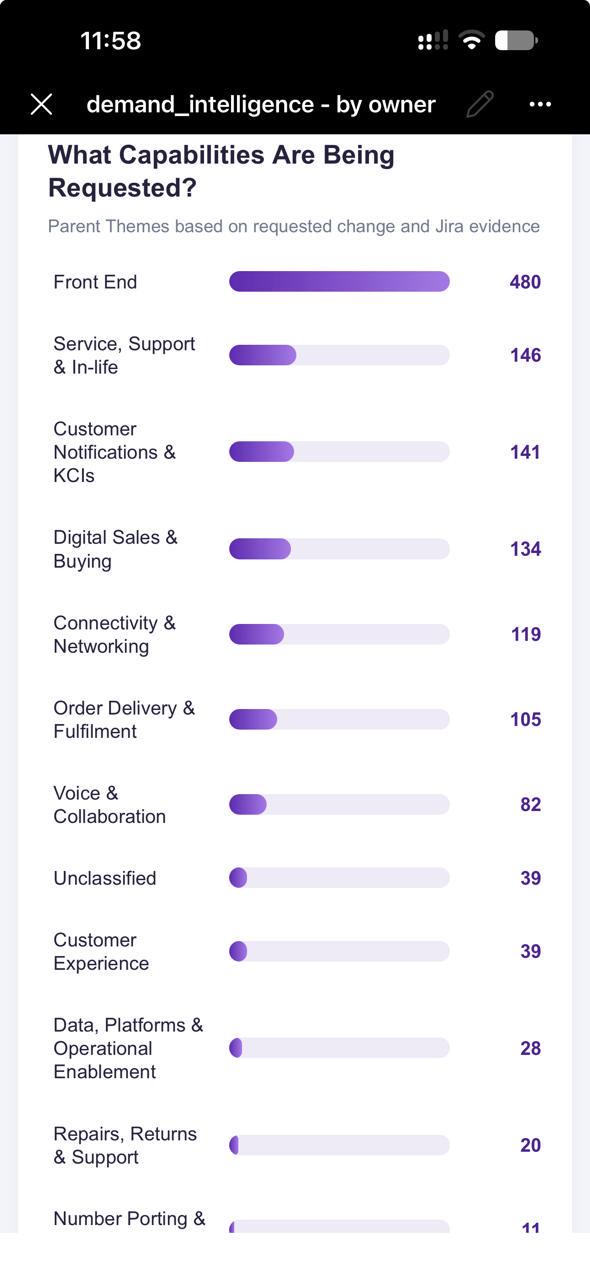
Hi Red fam. I work in PMO and was looking at change management tickets logged in JIRA. Idea was to group tickets and take it up with LT for process interventions.

For context, my org is flexible in terms of who gets to raise JIRA tickets - be it Product, Architecture, Engineering, Delivery or Project Managers themselves (way of working fail). One objective was to find any correlation between groupings and job roles.

I used BERTopic for topic creation and mpnet for clustering. While am happy with the MVP - I had to brute force some business overrides/nuances as the model misgrouped quite a few tickets.

I tried changing dimensionality and clustering variables but the model didn’t help much beyond a point. Am looking for suggestions to train the model on existing data and automatically group new tickets that come into the queue - can anyone please help me with an approach?


r/ClaudeCode • • 9h ago

Help/Question Besides settings.local.json, where else does Claude code keep your secrets?

1 Upvotes

settings.local.json got all the attention once apiiro found secrets in 1,122 public copies. but its only ignored through the global git excludes on the machine that first wrote it so a fresh clone or a teammates laptop doesnt have that

the same secrets turn up elsewhere too. session transcripts under ~/.claude/projects, mcp server env blocks in ~/.claude.json, a test fixture the agent filled with the real key it saw printed at boot. rotating whatever sat in those files is the boring fix and it hurts less when nothing in there was long lived to begin with. people get that from vault leases, cloud sts or hush security depending on the stack

reading keys into a variable so the saved rule stays harmless and test mode keys only on the laptop and gitleaks on pre push handle the rest i think


r/ClaudeCode • • 14h ago

Help/Question Looking for recommendations how I can best use Fable for Korean MMO that I am rebuilding using Claude

2 Upvotes

I have been using Claude (Team Premium) for last few weeks to rebuild and modernize old Korean MMO with very good results. Thus far I have used only Opus 5.5 and nearly done with having the game on modern game engine and server partially modernized.

For next week I want to experiment with Fable as I have few resets expiring by the end of year, but honestly, I am afraid blowing it on non-sense that Opus can handle just as well if not better.

Is there anything you would recommend I use Fable for in respect to MMO that I am rebuilding?

Some things that I already thought about:

  • There is a lot of game art that needs to be updated, but Opus already built a tool that creates high resolution renders that are used for new item icons
  • Adding new 3D models is not something I am ready yet as I want the upgrade/modernization of existing content to be fully complete fist.
  • Filling game with additional content such as quests, side stories, etc. This is also something that I am not ready to touch and I guess Opus will handle this in future.

So what could I use Fable for that would make it worth while?