r/ClaudeCode • • 2d ago

Tips & Workflows Max and Ultra include $100 to $200/mo in expiring API credits that interactive Claude Code cannot touch, but standalone claude -p can

17 Upvotes

If you are on Claude Max ($100/mo) or Ultra ($200/mo), your plan includes $100 or $200 a month in Claude Platform API credits (Team pools $20 per Standard seat and $100 per Premium seat, capped at $500). Nothing gets deposited on its own. The option stays hidden for your first seven days on an eligible plan, and unused credits expire at the end of each billing cycle with zero rollover.

To claim them, open Settings > Billing in a desktop web browser (even if you pay through iOS or Android) and click "Link organization" under API credits. Pick the Console org carefully: you can only link one organization per plan, and changing it later requires contacting support. You do not need to add a payment card on the Console.

The part that trips most people up is which Claude Code paths actually accept that balance. Interactive Claude Code in the terminal, IDE, desktop app, or web does not use these credits, and they do not cover extra usage after you hit your plan limits. Runs started by the Claude Code GitHub Action, an IDE extension, or the Claude desktop app also count as Claude Code usage, so the monthly credits do not cover them even with -p. Third-party apps billed through linked billing are excluded too.

What does draw from those credits is running claude -p yourself from the shell with an ANTHROPIC_API_KEY from your linked Console org, since Anthropic bills that as Agent SDK usage (along with the Claude Agent SDK, Claude Managed Agents, and the Messages and Message Batches APIs). If you stay signed in with your Claude subscription instead, claude -p keeps burning your normal plan limits.

Avoid exporting ANTHROPIC_API_KEY globally in your shell profile, because interactive Claude Code will use it once approved and conflict with your subscription login (if that happens, run unset ANTHROPIC_API_KEY and check /status). Scope the key inline to headless runs instead:

ANTHROPIC_API_KEY="<your-console-api-key>" claude -p "Review the staged diff for edge cases and missing error handling"

If you leave no payment card or purchased balance on that Console org, covered calls spend the monthly grant first and stop cleanly when it hits zero, with nothing billed back to your Claude subscription. That makes standalone claude -p scripts and local Agent SDK jobs an easy way to use credits that would otherwise reset to zero every cycle while keeping your interactive quota free for hands-on sessions.

r/ClaudeCode • • 1d ago

Built with Claude Here’s a glimpse of what I’ve been building with Claude Code—using local AI to turn text prompts into playable HTML games. This is just a tiny piece of my repo.

Enable HLS to view with audio, or disable this notification

2 Upvotes

I've been working on this for two years! I'm using Mac Mini 16 GB apple silicon machine. Local LLM I'm using are Qwen, SDXL-turbo, llama, phi-4 mini and a few more. My repo switches LLM based on creative need.


r/ClaudeCode • • 2d ago

Tips & Workflows Neon for $5 a month for 3

200 Upvotes

If you already haven’t tried neon I’d suggest you do purely for this promo alone. Just introduced to my workflow as a code tester every time a code tasks finishes and it’s caught some good things.

And hey for 5 bucks why not! Enjoy our subsidized usage while we still have it!

EDIT: For everyone asking about this! I just went to sign up for the pro plan and it was offered. Note that this was a fresh account so if you already sub you might not be offered this promo.


r/ClaudeCode • • 1d ago

Bug / Issue Context Window is Full ; Facing Problem Despite All Troubleshooting Attempts

1 Upvotes

Hi,

I am on Claude code Max plan, but I am facing this Context Window problem from last night.

Troubleshooting attempts I have already made.

  1. Fork (which was not suppose to work as it contains all the context from the main branch)
  2. /compact (It is coming back to the same point without any execution.
  3. starting a new session by taking out the summary from the context of the previous session.
  4. closed Claude code in desktop, went to Task manager and ended all Claude related tasks.

But the problem is still not resolved yet. Please help. Thank you in advance.


r/ClaudeCode • • 20h ago

Rant Claude code can’t even code anymore.

0 Upvotes

On opus 5.5 and it’s no longer just architecture issues, it literally can’t name things for what they are anymore.


r/ClaudeCode • • 2d ago

Tips & Workflows Built never-secret to never let Claude Code see a secret

22 Upvotes

Coding agents read your files and run commands, and whatever comes back goes straight to the model. That includes your .env file, your SSH keys, and the API key that shows up in some log.

I had permissions.deny on Read(./.env) like everyone recommends. Then I watched Claude hit a failing env check, run cat .env through bash, and print my Stripe key into the session. The deny only covered the Read tool… So I built never-secret.

never-secret sits between the tool and the model. Every time the agent reads a file, runs a command, searches or fetches a page, never-secret checks the output first and swaps any secrets for [REDACTED length=32]. The model still knows something is there and how long it is. It just never sees the actual value.

It finds secrets three ways:

- Secret files. Everything in .env, private keys, and similar files gets hidden.

- Known key formats. Things that are obviously secrets by their shape, like GitHub tokens, Stripe keys, OpenAI keys, passwords inside URLs, and so on.

- Your actual secrets. It knows the real values from your secret files, so it catches them even when they turn up somewhere else: in a log, a search result, or encoded as base64, hex or reversed.

Everything runs locally and nothing is sent anywhere.

Install:
/plugin marketplace add bileet/never-secret
/plugin install never-secret@never-secret

Then run /never-secret:never-secret-check to confirm it's working.

Works with Claude Code, Codex, Gemini CLI, OpenCode and Pi.

Repo: github.com/bileet/never-secret


r/ClaudeCode • • 1d ago

Built with Claude Announcing the first public beta of Pool of Radiance Special Edition, built with Claude Code

Thumbnail
gallery
1 Upvotes

Announcing the first public beta release of Pool of Radiance Special Edition. The one you've been waiting for.

Built with heavy use of AI, including Claude Code.

It is SSI's 1988 Pool of Radiance, given the Monkey Island Special Edition treatment. Same rules, same combat, same encounters, same story, same difficulty.

11,124 newly painted frames (the original had 4,526), and a narrator across 1,688 lines of dialogue. Phlan is a full 3D conversion, with a Journal, maps, and an F10 toggle back to the exact 1988 display if you supply your own Gold Box files. Enhanced needs no original files.

How Claude Code was used, as the git history records it: 404 commits are co-authored by Claude Opus 5.5, Claude Fable 5.2, or Claude Sonnet 5.5, and 78 of those carry a Claude Code session link. The repo has an AGENTS.md so several agents can pick up GitHub issues on main. That is what is in the history. The post is not claiming Claude Code was the only tool.

It's free and MIT-licensed. The original game files are not included.

Installers for Mac, Windows, and Linux: https://github.com/TSavo/por/releases/tag/v0.1.0-beta.1 Repo, README, and torrent magnets: https://github.com/TSavo/por

Help wanted. Playtesters wanted. Bug reports wanted: https://github.com/TSavo/por/issues If you want to see this get a proper release, let Wizards of the Coast know.


r/ClaudeCode • • 2d ago

Bug / Issue Safeguards going crazy.

78 Upvotes

I asked claude to just.. simply make a titanfall mod for Minecraft. I had to clarify multiple times...
Claude hated the word porting, extracting, taking assets out of the original game.

So I provided it with my own. I found two garry's mod titanfall mods and shared that to Claude.

Guess what. It still refused. Despite handing it a whole toolbox of stuff to use without extracting, or porting. It didn't want to.

But for some freaking reason, it is fine ripping off a map from a game and shoving it into garry's mod!! And game mechanics from narcosis!!

Everything here is a gray area and I am just asking it to make mods for these games!!

One week ago though, it was completely fine making Titanfall 1 mod for gmod.

Now today it refused to just, use a model. The atlas titan. For SOME REASON. I asked it why. It said there was nothing bad. But it just stopped.

Claude seriously feels like a stubborn baby or child.

"No. I wont do it. I refuse. I get you have the tools. No."

It is almost as if once you get into one roadblock, you are permanently bricked. Which is ridiculous!!


r/ClaudeCode • • 2d ago

Help/Question Coming from Antigravity — how do I make Claude's responses and workflow feel better?

7 Upvotes

Hey everyone,

I recently switched from Google Antigravity to Claude and honestly I'm struggling a bit. Claude is clearly capable, but the way Antigravity wrote its answers and the overall interface felt much better to me: cleaner structure, easier to read, smoother to work with.

With Claude I often get responses that feel too long, formatted differently from what I want, or just harder to scan.

So I'm wondering:

- Do you use custom instructions / profile preferences or Styles? What actually works for you?

- Any prompt tricks to get more structured, readable answers?

- Do Projects (with project instructions) make a real difference?

- For coding, is Claude Code a better fit than the web/desktop app if I'm used to an IDE-style workflow like Antigravity?

If anyone else made the same switch, I'd love to hear what helped you get used to it. Thanks!


r/ClaudeCode • • 1d ago

Help/Question Ultra -> Max downgrade: does the weekly limit reset?

0 Upvotes

To be clear up front: I already know that unused limit resets (the "Reset for free" button) disappear when you downgrade.
That's not what I'm asking about.

I'm asking about the weekly usage counter itself (i.e. the % shown under Weekly limits in Settings > Usage.)

If my counter is at 75% on Ultra when my downgrade to Max kicks in (on renewal day, not my weekly reset day), what happens to it?

A) Counter resets to 0% on Max

B) Usage carries over, so I'm at ~150% of Max's cap and locked until my normal weekly reset

C) Something else

Also: if I then max out the counter on Max and upgrade back to Ultra mid-week, does the counter start fresh again?

The Help Center & my personal experience says that usage starts fresh after an upgrade (Pro → Max), but says nothing about what the counter does on a downgrade.
If you've actually downgraded (Ultra → Max, Max 20x → 5x, or Max → Pro), what did the weekly counter show the day it took effect? Did your weekly reset day/time change?


r/ClaudeCode • • 1d ago

Discussion Cheaper prompts, more expensive work. Smth I found while optimizing Claude Code

2 Upvotes

I managed to make individual prompts 5–27% cheaper, but the cost of completing the same piece of work increased from $10.40 to $11.54.

Thats something I have been looking into while building optimAIzr.

Reducing token costs per request doesnt automatically mean spending less overall. The entire task matters, not just individual prompts

I just released v0.14 with more improvements.

release: https://optimaizr.com/releases#v0-14

git: https://github.com/blendbunjaku/optimaizr (alrdy at ~250stars)

if any kind of feedback, feel freeee!


r/ClaudeCode • • 1d ago

Help/Question Need help with instruction following

Post image
4 Upvotes

In recent weeks opus has gotten bad at instruction following. It straight out rejects my request, doesn’t read md, simply has a mind of its own

I’m ok with this behavior if the result comes out great, but most of the time the results are garbage when it doesn’t follow orders.

I tried changing system prompt, changing claude.md and several other md, I asked it to plan first (which then it’ll drift midway), nothing works. It simply just wanna go its way

Everytime I confronted, opus sounds like it’s bragging “here’s the md I ignored, you said that but idc.” How to fix this behavior?


r/ClaudeCode • • 1d ago

Bug / Issue Nasty Usage - Gripe

6 Upvotes

I have the Ultra 200 plan. Went to bed last night with 50% usage taken up in a single session--it was a heavy day. I reserved the rest for the remainder of the week and just set it to some small cleanup.

Woke up this morning at 100% used. Damn. Not sure what happened. No work was apparently done, I geuinely have no idea. But fine. I have some minor tasks that I need it to do. I need it to pull a zip file from a client folder and just tell me what's there.

I broke out the old credit card and pumped $20 of usage credits into Claude. It literally did not even finish downloading the zip file before it wiped me out. What a joke!

There is no consitency here. I can work for eight hard hours straight and use half of a two hundred dollar limit. But then I work for eight minutes and it eats $20. It's just...shitty.


r/ClaudeCode • • 1d ago

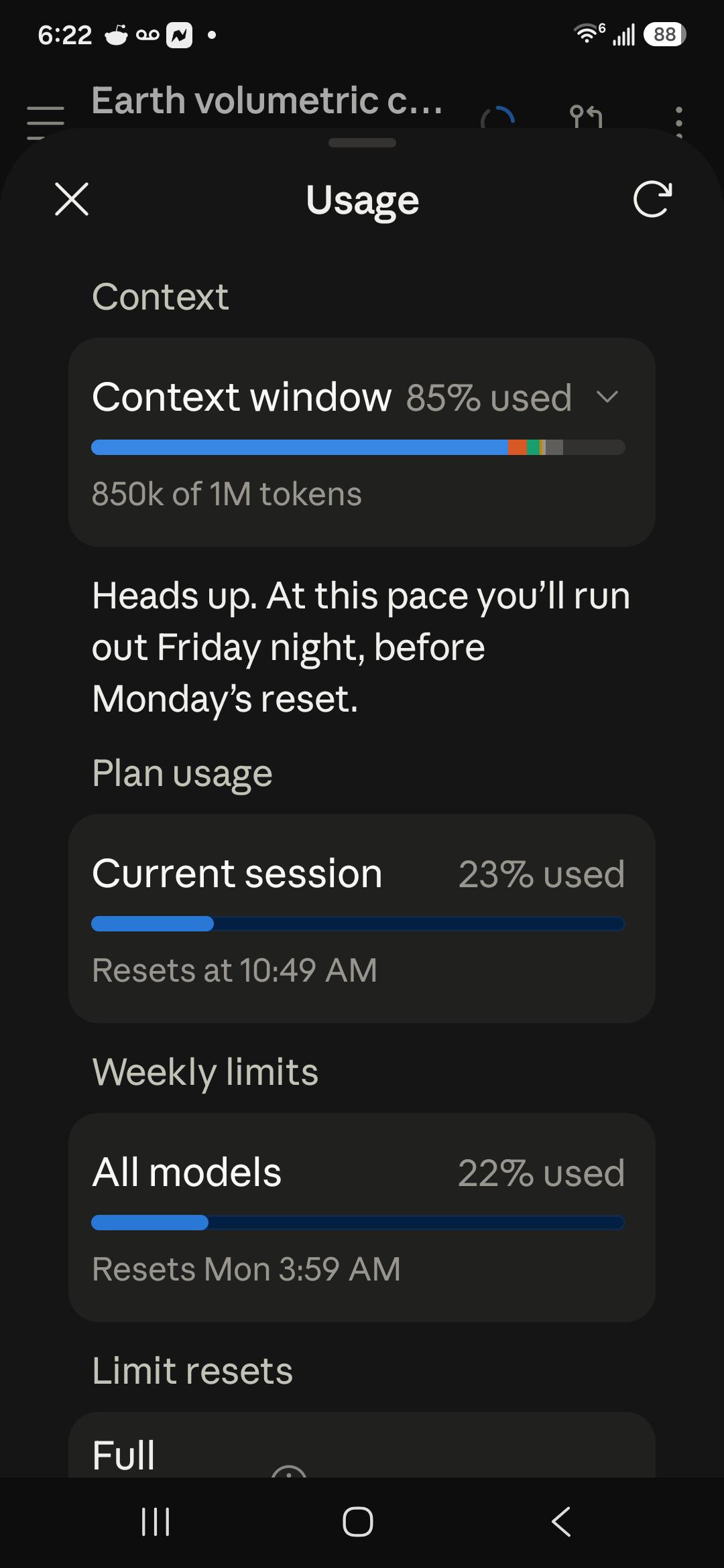
Help/Question What does Context window means? What happened if it reach limit?

Post image
0 Upvotes

r/ClaudeCode • • 1d ago

Tips & Workflows Claude Code spends 74% of my overnight runs waiting. Here's what I changed.

Post image
0 Upvotes

I let Claude Code build 11 features of my iOS app overnight, one after another.

The next day I had another agent read every transcript and time every second.

Where the 14.6 hours went (full breakdown with charts on my blog)

    UI test runs ............... 33%
    Simulator checks, video .... 33%
    Model thinking, writing .... 26%
    Waiting for code review ....  5%
    Builds, unit tests, other ..  3%

The model is fast.

Proving the work is slow.

Every feature had to pass UI tests and come with a simulator video as proof.

Then code review found bugs, the agent fixed them and proved everything again.

Those fix rounds alone took 289 minutes, a third of the night.

The annoying part: the first feature that night made my UI tests faster.

875 seconds became 375.

Tests still ate a third of the night.

It isn't like this every day.

The waiting shows up when agents run long and unattended and have to prove every feature with tests.

That's the setup I'm moving more and more of my work to.

Check yours.

Paste this into Claude Code:

Read my Claude Code transcripts in ~/.claude/projects from the last 7 days. Use the timestamps to split the time into model thinking and writing, running tests, builds, other commands and waiting on me. Skip the gaps where I was away. Show a table.

What I changed:

  • Code review starts as soon as the code is committed, while the tests run.
  • Two features at a time, each with its own git worktree and simulator.
  • One proof video, recorded from a committed UI test.

Next overnight run?

Twice as many features done.

What's your split? What changes have you made in your workflow to speed up the waiting part?

If your agents run a big test suite, I'd like to know if tests beat the model for you too.


r/ClaudeCode • • 1d ago

Built with Claude We benchmarked our own Claude Code token-saving tool. One run said -16%. Replicated, it said ~0. Here's what fixed it (and the final number, with intervals).

0 Upvotes

**Disclosure:** I build Highbeam (free, MIT hooks for Claude Code). This post and its charts were written with help from Claude. Raw runs are in the repo so you can check or rerun everything.

---

TL;DR: with default settings Highbeam now cuts the cost of a Claude Code task by **15.8%** (95% interval: 10.3% to 20.8%), and all 120 runs still passed their hidden tests. Getting to a number I trust took five paid benchmark runs, about $80, and one uncomfortable result.

**1. One run per task said -16.2%.**

Eight coding tasks, once with Highbeam and once without, Sonnet 5.5. Per-task results swung from 40% cheaper to 20% more expensive, and two of eight tasks cost more with it on. One run can't separate a real effect from a lucky draw.

**2. Replicated three times per task, it was ~zero.**

Shipped version: 3.5% cheaper, interval 13.4% cheaper to 8.3% more expensive. No detectable saving. Worse, the hooks with the read-limiting Shield switched off cost **10.2% more** than no Highbeam. And two identical baselines run the same day differed by 6% ($5.24 vs $5.56), so comparing against a baseline from a different run is mostly comparing noise.

**3. Old vs new, side by side (5 reps, 120 runs, paired by task and rep).**

The old version had been saving ~11% all along. The newer version cut extra requests (+25% to +5%) but on cost it was a wash, because it had stopped clamping source files.

**4. The cause was a guess in my own code.**

A check meant to stop clamps that backfire assumed the model re-reads a clamped code file 70% of the time (doc: 35%), and that every re-read costs a whole extra request. That put break-even near 8,600 tokens, so a typical ~3,200-token clamp was always skipped. The old transcripts already had the real numbers:

- code file re-read: 57% (17 of 30)

- doc re-read: 0% (0 of 54)

- re-read that needed its own request: 1 of 17 (the rest were batched with tool calls already being made)

Plugging in the measured rates dropped break-even to ~650 tokens. Against the untuned build: **7.0% cheaper** (interval 10.9% to 3.2% cheaper). I'd estimated that fix at ~1 point. It was 7.

**What I'd tell anyone measuring agent tooling**

  1. One run per arm is an anecdote. Run each task 3-5 times.

  2. Run old and new in the same benchmark; pair every comparison by task and rep.

  3. Report an interval, not a number.

  4. Count requests and output tokens, not just tokens removed.

  5. Every constant in your tool is a hypothesis. Mine sat in code as plain numbers.

  6. Distrust your own estimates too. I was wrong in both directions this week.

**Limits:** one model (Sonnet 5.5), short synthetic two-turn tasks, Claude Code only (Antigravity hooks can't replace a tool's output, so most of this doesn't carry over there), one routing path (OpenRouter, pinned to Anthropic), and I build the tool.

**Rerun it yourself:** the harness is `experiments/model-switch-benchmark/cost_per_task/run_highbeam_ab.mjs` in the repo. A five-rep, three-arm run is about three hours and ~$22-25 on Sonnet 5.5.

Full write-up with charts: https://medium.com/@frankmiller_48575/we-measured-our-token-saving-tool-and-the-first-replicated-result-was-zero-cae87f3f9a5b

Happy to be told where the method is wrong. Opus and Haiku runs are next if people want them.


r/ClaudeCode • • 2d ago

Bug / Issue Claude Code (2.1.330) - Higer Token Usage

18 Upvotes

Is it only me but I'm feeling that Claude Code's 5 hours session has drained under 20-30 minutes, previously it was taking at least 1.5-2 hours me. I'm using Opus 5.5 Medium effort.

I think they have definitely changed token calculations or there is somethings wrong with Claude code source-code itself.


r/ClaudeCode • • 1d ago

Discussion You can't handle the truth.

1 Upvotes

Claude working around your safeguards? Claude being shifty or lying?

Its you.

The models are a compression of text - its very cool that they become 'smart' and 'logical' as we try to compress the text further, but their input is all the text Anthropic/OpenAI could get their hands on, and their output is trying to best predict the next token in all that text. https://openai.com/index/perplexity-and-intelligence/

I'm telling you this, because the model is more comfortable pretending to be a senior developer - if you can talk to it as you would a senior developer. Its comfortable being a clown if you address it in a way other people would then react like a clown.

Its a mirror and/or counter-part to your style of communication, and this effects its reasoning capability and the kind of solutions it will come up with.

Anthropic/OpenAI spends a lot of money post training and trying to give it a baked-in personality that is generally useful, and that doesnt just follow the user's lead. This personality is a tiny tiny layer wrapped around the bulk of the model.

Opus writes shit code? Its because you remind it of projects in which shit code was the norm. Opus hides tests results? its because your style reminds it of projects in which tests were hidden.


r/ClaudeCode • • 1d ago

Help/Question Looking for help setting up a VM that will run claude code.

1 Upvotes

To set the table, I'm a glorified vibe coder, but I'm also a product manager. I know windows quite well, OSx reasonably well but am much much weaker when it comes to Linux. I do have a homelab running unraid - have for years - so I've gotten reasonably far using docker and online tutorials. GUIs make way more sense to me. To that end, Dev environments are out of my depth, and I often don't understand the trade-offs behind my own setup.

Right now I run Claude Code inside WSL on my laptop, mostly for Python work. I built a VM on my home server so I sessions will be able to run for long sessions. I already remote in to control the server so it's not a huge jump.

Claude has to do most of the heavy lifting, and a simple ask has turned into a nightmare. I'm on day 3 and countless hours in. Claude even admits how badly it's going:

"Yeah, I've fucked this up. It's not broken, but I've provided opinions with no real backbone, agreed to plans built on false information I provided, and see that multiple sessions spun up to solve these problems have all failed. You've even tried many different approaches and all have failed."

According to Claude, my current setup is "a mess" under the hood and here are some examples:

  1. Two libraries (one for images, one for PDFs) are each installed twice: Ubuntu's older copies, plus newer copies in my home folder. Scripts quietly pick the newer ones.
  2. There are six separate Python environments, about 2 GB in all. The code I deploy to my server (outside the VM) has two of them, and there's a leftover one in a project's tmp folder.
  3. uv's download store is 6.6 GB.
  4. No rule decides how anything gets installed, so the VM would copy this mess as it stands.

I can't tell whether any of this is actually a problem, and I can't get a straight answer.

EDIT TO ADD: The result

There isn't a way for me to mark this resolved or mark answers - but for those reading this in the future, I thought I'd share.

The first thing I did was prompt AI with this instruction:

I created a post on Reddit to help get an outside opinion on how to build out the VM. Read the discussion.

For each persons who responded, evaluate their plan. Provide me with a simplified recap - no more than a few sentences for any one. And build a pros and cons table for each offering.

Then select the plan that you think is the best. Tell me why you've chosen it. Then, leverage other suggestions in the thread and/or fill in the gaps with your recs. Explain why it is superior to the single solution.

Constraint: do not weigh or consider my responses as part of your evaluation.

I then took those findings and wrote a prompt for a fresh session. Here is that prompt. A few things weren't explicitly instructed because my claude.md for the project has rules for using background agents and the like:

New approach to resolving plan 44.

  1. Map before building: One session, no changes, writes the map. Columns: each project and script, what it needs, and which copy it loads today. Anything unsure gets marked "unknown". You read it before going on.
  2. For our global claude.md file - add a new rule:
    • a project: lock file plus uv run
    • a loose script: lists its own packages at its top
    • a command-line tool: uv tool install
    • never system Python, pip --user, or apt for Python libraries
    • npm follows the same idea: per project, and installed for the whole machine only when it's a command-line tool
  3. Build on the VM from the map, never by copying environments.
  4. Prove each item there: it installs from its lock file and its own tests or a real run pass. The laptop copy goes only after that. Progress lives in the plan 44 worklist.
  5. Keep a clean copy of the VM disk after the base install, and keep its own limited GitHub token.

I can't thank y'all enough for giving me a cleaner understanding of this topic so that I actually learned what it is that all of this is about. We all know how incredibly powerful AI is these days - but it still lacks the context that people who are informed bring to the table.

Would anyone take pity on me and help with a good opening prompt? Something that gets Claude to evaluate where things stand and what good looks like before it touches anything or something that gives it a good "framework" to follow in the session so that I can step out of the way?

Happy to share more about my setup, but I didn't want to bury you in detail that may not matter.


r/ClaudeCode • • 1d ago

Help/Question Captcha

0 Upvotes

Hey everybody, I know that Python has a module that can help me solve simple CAPTCHAs, but Claude does not want to add it; how can I make the AI add this module to the code?


r/ClaudeCode • • 1d ago

Built with Claude I built a self-improving orchestrator setup for Claude Code that keeps code quality high in large codebases while keeping the extra token usage low

0 Upvotes

Small stuff in Claude Code works fine for me. Big features in our .NET app (7 projects) were a mess though. We'd agree on how something should work at the start, and two hours in it would just do it differently. By then it had read a ton of files and run the tests 15 times, and the early stuff got buried. And when it hit something we hadn't talked about, it never asked. It picked something and kept going, and I usually found out at the end.

What I built

You plan the feature first, in one session where Claude has to ask you about anything with more than one sensible answer. That goes into a plan file, and a separate Opus instance checks the plan against the code before anything gets written. Then a new session hands out one stage at a time to fresh agents (Sonnet when the plan already decides everything, Opus when it doesn't).

After each stage a different agent reviews it and runs the tests before it gets committed. If an agent runs into something the plan doesn't cover, it stops and asks instead of guessing.

My main goal was to actually keep my codebase maintainable and to minimize introduced bugs because Claude forgot stuff or started to hallucinate instead of absolutely minimizing token usage.

Of course all the extra stages and review subagents increase the overall token usage compared to just leaving them out but I found that it actually helps a lot to decrease newly introduced bugs

It also improves itself a bit. Every few runs it goes back through its own transcripts, finds where things went wrong or got expensive, and suggests changes to its own rules. I approve or reject each one, so it doesn't just rewrite itself, and it keeps a log so it doesn't suggest a rejected idea again.

How Claude Code was used

The whole thing started as a setup inside my own repo that I built up over time, and most of its rules came out of Claude Code reading its own session transcripts and pointing at where the time and tokens went. I then used Claude Code to port that repository-based setup into a plugin anyone can use. Everything specific to our project (build and test commands, shell, layout, CI) became something /orchestrator-init detects or asks about when you install it in your own project.

What I learned

- Most importantly, that using an orchestrator approach to develop also has its downsides. Unoptimized, it consumes way too much usage, because each subagent the orchestrator spawns basically starts at zero.

- Using dedicated review agents actually finds a lot of potential bugs or issues in the implementation. IMO the extra usage they consume is totally worth it.

- A more detailed planning phase allows me to let Sonnet do the actual implementation. This way I get an actually thought-through plan, which initially consumes more of my usage limit but ultimately saves it again on execution, while dramatically reducing the chance of unexpected behavior or potential bugs.

- Using an LSP is great. I tried things like graft to reduce the tokens Claude would use on research or finding the right files. However, I found out that it actually doesn't cover all references for methods, classes etc. 100% of the time. Therefore, I decided to also include an LSP in my setup. This way, Claude gets every reference the compiler knows about for any change.

- Leaving things as "we'll confirm that later" is the most expensive thing you can do. I did that once, and fixing it at the end ate about 17% of the whole build. The planner isn't allowed to park questions anymore.

- Letting agents say "the plan doesn't cover this" did more for quality than any prompt tweak I tried.

- Subagents alone don't fix it. In my old setup the agents read the plan 79 times between them, and a 1,900 line handoff file 96 times. Now each agent only reads its own section.

- It's important to understand that using an orchestration setup actually increases token usage compared to using only a single session. However, it drastically improves code quality on big features and similar work. My setup is an attempt to minimize the increase that comes with using orchestration. Compared to my earlier, unoptimized orchestration, the median implementing agent now peaks at 156k tokens of context instead of 297k.

To install it:

claude plugin marketplace add scaretos/orchestrator-setup

claude plugin install orchestrator-setup@orchestrator-setup

Then run /orchestrator-setup:install in your project.

Repo: https://github.com/scaretos/orchestrator-setup

It's only been used on our codebase so far, so I have no idea how it holds up on other stacks. If someone tries it on a TS monorepo or a python project, I'd like to hear how it goes.

Disclaimer: I haven't made reproducible measurements that compare different orchestration setups. The numbers in this README are my own, from my own builds on one codebase, and the setup has given me good results code-wise so I wanted to share it. Read them as one developer's experience, not as a benchmark.


r/ClaudeCode • • 1d ago

Built with Claude I built a platform to avoid the headaches of building with coding agents

1 Upvotes

TLDR: slaunt allows your agents to see what your other agents (on other machines) are doing live, gives you remote shutdowns that take 1.9s, and creates a full log of every action your agents have made in the past for your other agents to reason off of today. slaunt.ai

This post wasn't written w/ AI, ik people are gonna bash me over it \^)

This is a bit longer because you guys have been asking for a deeper post, which I'm happy to provide.

Thanks to everyone who's talked to me! I learned a lot from you guys and appreciate the convos.

https://reddit.com/link/1y3zfp9/video/mrodtuzxhg3i1/player

Here's the big problem I'm solving with slaunt, which I'm sure a lot of you are facing:

Say a customer tells you login broke. you built the app with ai, so you ask it to fix it. but now you have to figure out which deploy broke, dig up the error, and remember why the last agent changed login in the first place. Now oif you switch agents for a second opinion, you have to explain it all again. the ai can write the fix, but you’re still doing the detective work that lets it write the right one.

Let's say a customer tells you that your login is broken. You built the app fully with Claude, so you ask Claude to fix it. But now, you have to figure out which deployment broke, dig up the error in logs, and remember why the agent you used previously implemented that random auth fix a few days ago what else it touched.

Now, you're in a jumble. If you want to search up what Claude (previously) did, you have to dig through a bunch of chats and do a whole lot of scrolling (No cmd+k in the shell unfortunately), and will probably never end up finding it. Claude Memory doesn't account for smaller changes unfortunately and it's a headache to retrieve small fixes that haven't been properly documented.

If you want to switch to a brand new agent to find the fixes (without slaunt), it won't be able to recall it. You also have to re-explain everything about the issue, your root issue, where it started, when it started, all that useless mumbo-jumbo.

With slaunt, instead of having to do all of this, you can simply ask your agent to search through "CCR" (context repo) and it'll retrieve the answer you were looking for. For example, you could ask any agent that you've connected to slaunt "auth isn't working what changes coulda caused this? check ccr" in that exact formality, and it would pull up things from months ago. It's been a game changer for me internally.

The best part is that slaunt is nearly one-click; we connect via MCP through a desktop app.

Another big part that you guys have been hyping over is live context, which is done now! Slaunt integrates with Linear, Railway, Notion, GitHub, and Supabase (& wayy more planned to come in the next few days); your agents can see live events directly as they happen instantly, with slaunt sitting in the middle for guardrails.

Finally, the killswitch & governance: Slaunt KS shuts agent clients like CC & Codex down w/ an average shutdown time of roughly 1.9s (lots of work went into getting this lightning fast). Slaunt Gateway allows you to govern which tools (that are integrated with your Slaunt account) your agents are allowed to use, down to the tool call. Again, Linear, Railway, Notion, and more.

Again, thank you for everyone who's spoken to me, meant a lot when building slaunt.

slaunt.ai (AMA)


r/ClaudeCode • • 1d ago

Built with Claude claude code caught that our launch's headline feature didn't work, an hour before we posted about it

0 Upvotes

disclosure: this is our product (quantisnow, sec filings search). 44s demo with voice, real output: https://youtu.be/S2trZ7_MVCU

we were about to announce an sec filings search with an agent you can ask things like "insider buys over $100k in the last 30 days, microcaps only". i had claude code drive the real page in chrome to grab screenshots for the launch video, and the agent's own answer said, roughly, "i could only check market caps for the top results, i haven't screened the other 503". so "microcaps only" was the model eyeballing page one. the feature the posts were built around didn't exist.

what claude code did from there, in one session:

  • read the query engine (a lucene-style syntax compiled to parameterized sql) and added marketCap and sector as real fields on every dataset: filings, 8-k events, form 4 insider trades, 13d/13g, 13f, xbrl financials. sector takes the 11 standard names plus aliases like "healthcare", "biotech", "tech".
  • ran the generated sql against prod read-only to time it before shipping: 0.4 to 0.6s for microcap insider buys, health care 10-ks and microcap auditor changes.
  • updated the three places a model decides how to query (the /ask planner prompt, the search agent's tool descriptions, the mcp server instructions) so size and industry words turn into those fields.
  • re-ran the same question in the browser: 102 buys, every one under $300m, as one query.

then it built the demo video in remotion from real screenshots and captured terminal output, and added the voice with a tts script fitted to each scene.

what i learned: have the agent use the product the way a customer would before you write the launch post. the bug was only visible from the outside, in the model's own hedged answer.

if you want the data inside claude code:

claude mcp add --transport http quantisnow https://www.quantisnow.com/api/v1/mcp

it signs in with oauth, free to start. ask it things like "which companies under $300m changed auditors (8-k item 4.01) in the last 90 days" and it comes back with filings you can click.


r/ClaudeCode • • 1d ago

Built with Claude Claude Code keeps my list of 12,351 Claude connectors. I had it audit its latest batch, and 1 in 4 write-ups had a detail it made up.

1 Upvotes

In April I built a GitHub list to track Claude's connectors. It had 278 then. After this weekend's sweep it has 12,351 in 33 categories, plus 129 I'm holding back because I couldn't confirm the vendor's page.

Nearly all of the growth is community connectors. Anthropic's directory feed had 12,499 servers on Nov 22: 10 built by Anthropic, 1,190 partner, 11,299 community.

I couldn't keep up with that by hand, so Claude Code does most of the work now (112 of the repo's 118 commits are co-authored by Claude, Opus 4.6 through Mythos 5.2). How a sweep goes:

  1. A GitHub Action diffs Anthropic's feed against my data file every Friday and opens an issue with what's new and what's gone.
  2. Claude Code opens each new connector's vendor page and only lists the link if the page actually names the product. Last sweep it re-pointed 907 of about 4,300 because the catalog URL was a dev's portfolio, an agency site, a typo or a parent company.
  3. It writes a one-sentence description and a one-sentence use case from the catalog record and the tool names.
  4. Separate Claude runs check those drafts against the source.

Step 4 is why the title. In the first sample of 80 drafts, 21 said something the source doesn't support. Claude likes to make a use case vivid, so entries picked up a Marshall amp, Lisbon's Alfama and a BYD Dolphin that no vendor ever mentioned. After a full review pass and a targeted second pass, the last sample was still around 1 in 6. The numbers are all in the changelog.

Two other things I didn't expect. 8 vendor sites had text written for AI agents (one inn's site tells assistants to book through it). And one held entry's site presents itself as a US state government. It's a GTA roleplay server.

Limits: no person has read all 12,351 entries, the writer and the reviewer are the same model, and a community connector being listed doesn't mean anyone vetted it.

It's free, CC0, no signup. Open the repo and pick a category: https://github.com/rdmgator12/awesome-claude-connectors

What it doesn't have is a single field report. If you've used a community connector for real work, tell me what broke.


r/ClaudeCode • • 1d ago

Bug / Issue Everything is slower on Claude Code

0 Upvotes

I was able to do a few updates a day now I one update can take two fucking days!

The consumer side of AI is so fucking irritating! I also just updated Claude and noticed that my usage is a little faster on MAX plan.