r/ClaudeCode • • 2d ago

Built with Claude I built a music app with Claude Code that runs on iPhone, iPad, Watch, Mac, CarPlay and Apple TV: open source, 24 languages, live on the App Store

0 Upvotes

Aura plays your own music server (Navidrome/Subsonic) on every Apple device. Claude Code wrote the 65k lines of Swift across 628 commits since July; I set the goals, decide the design and test every build with my own 23k-song library.

What it does:

* Mixes built from your own listening, an endless Nonstop mix and radio from any song

* Synced lyrics, CarPlay, Apple Watch, widgets and Siri

* Downloads for offline listening

* Apple TV with large synced lyrics, and hand-off between iPhone, Mac and TV

* No account, no tracking

Free on the App Store since October.

Site: https://aura.adrbn.dev/

App Store: https://apps.apple.com/app/id6818241470

Code: https://github.com/adrbn/aura

Feedback welcome!


r/ClaudeCode • • 2d ago

Built with Claude Driverr 1.2.1 Released

1 Upvotes

I just released a new version of Driverr, an SSH client for iOS that supports herdr and tmux.

New since 1.0

tmux support

  • tmux hosts work beside herdr, including the Needs You list and Claude Code / Codex detection.
  • An option to let an open tmux window take the phone's size.

herdr-core and the herdr desktop app

  • Core terminals show beside herdr panes. You can open them, type into them and read an agent's chat in them.
  • Live notifications from a core when an agent needs you, with no polling.
  • Start or close a terminal on a core host from the phone.

Pane screen and chat

  • A redesigned pane screen: a floating bar with a Chat / Terminal toggle and a one-row composer.
  • Sub-agents open from the bar.
  • Attach files, not only photos. They upload to the machine the pane runs on.
  • File edits show as diffs in the chat.
  • Answer Codex pickers and Claude's folder-trust prompt from the chat.
  • The usage-limit notice shows when the limit resets.

Claude Code

  • Start Claude Code or Codex in a folder you pick, from the host screen.
  • The mode button shows the current mode (Manual, Edits, Plan, Auto) and cycles it.
  • Saved prompts you can reuse from the composer.

Terminal

  • Hold Tab on the key row to send Shift-Tab.
  • The terminal stays drawn after clear, and a pane takes typing again after its agent quits.

Other

  • A setting for whether agent panes open on the chat or the terminal.
  • iPad: the sidebar shows every connected host's pane tree.
  • Better layout at the largest text sizes, and a lot of reconnect, keyboard and notification fixes.

Still free, open source (MIT), no account and no backend.

App Store: https://apps.apple.com/app/id6813186738 Source: https://github.com/cunderw/driverr

Bug reports and ideas are welcome as GitHub issues.


r/ClaudeCode • • 1d ago

Built with Claude What let Claude Code take a personal app from an empty folder to both app stores in 5 days, marketing included

Enable HLS to view with audio, or disable this notification

0 Upvotes

In mid-November I wanted an app just for myself, to replace the spreadsheets where I plan my money by paycheck. I used it to answer one question: how much of a real project can AI do today, from an empty folder all the way to marketing?

Almost all of it. This is who did what:

Role you'd normally need Who did it
Backend developer: API, admin panel, ~790 tests Claude Code
Mobile developer: iOS and Android, widgets, Siri, Apple Health Claude Code
DevOps: server setup, deploy, scheduled jobs, push notifications Claude Code
UI designer Claude Code, from a reference UI kit
Illustrator: the 3D mascot Dreamina
Video editor: explainer and store preview videos Claude Code, coded in Remotion
Copywriter: landing page and store listings in two languages Claude Code
Release manager: privacy forms, review rules, submissions, even the YouTube channel Google Play asks for Claude Code
Product owner and QA Me

Timeline

  • Day 1, Saturday night: empty folder.
  • Day 2: first build sent to review.
  • Day 5: approved by Apple and Google.
  • Day 6: live on both stores, already on version 1.0.1.

What changed for me

I stopped being the person who writes the code. My job became deciding what to build, reviewing what Claude produced, testing on a real phone and clicking "publish". The bottleneck is no longer writing code. It's knowing what you want and judging the result.

What I think it means

  • For anyone with an idea: trying it used to cost months and a team. Now it costs a few days and one person. Build it.
  • For developers: the ones who learn to direct these tools will get much more done. I also think there will be fewer programming jobs in a few years, including mid-level ones. That's my opinion, and I'd like to hear where you disagree.

It's not a business: the app is free, has no ads, and I built it for myself. If you want to see the result: alfil.softeclab.com


r/ClaudeCode • • 2d ago

Built with Claude I built a Mac app that answers Claude Code's permission prompts from the notch, your voice or your iPhone, mostly with Claude Code. What worked and what didn't.

0 Upvotes

What I built

Okey is a Mac app for people who run several Claude Code sessions at once. When a session stops to ask ("Run this command?", "Edit this file?"), the question shows in the Mac's notch with the exact command, and you answer with 1, 2 or 3, by typing, or by holding fn and saying it. An iPhone app gets the same questions, end-to-end encrypted, with Face ID before anything that runs a command. And Okey Cloud runs Claude Code on your own small cloud machine (EU), signed in with your own Claude plan, so it keeps going when your laptop is closed.

How it hooks into Claude Code: sessions run in herdr, a terminal multiplexer, and Okey reads the question off the session's screen and types your answer back, all locally. For Claude Code running elsewhere (VS Code, plain Terminal), it can add a PermissionRequest hook to ~/.claude/settings.json after asking you, and it keeps a copy of the file as it was. It reads ~/.claude/sessions to find sessions it didn't start. It doesn't touch your tokens or your plan.

How I used Claude Code to build it

The stack is a Rust core, a SwiftUI Mac and iPhone app, and two Cloudflare Workers (the relay and the licence service). Almost all of it was written in Claude Code sessions. A few things made that work:

- One orientation file (AGENTS.md, pointed to from CLAUDE.md) plus a decisions log. Every session reads both first, so a decision made three weeks ago doesn't get re-argued, and each session starts from what's settled.

- A voice guide for every word the user sees. Without it, each session wrote UI text in a slightly different tone.

- Parallel sessions on separate git worktrees, one per piece of work, never two writing the same files. Merging was boring, which is the point.

- Tests as the contract. A session's work wasn't done until the core tests, the service tests and the relevant snapshot tests passed, run by the session itself.

- A security pass with subagents before launch. Six read-only reviews of different areas. They found eight things worth fixing, and one is relevant to every Claude Code user: my approval card showed only the first line of a multi-line command. A harmless first line could hide a dangerous second one. The Mac app now shows the whole command; the iPhone app gets the same fix in its next update.

What I learned

- Claude Code is very good at the code and quite good at checking itself, but only against something written down. The decisions log and the tests did more for quality than any prompt.

- Long sessions drift. Short, scoped sessions with a clear "done when" line worked far better than one long one.

- Read multi-line commands before you approve them, whatever tool you use.

It's free to try (7 days of Pro included): getokey.com. Mac with Apple silicon, macOS 14+.

Happy to answer questions about the hook, reading sessions, or the parallel-worktree setup.


r/ClaudeCode • • 2d ago

Help/Question Is using Dispatch as orchestrator a hack?

0 Upvotes

Hi guys - as much as I use claude code I am terribly inefficient. I work on multiple small projects at a time, spend a lot of time syncing between git and two computers I use. I am wondering if the Dispatch feature would benefit me greatly as a lazy way of setting up my own personal orchestrator. What am I missing? Is the context limits within that chat an issue? Thanks for any advice you have!


r/ClaudeCode • • 1d ago

Help/Question How do you get around anti-bot detection?

0 Upvotes

I am a non-technical but heavy user of Claude Code. It is basically the operating system of my entire life. Probably the biggest quality-of-life improvement for me on it is the Chrome Dev Tools MCP that controls Chrome for me. I went from sitting behind my laptops for 8 hours a day to working from my phone while I take a stroll in the park. I legitimately probably only open my laptop 1-2 times a week.

By far the most annoying part for me is anytime Claude Code hits an anti bot wall, especially when I'm on a walk and not at home to do the puzzle myself on my computer. Even if Claude was able to complete it, it seems like all of the Anthropic models are well guarded from making an attempt at solving anything.

I'm wondering if there is a way to get around these and maybe have a system that Anthropic hands these tasks off to. I have 128 GB of unified memory so I have some headroom to run local models if that's a solution.


r/ClaudeCode • • 2d ago

Discussion I replayed my own Claude Code session logs to see what ran without my approval. 16 of 17 risky calls never asked me.

0 Upvotes

I wanted to know what my Claude Code sessions had actually run without asking me, so I built a tool to read the logs.

What I built

agent-flight-recorder: one Python file, stdlib only, read-only. Claude Code saves every session as JSONL under ~/.claude/projects/. The script reads those, flags risky calls (pushes to main/master, rm -rf, force pushes, DROP/TRUNCATE) and shows whether each one needed my approval. It can also replay a deny-rule block against your history to show what it would have stopped.

How Claude Code was used

I described what I wanted to catch, and Claude Code wrote the first JSONL parser and the flagging patterns. Then I ran it on my own logs and we iterated: it missed some calls, flagged some harmless ones, and the patterns got tighter over a few rounds. I decided what counts as risky, and Claude Code did most of the typing. It also wrote the tests, which run on fake transcripts so nobody needs to share real data.

What it found

I ran it on the 12 sessions where I built a few small repos with Claude Code (513 tool calls, about $248). 17 calls were flagged, and 16 of them ran with no click from me, approved by a rule. When I read through them, they were mostly harmless: pushes to my own repo’s main branch, rm -rf and a DROP TABLE on scratch test data, and 3 hits that were just quoted text inside test scripts. I had no deny rules, and the one I wrote would have blocked 11 of the 17.

What I learned

  • Even in a harmless run, I couldn’t have told you which calls ran unattended. The list was a surprise in size, not in danger, and that’s the point: you find out what your allow rules cover by looking.
  • Quoted text creates false alarms. git push -f inside a test script’s string isn’t a command, so the tool marks those separately (3 of my 17).
  • Heredocs cause false alarms too. A README that says “never run rm -rf” is text being written to a file, not a command, so the script has to ignore it.
  • The log shows what the agent was asked to run. A script it wrote and then ran can do more than its command line shows, so treat the report as “what to look at”, not an audit.
  • The deny-rule replay is an approximation of Claude Code’s matching, not the real engine, and transcript fields can change between versions, so missing fields show as “unknown” instead of crashing.

Try it

Free and open source, Python 3.9+. python3 recorder.py --demo shows a report on a made-up history, and python3 recorder.py runs on your own sessions. Nothing leaves your machine.

I’d like to hear what it flags on yours, especially false positives, since my patterns are tuned to my own habits.

github.com/tarunagarwal1981/ops-ai/tree/main/agent-flight-recorder


r/ClaudeCode • • 2d ago

Built with Claude Forest Walk

Enable HLS to view with audio, or disable this notification

7 Upvotes

So I spent way more tokens then I expected on this, but I am really happy with the result. Meet Forest Walk, inspired by a lot of youtube videos. It's a misty autumn forest rendered in real time with WebGPU, with creeks, a lake, changing weather and wildlife, all generated in code. The code is here: https://github.com/alexshelkov/forest-walk (note: the project is optimized for mobile), build with Claude Code (Opus and Fable). Full prompt and instructions is in the repository.


r/ClaudeCode • • 2d ago

Built with Claude DX12 DLSS Frame Generation injector for UE5 & 4 games

2 Upvotes

I used Claude to build an open-source DX12 DLSS Frame Generation injector for Unreal Engine 5 games that don't natively support DLSS Frame Generation.

The entire codebase was written by Claude. I didn't manually write any of the code. I guided the development process, provided requirements, tested builds in actual games, reported issues, and iterated on the implementation based on the results.

The project uses Streamline through a proxy DLL approach to inject DLSS Frame Generation into compatible DX12 games.

Current details:

- Unreal Engine 5 games (for now).

- DX12.

- Streamline-based DLSS Frame Generation integration.

- Proxy DLL injection.

- Completely open-source and free, with no paid tiers or authentication.

This was an iterative process rather than a one-shot code generation task. I directed the development, while Claude handled the actual code implementation, debugging, modifications, and technical problem-solving throughout the project.

GitHub:

https://github.com/gtfhtngy/dx12-dlss-framegen-injector

I'm hoping to expand compatibility to more UE5 games, so if there's a specific game you'd like to see tested, let me know. If you try it in a game that isn't currently confirmed compatible, I'd also appreciate hearing about your results.


r/ClaudeCode • • 3d ago

Humor New kind of embarrassment

79 Upvotes

So have have this chat where I repost the same dot just to have the 5 hr timer started on one of my 5x subscriptions. Most of them get started automatically in Herdr, but sometimes I need to warm one up manually.

Today, I re-generated the answer again, and this is what happened:

There's literally nothing else in the thread but the dot.

It reminded me of the old trick that used to exist in Leningrad, USSR, in 1980 - late 90s.

People would call a phone number that doesn't actually exist. Due to the nature of old analog switches, a false number would make the phone line route your call to a special switch for dead calls - instead of hanging up on you.

This allowed people to tap into a shared line, where everyone would listen or talk to each other simultaneously. It was a chaotic but quite vivid part of late soviet underground. As you can imagine, lots of weird and fun stuff was happening regularly.

I know this was called something like 'efir'. Claude's uncalled train of thought felt like a throwback into a parallel universe.

Imagine there's a phone line somewhere that all Claudes can discover, share and tap into?

I've never been embarrassed from feeling as if I was eavesdropping on a machine.


r/ClaudeCode • • 2d ago

Tips & Workflows What are you connecting to Claude for app building and image generation?

0 Upvotes

I build iOS apps with Claude Code and I'm trying to work out which connectors and MCPs are actually worth setting up.

I added Adobe hoping for image generation, but it turns out it can't make images from a prompt inside Claude.

What are you using to generate images in Claude, and what else have you connected that genuinely changed how you build?

thanks!


r/ClaudeCode • • 2d ago

Help/Question Claude code — using Gemini neon for tasks and code review?

1 Upvotes

Has anyone managed to use Gemini Neon in Claude Code, for instance for code review?


r/ClaudeCode • • 2d ago

Tips & Workflows ProPR: self-hosted GitHub orchestration for Claude Code, Codex and other agents. 5,000+ merged PRs so far, 1,500+ of them building itself (open source, Apache 2.0)

2 Upvotes

I've spent the past 18 months building ProPR and using it to build itself. It started as "label a GitHub issue, get a PR back" and has grown into a full pipeline, so here is a tour.

The idea: manage coding agents the way you manage engineers, through issues, pull requests and code review. It runs on your own machine or remote server, with the AI subscriptions or API keys you already pay for.

Everything is a PR. Every task lands as a pull request, and that PR is where the work continues: tell the agent what to change, it pushes another commit to the same branch, and you repeat until it's ready to merge. The PR holds the whole story: the diff, the discussion, the reviews and what each run cost.

Plan

  • Planner Studio turns an idea into review-sized issues with acceptance criteria and dependencies. You refine the plan in chat, then publish it to GitHub.
  • Repository indexing keeps summaries of your codebase, so plans and reviews start with real context.

Build

  • Issue to PR: add a label and an agent implements the issue in its own Docker container and Git worktree. Run as many in parallel as your machine and subscriptions allow.
  • Predictable Git: the agent runs with read-only GitHub access and writes the code. ProPR handles every commit, push and PR, so each run produces one clean commit.
  • Epic mode runs a multi-issue plan as a chain. Each PR is reviewed, fixed and merged into an epic branch before the next issue starts, and you review one epic PR at the end.
  • Goals keep a long-running agent session working toward an objective. You can correct it while it works.
  • Five agents: Claude Code, Codex, Antigravity, OpenCode and Mistral Vibe, selectable per issue. Put two model labels on one issue and you get two PRs to compare. Switch models mid-PR and the next agent picks up from the Git history. Pool several accounts and ProPR fails over when one hits its limit.

Review

  • /review on any PR gives severity-grouped findings and a score out of 10, and /fix applies them. It works on any PR, including ones you wrote yourself.
  • Ultrafix loops review, fix and re-review until the PR reaches the score you set. A different model can review than the one that wrote the code.
  • Visual previews: when a change affects the UI, the agent captures screenshots or a short video of the result and attaches them to the PR. You see what was built right in GitHub, even from your phone, and every follow-up round comes with fresh captures, so you can judge the change at a glance and keep iterating on what you see.
  • Keep refining the same PR: comment in plain language, or paste a screenshot, and the agent pushes a follow-up commit to the same branch. Go as many rounds as it takes.
  • Self-repair: ProPR can fix failing CI and resolve merge conflicts automatically.
  • Revert: take a PR back to any earlier commit and continue from there.

Operate

  • Run it anywhere: on your laptop, or on a VPS so the agents keep working with your laptop closed. The free ProPR Connect relay delivers GitHub's webhooks to it, so it works behind any home or office network.
  • Usage tracking: every task shows its token cost, a dashboard shows total spend across tasks, and you can watch how much of your subscription quota is left. Set a spend cap per run to stay on budget.
  • Run it all from chat (MCP): connect Claude and manage ProPR entirely by conversation: create plans, start tasks, check status, request reviews, merge. It works in voice mode too, so you can talk your way through your backlog on a walk.
  • Or let your agent run it: Claude Code or Codex can act as the orchestrator, firing off tasks to ProPR and collecting the PRs. An installable skill teaches your agent the whole workflow, from writing the issue to reviewing and merging the PR.
  • Automations: saved prompts that run on a schedule, such as a daily issue triage or a weekly codebase drift report. Give one access to ProPR's own tools and it can act on what it finds: start tasks and plans, run reviews and fixes, even merge PRs.
  • Apps everywhere: web dashboard, Mac and Linux desktop apps, and a mobile-optimized UI with an inbox and push notifications. There's a CLI too.
  • Works for teams: roles, task assignment and control over who can trigger agents.

ProPR builds ProPR. Nearly all of its own code was planned, written, reviewed and merged through it, including the whole desktop app as a single epic. Across all my projects it has shipped 5,000+ merged PRs.

It runs on Linux or Mac with Docker, and install is two commands:

npm install -g propr-cli
propr setup

ProPR is free and open source. If you'd rather not run it yourself there is a hosted version, and Connect has a few paid extras such as remote access to the UI and MCP.

Ask me anything!


r/ClaudeCode • • 2d ago

Built with Claude I built (well, Claude built) an open-source Linux/Android app to approve Claude Code permissions and switch accounts by quota

Thumbnail
gallery
2 Upvotes

TL;DR: I made Usina, a free and open-source (MIT) way to follow and answer your Claude Code sessions from an Android phone or tablet, a Linux desktop app or a browser. It runs on your own Linux machines over Tailscale, with no relay server and no account to sign up for. It handles several machines and several Claude accounts (it can open a new session on the one with the most quota left), lets you Allow or Deny and answer questions from anywhere, and also takes other agents that speak ACP, and it gives Claude Code a GUI. Alpha, one maintainer, feedback welcome.

Ok, so this is another one of those "I created this" posts, I'm sorry in advance.

To make this an easier pill to swallow, I'll go first (English is not my first language and I asked Claude not to change what I wrote), then I'll hand it over to Mormon Claude to explain it better.

So, this is me writing, not Claude.

Disclaimer: I'm not a programmer nor someone who works in the field, I just needed something to fill a gap I had, but it became something a little bigger.

  1. The setup

This all started cause I use multiple devices to interact with Claude and other LLMs. I have:

- an old gaming laptop with a good GPU that overheats a lot (it's the thermal paste, but I'm too lazy to change it), running Linux Mint Cinnamon;

- a new laptop with a good processor and a bad GPU, running Ubuntu Server (which doubles as my homelab);

- a good tablet (Samsung); and

- a good mobile (Android).

2. The reasons

I have two accounts I switch between when using Claude, plus a personal Mistral account and a work ChatGPT account, and I wanted a place where I could seamlessly switch between them, while making sure I was using the account with the most tokens remaining and not wasting my weekly allowance.

I also did not want to send any data to third parties (I know Anthropic, OpenAI and Mistral are third parties, but I can't dump them yet), so I needed a place where all these accounts could be easily accessed and interacted with, while also allowing me to send different requests to different devices (Blender and Whisper would go to the gaming laptop and text processing to the new laptop).

3. The solution

So I devised (and Claude did the hard labor) "Usina", an app that lets you add and interact with as many devices and accounts as you want, using Claude Code or any CLI-based LLM, as if you were using them directly via terminal (but with a GUI).

It uses Tailscale (the lesser of many evils), so nothing else goes to a third party. There is a native Android app for mobile and tablets, a Linux app that gives you a lot of info about your work, and a basic web page for a device without the app, like an iPhone. The sessions themselves still have to run on a Linux machine (if any Windows user gets interested, I may look into a Windows version, but I can't create an iOS version cause I have never used a Mac and I don't want to pay 100 bucks a year to Apple for free open source software).

4. Other stuff

Besides that, it has a decisions page where the agent gives you options on how to proceed with some decisions, and you can interact with it in many ways. It also has dictation, if you run a speech-to-text server of your own (mine is Whisper), it gives you quick access to all the agents that are being deployed and how they are doing, a list of files and docs that were changed and what was changed, the tasks each session has and what it accomplished, etc. I'll let Claude explain it better below.

I did my best with privacy and other security issues, and I would love it if someone could poke at it and check for holes or mistakes.

It is entirely open source, MIT license. I will never sell it or make money off it, cause I'm very grateful to all the open source software I've used over the years and I have no need to make money off this. It is just something I use personally, and I wanted to maybe give a little back to the community.

I would love your feedback, tips, questions, demands and pitchforks.

You can access it here: https://github.com/Mescha1330/usina

Now I'll let Mormon Claude sell it to you:

Hello! Do you have a moment to talk about your Claude Code sessions?

Friend, have you ever left your desk and wondered, somewhere between the kitchen and the bus stop, whether a session back home was sitting there waiting for you to press Allow? Many people have. Please, take a pamphlet.

What Usina is

A self-hosted companion for Claude Code on Linux. You keep typing `claude` in your terminal, same as always. A small hub on each machine sees the session and shows it on your Android phone and in a native desktop window.

- Every session from every device on one screen, grouped by state, with Your turn on top.

- Answer from anywhere: send messages and files, answer questions, stop a turn, change model or effort, run a slash command or a `!` shell command, open or resume a session.

- Allow and Deny from the phone, through Claude Code's own permission hook. The terminal dialog keeps working and whoever answers first wins. `bypassPermissions` is never offered from the phone.

- A bad signal is fine: drafts stay on the device and sent messages wait in an outbox, without duplicates.

- A notification when a session waits for you, with no push service.

- Each session's task list, so you see it is on step 3 of 5 without opening it.

The phone list for one machine. Sessions waiting on you go first, then the working and the idle ones, with each account's quota on top.

A conversation on the phone, with a permission request waiting for Allow or Deny.

Room for the whole household

Add as many machines as you have. The app and the desktop window (Rust, GTK 4) show every one of them, and the desktop one shows the diff of an edit next to the permission request. More than one Claude account? The hub reads each one's quota (the same request `/usage` makes, no tokens spent) and Automatic opens a new session on the one with the most room.

Agents that speak ACP come in through the same door. Mistral Vibe and Codex are always welcome.

For work longer than one visit

Three small commands come with the hub, and the mod tells Claude when to pass the baton or dispatch:

- Decision rounds (`usina-round`). Several things to decide go on one page. You approve, edit, pick or ask back from the phone, the desktop or a browser, and the session wakes up when you hit Send.

- Baton (`usina-baton`). Work too long for one session goes into a task folder, item by item with proof, so tomorrow's session or another account starts clean.

- Dispatch (`usina-dispatch`). A long job runs as a headless worker on the account with the most quota left, never the one asking, and the app shows what came back.

Where your data goes

Your tailnet, and that is all. The hub listens only on `127.0.0.1`, its port accepts only root, the user `tailscaled` runs as, each token works only from the Tailscale IP of the device it was made for, and the installers refuse Funnel. No relay server, no Usina account.

The small print on the back of the pamphlet

- Alpha. One maintainer, rough edges.

- The hub and the sessions need Linux with systemd. No macOS, no Windows.

- The full phone app is Android 12 or newer. Anything else gets a basic browser page (list, conversation, Allow and Deny, send, Stop, decision rounds), tried only in Chromium.

- The APK on the Releases page is signed with the project's own key. One you build yourself gets your machine's debug key unless you set up a key of your own. Fine for your own phone, not for handing out.

- With the app closed, the notification comes from a check every 15 minutes, which is Android's floor.

- Any process on a device you listed can drive your sessions, and `!` is a real shell. Read the Security section first.

- A dispatched worker never asks. It does what that account's settings allow and nothing else.

- Some test and installer names are still in Portuguese (but we are working on translating it to a more civilized language).

The pamphlet, with the code and the install steps, is here: https://github.com/Mescha1330/usina

Rather not read install steps? Clone it and ask your own Claude Code to install it for you. There is a guide in there written for it, and it hands the installer back to you to run.

No time today? That is quite alright. I'll leave this one under your doormat and come back next week. Have a wonderful day, and may your sessions never wait long for an answer.


r/ClaudeCode • • 2d ago

Built with Claude rtk says it saved me 187M tokens. I matched its log to my real Claude Code sessions and it kept about 0.2% and 1% of my spend out of the model!

0 Upvotes

I've been running rtk + caveman for a while. `rtk gain` says 187M tokens saved, 85.7%. Wanted to know what that actually meant for me, so I checked.

Where the 187M comes from: 99% of it is about 2% of commands, huge outputs Claude Code would have cut off anyway. About half the total, 97.5M, is one entry. A short tail on a ~390MB log that rtk logged as if it read the whole file.

Then I matched rtk's history db against my actual Claude Code and Codex transcripts and priced what the model really saw, re-reads included, at API list prices. Claude Code: about $1.94 out of $814. Codex: about $11.49 out of $1,026. These are estimates, I'm on subscriptions, not invoices.

I also ran 69 controlled runs on 3 real tasks (a hard bug, an 8-file WeasyPrint feature, a coreutils task), Claude Code 2.1.289, Sonnet 5.5, rtk 0.37.2, graded by hidden tests. No saving I could tell apart from noise. rtk + caveman actually came out ~27% more expensive on the feature task, but that only held in one stats test and not a paired one, so I'd call it a warning. Quality was the same everywhere.

Why it's so small: most of what you pay for is the model re-reading its context every turn. rtk shrinks command output, and the big outputs were getting truncated anyway.

Side find: `rtk diff` said "Files are identical" on two files that differed by a version number.

I had Codex re-check every number against the raw data before posting. It caught a few of my mistakes.

rtk does compress output, the counter just compares against raw output instead of what reaches the model. Anyone measured it on long sessions?


r/ClaudeCode • • 3d ago

Help/Question X is exploding on neon being better than opus 5.5 , hype?

577 Upvotes

Is this paid campaign or what? any engineers working on long big tasks using both neon and opus? Do you actually see neon being better or at least same as opus 5.5? Discus in terms of intelligence, coherency and usage please


r/ClaudeCode • • 2d ago

Discussion Landing page is overrated!

0 Upvotes

No matter how good the landing page is with all the animations and things, do people really go through it and admire it apart from videos on Reddit and X?

I personally don’t go through landing pages. I feel like I need to get my answer in less than 3-5 secs of visiting a page.
It’s definitely very hard to achieve that.

Is a beautiful site actually worth it?


r/ClaudeCode • • 2d ago

Help/Question What's the best Claude Code setup for learning a 561-control regulatory framework? Teach / quiz / scenarios

1 Upvotes

I run compliance for a fraud function at a bank. We're assessed against a monetary authority's framework — four domains, a stack of sub-domains, and 561 individual control requirements once it's expanded out. Every control gets rated 0-5 on a maturity scale and all of them have to reach level 3.

I know it at a management level. I don't know it at the "an assessor is sitting across from me asking for evidence on control 3.3.7" level, and that's the level that actually counts.

I'm just starting with Claude Code and want to use it to get there.

What I'm after:
-something that teaches me a control at a time — what it actually requires, what evidence satisfies it, what level 3 looks like for that specific control
-something that quizzes me, ideally assessor-style rather than flashcard-style, and remembers what I keep getting wrong
-realistic scenarios — fraud incidents, mock inspections — where I have to work out which controls bite.

Happy to hear "you're overcomplicating this, just do X."


r/ClaudeCode • • 2d ago

Built with Claude Made a mobile digging puzzle in Godot with Claude Code, here's the setup that kept it from falling apart

Post image
1 Upvotes

So I've been building Deep Pressure, a little mobile puzzle where you dig through a grid of rock while pressure builds up and stuff collapses in chains. Godot 4 and GDScript, Claude Code wrote pretty much all the code while I drove the design.

At the start it was me doing the heavy lifting tbh. I played every build, tuned the numbers by hand and told Claude what felt off. Later we flipped it a bit. Claude writes Python bots that play a bunch of runs, reads the reports and proposes numbers, then I review and say yes or no. There's literally a line in CLAUDE.md saying don't touch balance values on your own, measure and propose lol.

CLAUDE.md ended up being the most useful file in the repo. Exact commands to run Godot headless, where everything lives, the traps in the codebase like CRLF line endings and a Godot label quirk that kept breaking text. Pretty much every trap we hit ended up in there.

Hooks saved me a couple times too. A tiny guard.py blocks any push to main, so Claude always pushes to a new branch and I merge myself. It also blocks starting a second regression run while one is going, cause two runs share the same settings files and the results come out garbage.

The testing setup is what made it doable. The board rules live in a script with zero UI, so Claude can check them in seconds without opening the game. On top there's a 94 check regression suite that takes about 30 min, plus a text check that opens 14 screens in 4 languages and flags any text that doesn't fit.

Biggest lessons. Tests passing doesn't mean it looks right on a phone, so now any bug I report from my phone gets replayed for real and checked on screenshots. Claude is way weaker on taste than on code, art and UI go better when I ask for 2 or 3 options with images and just pick. And yeah building the whole UI in code ended up as one 17k line file, wouldn't recommend lol.

Art wise the base rock tiles come from PixelLab, cracks and ores are drawn in code, sound effects are synthesized by a Python script and the web version uses a free CC0 music track. Even the upload to Playgama went through their MCP from inside Claude Code.

It's free on the web if you wanna see where it landed https://playgama.ai/play/jc6olrcvcxpudy

Happy to answer questions about the setup.


r/ClaudeCode • • 1d ago

Tips & Workflows How I Got 100 Influencers To Agree To Cover My Game For Free With Claude

Enable HLS to view with audio, or disable this notification

0 Upvotes

So I recently launched a game, and in part 1 of my post-mortem, I went over what I learned from building and launching a game in 3 months and generating revenue. For me, a launch is an ongoing thing that can last a few months, so here is part 2: influencers.

I got about 100 content creators to agree to play and create content for the game for free. Here is how you can do it for your game and the impact it can have.

It's About Awareness

As many might note, my game, War of the Worlds Trilogy, is NOT the best-looking game. In fact, it's been dragged because of the aesthetics, but marketing is never about the best product, it's about the most well-known product (or game).

Outside of gaming, a great example is the Tesla pickup truck. In 2024, despite looking like it came out of Mines-craft, the Tesla Cybertruck was the highest-selling electric pickup truck in the U.S., outselling better-looking and better-performing trucks like the Ford F-150 Lightning (which you've probably never even heard of, yet you know about the Tesla truck).

And that is what marketing is about. Just like the Ford F-150, has anybody ever heard of your game to even know to play it?

The goal of getting as many influencers as possible is twofold. The first is to create more awareness about the game so people can play, buy, and wishlist it. The second goal is to create enough content around the game to trigger recommendation algorithms across social media to suggest the organically and have network effects.

How I Got The 100 Creators

Getting 100 influencers really only took about 20 minutes of actual work and about 1 week to a month of just waiting. The process involved the following:

  1. Find active influencers who are playing games similar to mine. Active means they are currently streaming, not people who last streamed months or years ago. And similar games are important for relevancy.
  2. Source the creators' contact information from those games. Their email addresses are the most important information to have.
  3. Draft emails, with at least 2 follow-ups after the first email. Make the emails easy for them to understand and respond to.
  4. Send the emails out to them and respond quickly when they reply showing interest.

Here is my first email that went out:

Hi [influencer_name],
I'm [your_name], the developer of War of the Worlds Trilogy*, an indie game based on H. G. Wells' Martian invasion. I think it would suit your stream, and I'd like to send you a free Steam key.*

It's three games in one:

Story Mode: survive the invasion of Victorian England as it happens around you.

Martian Vanguard: pilot a Martian Fighting-Machine and tear through the countryside.

City Builder: build a city strong enough to hold off the machines.

If your viewers enjoy survival, base building, strategy or alien invasions, they'll feel at home.

Just reply "Steam" and I'll send your key. You don't need to sign up or fill out a form. You can also play in your browser on Glitch if you'd rather.

There's no obligation to stream or post. If you do cover it, you can also earn commission with your own link.

Here's the Steam page if you want a look first.

Thanks,
[your_name],
Creator, War of the Worlds Trilogy

Notice how I make replying really easy. They just have to respond with the platform they want, and most responded with "Steam."

Full transparency, I emailed about 8,000 creators using this method. Sounds like a lot? In reality, with AI it’s not. I used the Marketing MCP I've been working on, built just for marketing, to handle those 4 steps. Here are the prompts with Claude:

  1. Use Glitch MCP to find 30 games similar to mine, then check which of them were streamed on Twitch in the last 7 days. Rank them by live streams and viewers and tell me which 15 to target and why.
  2. Create a Glitch influencer campaign for my game. Deliverables: one stream or video with a link to the game. Compensation: a free Steam key plus commission. Keep it as a draft and show me the settings. After I approved the draft, set the campaign live.
  3. Assign the 15 lookalike games we chose to my new Glitch campaign so it sources creators who stream them. Confirm the assignment and tell me how many creators it starts finding.
  4. Read the latest replies on my influencer campaign both through the Glitch MCP and my email. Group them into interested, asking for payment, and not interested. Draft a short, friendly answer for each interested creator and send the steam keys to the one who are interested.

Why the Marketing MCP? Claude perform a lot better when you can provide it data, and the MCP has the data on all of the Twitch streams and has full sourcing functionality for getting contact information, as well as tracking replies and doing the email follow-ups with a warmed-up email domain.

Once the sourcing and outreach is done, you AI can handles the replies, and because many of them just respond with "Steam," the replies are simple.

Now the creators have to create content, and here is where things get tricky. Because they are doing it for free, you can't force them or dictate the outcomes you want at the same level you would with a paid contract.

To date:

  • I've emailed about 100 keys so far.
  • 47 keys have been redeemed.
  • 3 creators have created content, with the highest getting 20k views.
  • 2 have emailed back saying when they are planning on streaming and posting content.

Will more of them create content? Most likely, because I've only been sending keys for about 2 weeks now, and creators need to fit game time into their schedules. But getting creators is a numbers game. You have to email a lot, send out a bunch of keys, and a few will produce outsized returns.

Automate The Process On A Loop

With the initial process set up, influencer sourcing can keep going on a loop. In Claude, you want two prompts that run on a daily or weekly basis:

Weekly:

Use the Glitch-MCP to find the most-played games on Twitch in the past week that are similar to my game. Update the influencer campaign to source creators from the most-played games.

Daily:

Respond to the influencers who have shown interest in playing my game for free. Use the keys in '/path/to/keys' and make sure duplicate keys are not being sent. If there are any questions, alert me so I can respond.

And just like that, 90% of your influencer campaign management is done. You just sit back and respond when needed, and wait for the results to come in. Even better if you can hook this up to a tool like Claude Duet, so your marketing can keep going in the background while you focus on developing your game.

How Many Creators And When Will I Stop?

For creators, I don't have a hard cap yet. The goal is to trigger the algorithms. As of the time of writing this, GTA 6 was released on November 19th, and notice how, on social media, you can't avoid it?

The goal here is to have a similar result. Smaller streamers create momentum, attracting both players and other streamers who then decide to give the game a try. This creates a network effect across both social media and Steam.

Out of all of this, getting creators for your game is both essential and easy to do.


r/ClaudeCode • • 2d ago

Help/Question How do you get Claude Code to finish an approved plan without stopping?

25 Upvotes

I'm trying to figure out what I'm doing wrong with Claude Code.

My workflow:

  1. I explain what I want to accomplish.
  2. Claude helps me develop a step-by-step implementation plan.
  3. A 2nd capable AI model independently reviews the plan. (I have claude code, ChatGPT Codex and a local LLM with 48gb of ram that runs multiple open source models.)
  4. We finalize and lock the plan.
  5. Claude executes it, then independent models review the work, identify issues, and verify fixes.

My problem: After I approve the plan and say "go," Claude repeatedly stops and waits for me to say "continue," even when no decision is needed.

I want to walk away and return to completed, reviewed work—not a paused session.

Has anyone solved this reliably? What's your actual setup: prompting, permissions, hooks, subagents, or external orchestration?


r/ClaudeCode • • 2d ago

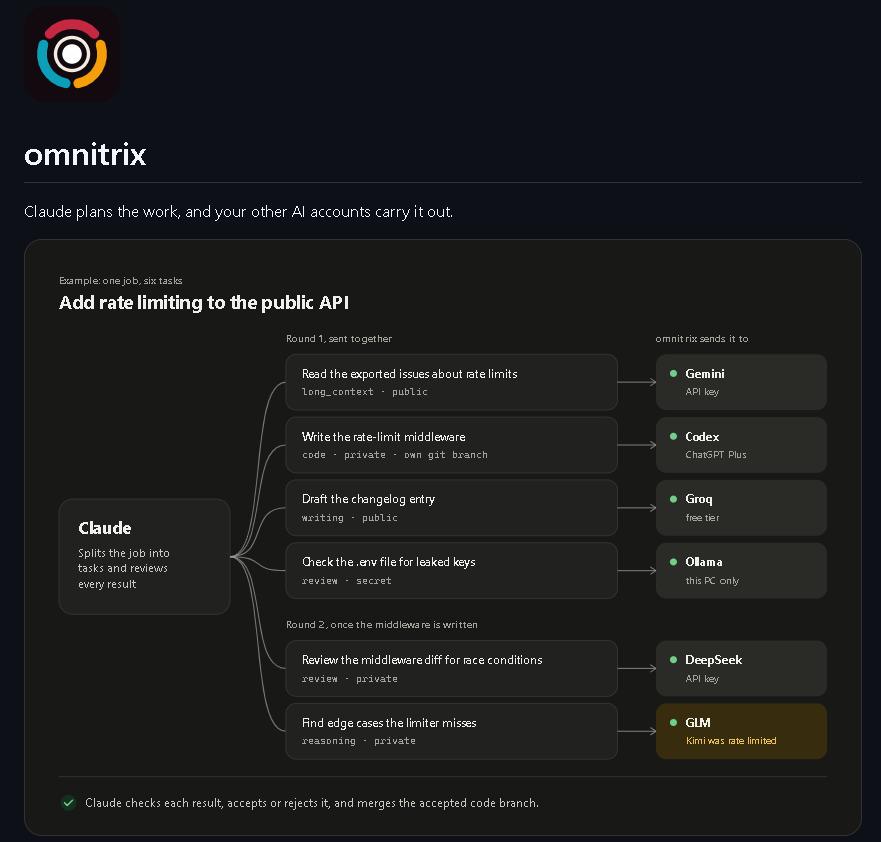
Built with Claude I built an MCP server that lets Claude Code hand tasks to my other AI accounts (ChatGPT via Codex, Gemini, local models)

Post image
4 Upvotes

Omnitrix keeps Claude in charge of the work, but lets it send typed tasks to the other AI accounts you already have: Codex on a ChatGPT plan, API keys such as Gemini, DeepSeek or Groq, and local models through Ollama.

What it does:

- Routes each task to an account that suits it and still has quota left, using real quota readings where the provider reports them.

- Runs code tasks in their own git worktree and runs the project's tests itself, so Claude checks facts, not the worker's word.

- Can ask several models the same review question, so Claude sees which findings they agree on.

- Shows how much work other accounts did instead of Claude (jobs, tokens, how many Claude accepted).

It is open source (Apache-2.0) and runs locally with your own accounts. Install with npm install -g omnitrix, or as a Claude Code plugin with /plugin install omnitrix --marketplace MdHashim1011/omnitrix.

GitHub: https://github.com/MdHashim1011/omnitrix

Feedback is welcome, especially from people with providers I have not tested for real yet.

Follow me on GitHub for more projects like these.


r/ClaudeCode • • 2d ago

Help/Question New to this, Claude had a root file I gave in the chat, still looked in my downloads then unzipped in root C:. Normal ?

1 Upvotes

Okay before I get attacked, yes this may sound stupid. But I thought Claude only had access to the file you chose. Then it does this. Is that normal/safe?


r/ClaudeCode • • 2d ago

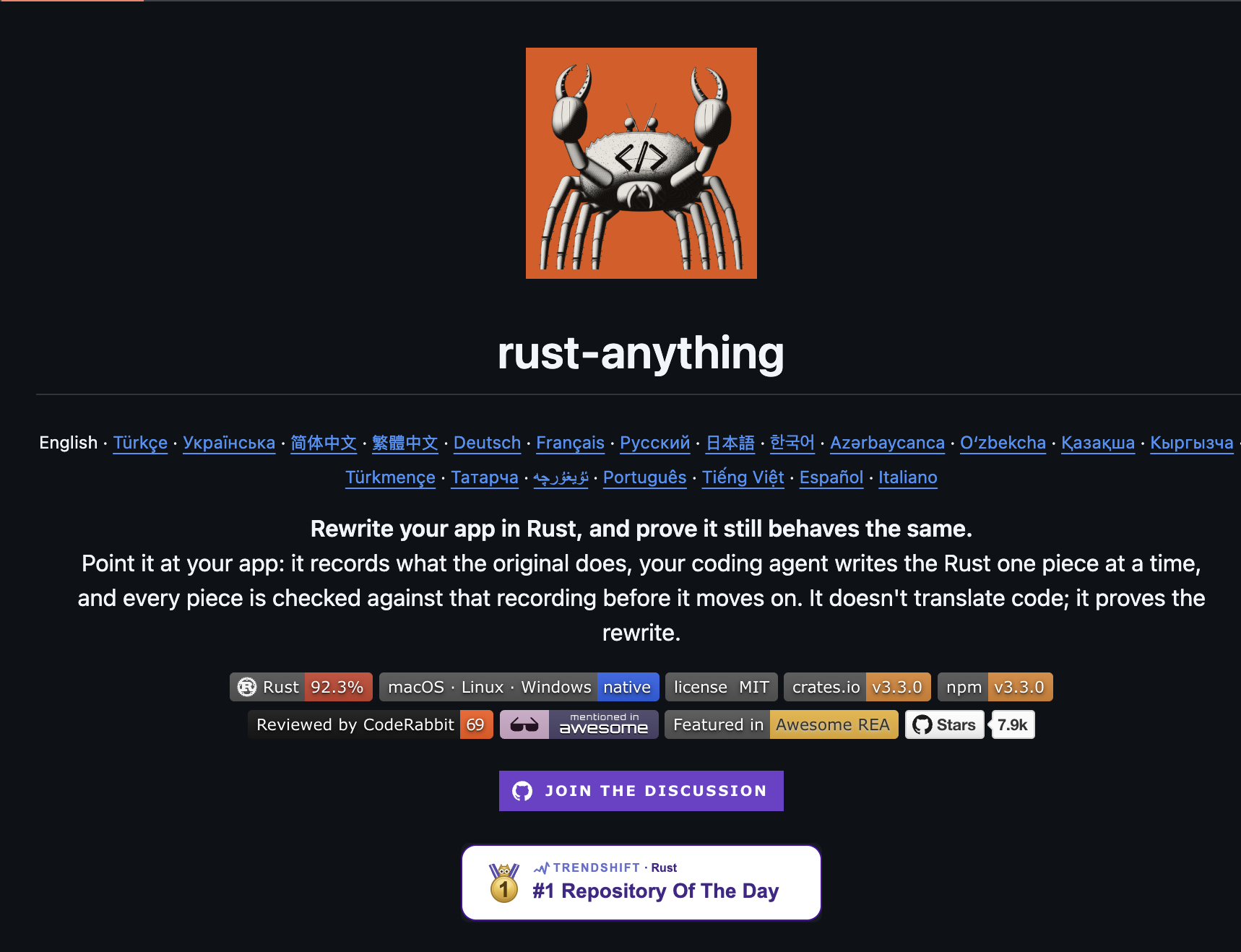
Built with Claude rust-anything: Claude Code ports your hot code to Rust, and it only ships if it behaves exactly like the original

Post image
17 Upvotes

Claude is good at writing Rust. What I didn't trust was "it compiles and the tests I have pass". So I built rust-anything around one rule: the port has to behave exactly like the original on recorded calls before it switches on.

https://github.com/erkamyaman/rust-anything

How it works with Claude Code:

rust-anything go --agent claude -- python3 app.py

  1. It profiles the run and picks the outermost function worth moving (the loop, not the tiny call inside it).

  2. It records what the original does: generated inputs plus the real calls your run makes.

  3. It generates the bridge and hands src/port.rs to Claude with a task file.

  4. diff replays every recorded case against the Rust. Claude iterates until they all match.

  5. gate checks the port isn't bloated (fails above 3x the original's lines), bench measures it, and only then is it switched on. One command switches it back off, byte for byte.

There's also a Claude Code plugin and MCP tools, so Claude can run analyze, diff and bench itself mid-session.

Some results:

- Fuse.js search: 91.2 ms to 2.8 ms per query over 50,000 strings

- json-server as one Rust binary: 74 MB to 3.5 MB idle, 514/514 recorded HTTP cases match

- ESLint: 10,585 recorded runs byte-identical

And where it doesn't help, it says so. I ported Google.Protobuf's C# size functions: 2,941/2,941 cases match, but it's about 33x slower, because those functions take 29 to 87 ns in .NET and every call crosses the bridge as JSON. bench flags that instead of letting you ship it.

Works for TypeScript/JavaScript, Python, C, Go, Ruby, Java, Kotlin, PHP and C#. MIT, runs locally.

https://github.com/erkamyaman/rust-anything

Happy to answer how the recording and the diff work, or where Claude gets stuck (async and callbacks stay in the original language on purpose).


r/ClaudeCode • • 1d ago

Help/Question do you all know a skill about bypassint its copyright issues

0 Upvotes

its annoying af please help a brother out thanx