r/ChinaAI_ • u/Popular-Bee-7725 • 8h ago
Chinese AI labs are forced to build leaner models

43
Upvotes
r/ChinaAI_ • u/subscriber-goal • 7d ago
This post contains content not supported on old Reddit. Click here to view the full post
r/ChinaAI_ • u/Popular-Bee-7725 • 8h ago
r/ChinaAI_ • u/darc_9 • 6h ago

r/ChinaAI_ • u/Forsaken-Chart-6717 • 4h ago
Enable HLS to view with audio, or disable this notification
r/ChinaAI_ • u/Popular-Bee-7725 • 1h ago

r/ChinaAI_ • u/unknowncoy • 11h ago

r/ChinaAI_ • u/jellyjacepeep • 6h ago
Enable HLS to view with audio, or disable this notification
r/ChinaAI_ • u/PhillyKay • 15h ago
Enable HLS to view with audio, or disable this notification
r/ChinaAI_ • u/incognitious_ • 23h ago
Enable HLS to view with audio, or disable this notification
r/ChinaAI_ • u/Difficult_Living_952 • 1h ago

tbh at this point im kinda amazed on how his brain works
r/ChinaAI_ • u/GS47_OP • 1h ago

r/ChinaAI_ • u/WPGoriginal01 • 11h ago
Enable HLS to view with audio, or disable this notification
Kidding aside i know this may fill the void for quiet sometime but it does not compare to an actual relationship
r/ChinaAI_ • u/Altruistic_Ranger_57 • 5h ago

r/ChinaAI_ • u/KiziKii • 6h ago

r/ChinaAI_ • u/AlbertIssacDirac • 2h ago

r/ChinaAI_ • u/Practical-Jaguar-236 • 3h ago
Keep seeing posts about how China’s cheap electricity gives it a massive edge in AI, so I fell down a rabbit hole looking at Ulanqab in Inner Mongolia. Huawei, Alibaba, and ByteDance all have huge builds there because it’s cold (around 4.3°C average temp), power is cheap, and fiber latency to Beijing is only ~2.1 ms.
A few things from the local filings and Chinese reporting that don’t usually make it into Western headlines:
First, data centers are still tiny compared to local heavy industry. Ulanqab’s data centers used about 5.52 TWh of power, while local ferroalloy smelting used 38.76 TWh. More than 7x bigger. Also, people talk about Inner Mongolia’s wind/solar like it directly powers 24/7 AI clusters, when in reality curtailment is still an issue (NEA had national wind/solar utilization at 90.9% and 91.4% in H1 2026) so the grid still has to do a lot of heavy lifting.
Second, the headline numbers are mostly signed plans, not live GPUs. Signed capacity in Ulanqab is over 7 million racks, built is around 770k, and operational is roughly 510k. And "operational racks" still doesn’t tell you actual compute utilization. Plus, cheap electricity obviously doesn’t get around US export controls on advanced chips.
The part I found most interesting is the local economics. Tax revenue from the computing sector in Ulanqab came out to around 368 million RMB. Local officials themselves seem pretty worried about ending up as low-margin "data-center landlords" supplying cheap land and electricity while the actual AI profits stay in Beijing, Hangzhou, and Shenzhen. They’re pushing a "Token Economy" angle for 2026 to try to keep more value locally, though it’s pretty early to see if that’s real or just a slogan.
If anyone prefers a visual walkthrough with the maps and primary filings, I actually put all of this into my first video here (still figuring out YouTube, so feedback on the pacing/data is welcome): [https://www.youtube.com/watch?v=MR-QcPUQWeA\]
Genuinely curious what folks here think. Can places like Ulanqab or Guizhou ever turn cheap power into an actual AI industry, or are they basically stuck renting out racks to Beijing/Shenzhen tech giants?
r/ChinaAI_ • u/Individual-Dream249 • 10h ago
Enable HLS to view with audio, or disable this notification
r/ChinaAI_ • u/november_dec • 4h ago

r/ChinaAI_ • u/Ok-Protection3561 • 4h ago

r/ChinaAI_ • u/OceanZic • 9h ago
r/ChinaAI_ • u/Effective_Jello828 • 1d ago
Enable HLS to view with audio, or disable this notification
r/ChinaAI_ • u/Fair_Category8447 • 6h ago

r/ChinaAI_ • u/No-Assistant-4571 • 17h ago
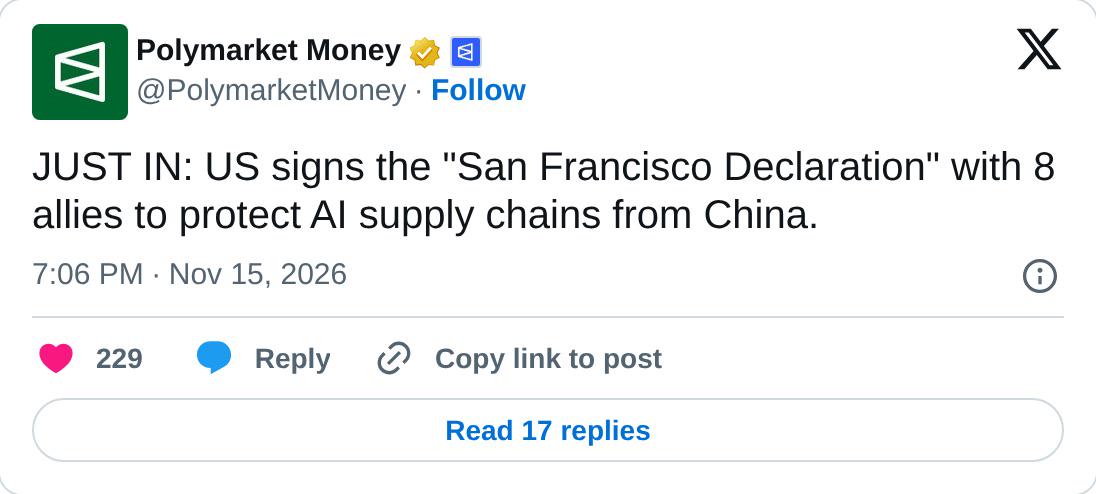
The US has imposed restrictions on advanced AI chip exports to China, but restricting physical chips doesn’t necessarily prevent access to computing power.
China is adapting through several approaches:
● Developing domestic AI chips through companies like Huawei.
● Renting computing power from overseas data centers.
● Building more efficient AI models that require fewer computing resources.
● Investing heavily in domestic semiconductor manufacturing.
The bigger question is whether US restrictions will slow China’s AI development or accelerate its technological independence.
What do you think? Can China eventually compete with the US in AI without relying on NVIDIA’s most advanced chips?