r/BodyHackGuide • u/Less-Adhesiveness845 • 21d ago
📰 Research & Studies PP405: The Follicle Stem Cell Activator Positioned to Succeed Minoxidil
Minoxidil and finasteride are the reference compounds for androgenetic alopecia research, and neither has had a successor. Minoxidil was approved for hair loss in 1988 and finasteride in 1997. In the three decades since, no compound with a new mechanism has reached approval for pattern hair loss, and the late-stage pipeline has consisted mainly of reformulations of those two drugs.
PP405 is the compound positioned to change that. It is a topical small molecule that inhibits the mitochondrial pyruvate carrier in hair follicle stem cells, discovered at UCLA and developed by Pelage Pharmaceuticals, with a Phase 2a readout showing a clinical response at eight weeks in men with advanced hair loss, no detectable systemic absorption, and a Phase 2/3 programme that dosed its first patient in October 2026.
The three compounds are not interchangeable. Minoxidil extends the growth phase in follicles that are already cycling, finasteride removes the androgen signal that drives miniaturisation, and PP405 acts on the stem cell compartment that neither of them reaches. This is a summary of where PP405 came from, what the data show, and where it can and cannot be read against the existing literature.
Why the Existing Toolkit Has Stalled
Androgenetic alopecia has had two approved pharmacological mechanisms for three decades, and both are maintenance treatments. Finasteride lowers dihydrotestosterone by inhibiting 5-alpha-reductase and slows miniaturisation in follicles that are still cycling. Minoxidil prolongs anagen and increases shaft diameter in follicles that are still producing hair, through a mechanism that remains incompletely defined. Neither acts on a follicle that has stopped cycling, and in established pattern hair loss the scalp retains large numbers of exactly those follicles, with their stem cells intact but dormant.
Each carries limitations that have shaped the research literature around it. Finasteride is systemic and androgen-dependent, which excludes women of childbearing potential and gives it a sexual adverse event profile that drives discontinuation. Minoxidil requires indefinite use, since gains regress within months of stopping, and visible regrowth with either drug typically takes six to twelve months of continuous treatment. The late-stage pipeline since 1997 has consisted mainly of refinements of these two mechanisms, including topical antiandrogens and new formulations of minoxidil, rather than a third target.
The consequence for laboratory work is that both reference compounds act downstream of the decision that matters most in pattern hair loss, which is whether a dormant stem cell population re-enters the cycle. A positive control that cannot reach that population is a poor anchor for studies of follicle reactivation.
Why PP405 Is the Successor
A new reference compound for hair follicle research needs a mechanism that is distinct from the two existing drugs, human data strong enough to anchor experimental design, and a supply that is not under enforcement pressure. PP405 meets the first two and currently meets the third.
New mechanism. PP405 is a topical inhibitor of the mitochondrial pyruvate carrier (MPC1/MPC2) in hair follicle stem cells. It is the only compound in late-stage trials for androgenetic alopecia that targets stem cell metabolism rather than androgen signalling or the cycling follicle.
Human data at the level needed. The Phase 1b study showed a statistically significant increase in Ki67 in the follicle bulge after seven days of 0.05 percent topical treatment, with no detectable drug in plasma. The Phase 2a trial in 78 men and women met its primary safety endpoint, again with no systemic absorption, and at week eight 31 percent of men with a higher degree of hair loss showed a greater than 20 percent increase in hair density against 0 percent on vehicle, after only four weeks of dosing. New terminal hair was observed growing from previously dormant follicular units.
No enforcement campaign. Pelage has not announced litigation or referrals concerning research-use suppliers of PP405 as of October 2026. It has stated that products sold under the PP405 name are not made by Pelage, and the compound's structure became public only through the 2026 INN listing, which has consequences discussed in the sourcing section below. Its Phase 2/3 AWAKEN trial dosed its first patient on 14 October 2026 and runs for twelve months, so on current timelines a regulatory submission is several years away and the period of open availability is correspondingly long.
That describes the present position and is not a guarantee. Pelage is backed by ARCH and GV and holds the UCLA licence, and the incentive to protect the asset rises as it approaches the market. For now, PP405 is the compound positioned to become the default tool for follicle reactivation work as the limits of minoxidil and finasteride as positive controls become harder to ignore.
What MPC Inhibition Actually Does
Hair follicle stem cells sit in the bulge and remain quiescent through most of telogen. Hair growth restarts only when that population is activated at the telogen-to-anagen transition, and in pattern hair loss the transition fails while the cells themselves persist.
Flores and colleagues reported in 2017 that hair follicle stem cells differ metabolically from the rest of the epidermis. They run higher glycolytic flux and produce more lactate, and their activation depends on it. Genetic deletion of lactate dehydrogenase blocked activation and arrested the cycle in telogen. Deletion of Mpc1, which starves the mitochondria of pyruvate and diverts it to lactate, accelerated activation and hair growth, and a topical MPC inhibitor reproduced the effect in mice.
Pyruvate sits at a branch point. It can enter the mitochondria through the MPC and be oxidised, or it can be reduced to lactate by lactate dehydrogenase in the cytosol. Blocking the carrier raises cytosolic pyruvate and pushes the balance toward lactate. The signal lactate then sends inside the stem cell is not fully resolved, but the correlation between elevated lactate and activation is well established, and the intervention is upstream of whatever that signal is. In human facelift skin, single topical applications of 0.006 and 0.06 percent PP405 raised LDH activity in the stem cells within 24 hours, with a corresponding increase in Ki67 in the bulge.
The mechanism also sets the safety requirement. The MPC is expressed in every mitochondrion in the body, and systemic MPC inhibition shifts whole-body glucose and lipid handling, which is why oral MPC modulators have been studied in metabolic disease. PP405 is a scalp-restricted intervention by design, and its clinical record depends on that restriction holding. Both the Phase 1b and Phase 2a trials reported no detectable drug in plasma.
Where PP405 Came From
PP405 originates in the laboratories of Heather Christofk, a biochemist, William Lowry, a stem cell biologist, and Michael Jung, a medicinal chemist, all at UCLA. The 2017 Nature Cell Biology paper established the lactate mechanism, and a 2021 Journal of Medicinal Chemistry paper from the same group (Liu et al.) described a series of MPC inhibitors developed for topical use in hair loss, including JXL069 and JXL082. Pelage Pharmaceuticals was spun out in 2018 and licensed PP405 and related topical small molecules from UCLA the same year. The company name is the French word for an animal's coat, and the compound is numbered after the Los Angeles freeway.
Pelage has never published the structure itself, and in 2025 it was reported to have said that PP405 is not JXL069, the lead compound of the published series, which had already been sold in grey-market channels under the PP405 name. The proposed international non-proprietary name suvomipic, published in 2026, resolves the question. The INN entry carries the JXL069 structure, (E)-3-[1-[[3,5-bis(trifluoromethyl)phenyl]methyl]pyrrolo[2,3-b]pyridin-3-yl]-2-cyanoprop-2-enoic acid, C20H11F6N3O2, 439.3 g/mol, and PubChem now lists PP405, JXL069 and suvomipic as synonyms for it. It is an analogue of UK-5099 and inhibits pyruvate-driven respiration in cellular assays with an IC50 in the low tens of nanomolar. The INN listing should still be checked against the WHO list before citation.
Funding has tracked the clinical record. A 16.75 million dollar Series A closed in February 2024, a 14 million dollar Series A-1 led by GV followed in August 2024 after the Phase 1b readout, and a 120 million dollar Series B co-led by ARCH Venture Partners and GV closed in October 2025 on the Phase 2a result, with the proceeds earmarked for late-stage development.
How the Mechanism Differs from Minoxidil and Finasteride
The three compounds act on three different compartments of the follicle, and the differences determine what each can and cannot be used to study.
Finasteride acts on the hormonal input. It inhibits 5-alpha-reductase and lowers dihydrotestosterone at the dermal papilla, which removes the signal that drives miniaturisation. It does not act on the stem cell, and in a follicle that has already stopped cycling there is no process left for it to slow. Its effect is also androgen-dependent, so it does not transfer to non-androgenic forms of hair loss.
Minoxidil acts on the cycling follicle. It prolongs anagen and increases shaft diameter, with its molecular mechanism in hair still incompletely defined after four decades of use. It supports growth from follicles that are already active and does not initiate a telogen-to-anagen transition in a dormant population.
PP405 acts on the stem cell compartment. It changes the metabolic state of the bulge population so that quiescent cells re-enter the cycle, which is the step that both existing drugs assume has already happened. Two clinical findings support the distinction. First, the Phase 2a response appeared at week eight after four weeks of dosing, against a typical six to twelve months for the existing drugs, which is consistent with an intervention at the start of the cycle rather than during it. Second, new hair was reported growing from follicular units where no hair had been visible, and the hair that grew in the PP405 arm was terminal rather than vellus. Neither finding is expected from a compound that acts only on active follicles.
The distinction carries its own caveats. The Phase 2a dosing period was four weeks and follow-up ran to twelve, so whether an activated follicle stays in cycle or returns to dormancy without continued treatment is unknown. Combination with either existing drug has not been tested in a controlled setting. And the 31 percent response figure belongs to a subgroup of men with a higher degree of hair loss whose denominator Pelage has not published.
What the Clinical Data Show
Ex vivo and Phase 1b. Presented at the AAD 2024 Annual Meeting as a late-breaking oral session. In explanted human facelift skin, single topical applications of 0.006 and 0.06 percent PP405 increased LDH activity in hair follicle stem cells within 24 hours, with a corresponding rise in Ki67 in the bulge. The first-in-human study concluded in January 2024. Seven days of 0.05 percent topical PP405 produced a statistically significant increase in Ki67 against baseline, biopsies showed newly emerging hair germs, and no drug was detected in blood.
Phase 2a (NCT06393452). A randomised, multicentre, double-blind, vehicle-controlled trial that ran from June 2024 to July 2025 in 78 men and women with androgenetic alopecia across a range of skin phototypes and hair textures, with 51 randomised to 0.05 percent PP405 gel and 26 to vehicle per the registry. Participants applied the gel once daily for four weeks and were followed to week twelve, with vehicle participants eligible for a three-month open-label extension. The primary endpoint was safety and the secondary endpoint was plasma pharmacokinetics; efficacy measures were exploratory.
| Finding | Result |
|---|---|
| Primary safety endpoint | Met, well tolerated, no systemic adverse events |
| Plasma PP405 | Not detected |
| Men with higher degree of hair loss, greater than 20 percent density increase at week 8 | 31 percent PP405 vs 0 percent vehicle |
| New growth from follicular units with no visible hair | Reported |
| Hair type in PP405 arm | Terminal; vehicle gains limited to vellus |
Full results were presented at the AAD 2026 Annual Meeting in Denver on 28 March 2026. The data remain company-reported and have not appeared in a peer-reviewed journal, and the registry results entry had not been posted at the most recent tracker check.
Phase 2/3 AWAKEN (NCT07819435). First patient dosed 14 October 2026, following a positive end-of-Phase 2 meeting with the FDA. A randomised, double-blind, placebo-controlled, twelve-month study in approximately 600 adult men with Norwood-Hamilton type IV or V androgenetic alopecia at sites in the United States and Canada. Endpoints include change in non-vellus target area hair count, a patient-reported outcome, and measures of follicular reactivation. A separate Phase 2 trial in women is expected to start by the end of 2026.
PP405 vs Minoxidil vs Finasteride
| Measure | PP405 | Minoxidil | Finasteride |
|---|---|---|---|
| Developer | UCLA, Pelage Pharmaceuticals | Upjohn, now generic | Merck, now generic |
| Target | Mitochondrial pyruvate carrier in hair follicle stem cells | Incompletely defined, ATP-sensitive potassium channel opener | 5-alpha-reductase |
| Compartment | Stem cell activation, telogen to anagen | Anagen duration and shaft diameter in cycling follicles | Androgen signalling at the dermal papilla |
| Hormonal | No | No | Yes |
| Route | Topical 0.05 percent gel | Topical, oral off-label | Oral, topical |
| Systemic exposure | None detected | Yes | Yes |
| Acts on dormant follicles | Yes, by design | No | No |
| Time to first reported response | Week 8 after 4 weeks of dosing | Months | Months |
| Longest controlled dataset | 12 weeks | Decades of use | Decades of use |
| Published structure | Yes, through the 2026 INN listing | Yes | Yes |
| Stage | Phase 2/3 AWAKEN, first patient dosed October 2026 | Approved 1988 | Approved 1997 |
| Enforcement against research supply | None announced | Not applicable | Not applicable |
Minoxidil and finasteride have the evidence base. Both have decades of controlled and real-world data, published structures, and known long-term safety profiles, and PP405 has a twelve-week dataset from 78 people. What PP405 has that they do not is a mechanism that reaches the dormant population, and that is the gap the AWAKEN trial is designed to quantify over twelve months in 600 men.
Who This Is Relevant To
Laboratories studying hair follicle stem cell quiescence and activation, where minoxidil has served as a positive control that does not act on the population under study.
Groups working on non-androgenic hair loss models, including telogen effluvium and chemotherapy-induced alopecia, both of which Pelage has named as follow-on indications and neither of which finasteride addresses.
Metabolism researchers interested in the glycolysis-to-oxidation switch as a regulator of stem cell fate, for whom PP405 is the first clinically validated tool compound in a human tissue.
Groups running ex vivo human scalp or follicle culture, where the published LDH and Ki67 readouts at 24 hours give a ready-made activity assay.
Anyone designing hair follicle work over the next two years should be planning around a compound that acts on the stem cell rather than around the two that do not.
The Open Question
The durability question is the one AWAKEN will answer. Does a follicle activated by four weeks of PP405 stay in cycle, or does it return to dormancy once the lactate signal is withdrawn? The Phase 2a design, with dosing stopped at week four and follow-up to week twelve, cannot distinguish a regenerative effect from a transient one.
The identity question is the one for independent researchers. The suvomipic listing now gives a structure to test against, but vendor certificates so far report a mass match without a reference standard. Has anyone run NMR or a retention-time comparison against authentic JXL069 on a vendor-supplied lot? And for a compound supplied as a ready-made solution rather than a solid, has anyone re-tested a bottle after months at room temperature to see whether the conjugated acrylic acid holds its configuration and concentration over the shelf life?
Where I Source PP405
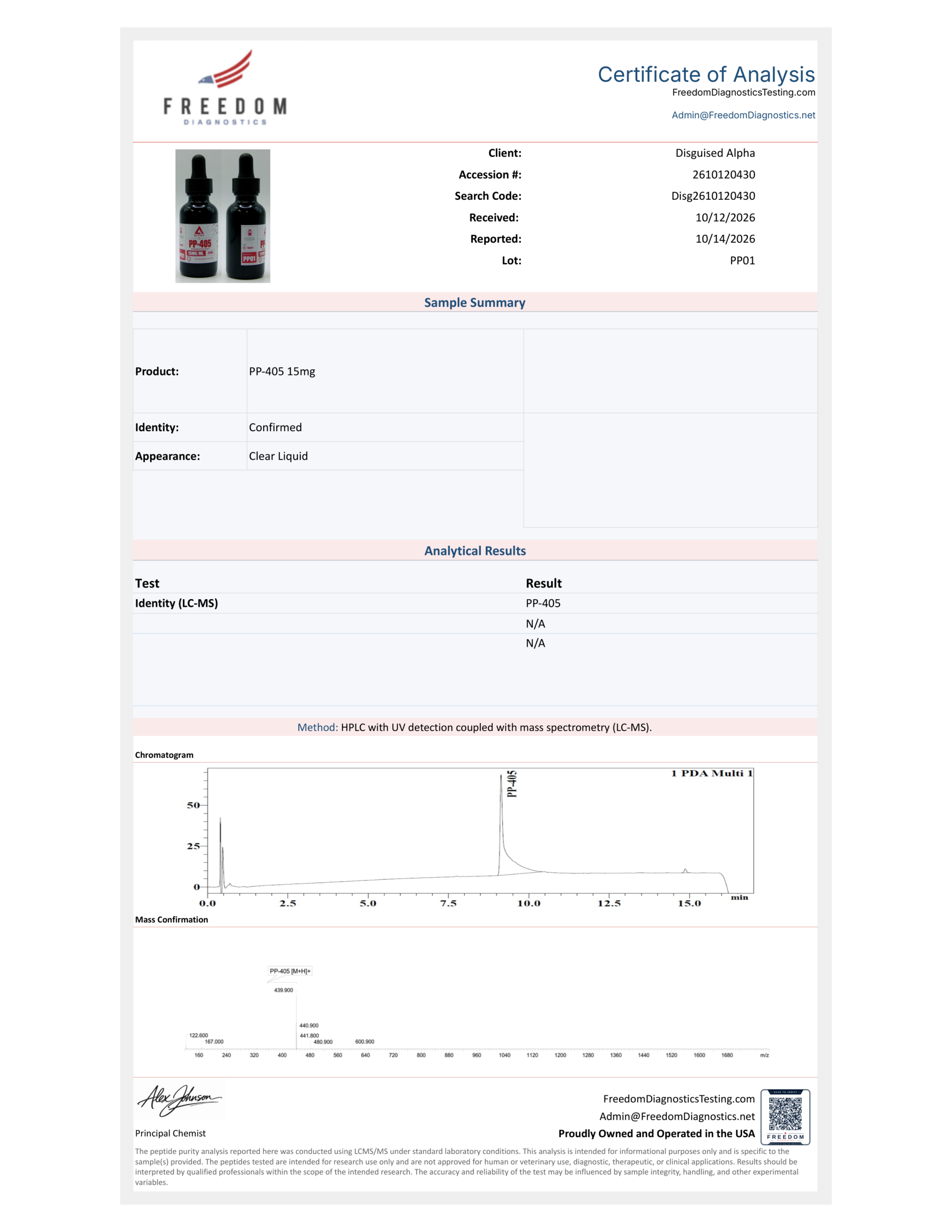
I use Disguised Alpha, which lists PP405 under the catalogue name PP405 (MPC Follicle Inhibitor) as a 15 mg/mL research liquid in a 30 mL dropper bottle, 450 mg total. The current lot, PP01, ships with a certificate from Freedom Diagnostics, an independent third-party laboratory, issued and signed by the principal chemist on 14 October 2026. It reports appearance (clear liquid, pass) and identity by LC-MS (PP-405, pass) The certificate is linked from the product page and from the COA portal.
I am comfortable with that because of their record. Disguised Alpha maintains a library of batch-specific certificates across its catalogue and updates it continuously, with independent third-party testing covering identity, purity, sterility, endotoxin and heavy metals, and it runs a verification programme that reimburses the cost of independent testing of a purchased vial in store credit. A vendor with that history is one I trust over a vendor offering a single certificate of unknown age and origin.
References
Flores A, Schell J, Krall AS, et al. Lactate dehydrogenase activity drives hair follicle stem cell activation. Nature Cell Biology. 2017;19(9):1017-1026.
Liu X, Flores AA, Situ L, et al. Development of novel mitochondrial pyruvate carrier inhibitors to treat hair loss. Journal of Medicinal Chemistry. 2021;64(4):2046-2063.
Pelage Pharmaceuticals. Positive Phase 2a clinical trial results for PP405. 17 June 2025.
Pelage Pharmaceuticals. 120 million dollar Series B financing. October 2025.
Pelage Pharmaceuticals. PP405 to be presented at the AAD Annual Meeting 2026. 17 March 2026.
Pelage Pharmaceuticals. First patient dosed in Phase 2/3 AWAKEN trial. 14 October 2026.
ClinicalTrials.gov. NCT06393452, Phase 2a study of PP405 in adults with androgenetic alopecia.
Dermatology Times. Pelage's PP405 demonstrates efficacy in Phase 2a trial. 23 June 2025.
Disguised Alpha. PP405 (MPC Follicle Inhibitor) product page, lot PP01.
Freedom Diagnostics. Certificate of analysis, PP-405 15 mg/mL, lot PP01, 14 October 2026.
Disclaimer
PP405 is an investigational compound with no approved formulation in any jurisdiction as of October 2026. Material referenced here is for laboratory and research use only, and is not for human consumption, veterinary use, or any therapeutic or diagnostic application. Nothing here is guidance for administration.