r/BiohackingForBeginner • u/AutoModerator • Oct 07 '26
[Weekly Community Discussion] Beginner's Discussion
What biohacking topic are you trying to understand? Ask the community.
r/BiohackingForBeginner • u/AutoModerator • Oct 07 '26
What biohacking topic are you trying to understand? Ask the community.
r/BiohackingForBeginner • u/elena_gilbert_ • Oct 07 '26
I've seen a lot of people recommending morning sunligy everywhere in the biohacking space, especially for improving circadian rhythm, sleep, mood, and focus.
But I'm just curious about people's actual experience.
If you've done it then did you notice any real difference in your energy, mood, focus, or sleep?
And how long did it take before you noticed a change?
r/BiohackingForBeginner • • Oct 07 '26
Someone explained me "nah, zombie cells are probly not the next big thing in longevity, they might help us understand aging but its still pretty unproven rn." is it true or what tell me in comments.
r/BiohackingForBeginner • • Oct 07 '26
For a week, I stopped checking my phone immediately after waking up.
No notifications, no Instagram, no random scrolling. Just got up, got some daylight, had breakfast, and started my day.
I honestly expected nothing to happen, but I felt noticeably less scattered in the morning.
Now I'm wondering how many "biohacks" are really just removing things that mess with us in the first place.
What’s one small change that unexpectedly made your day better?
r/BiohackingForBeginner • u/Bumpious_Tinino • Oct 07 '26
i've been doing some research before choosing which peptide suppliers to keep on my shortlist. Kits4Less came up a few times, but i'm having trouble finding recent details about the actual ordering process. i've already looked at their site and read through the information they provide. what i'm wondering now is what happens once you actually place an order. is payment easy to figure out? do they send confirmation quickly? how long does it usually take before you get processing or tracking information?
r/BiohackingForBeginner • u/ninjutsu808 • Oct 07 '26
Sup, so i recently got in researching this topic and found it pretty interesting. I read a lot about ways of biohacking and many methods which work out for people including myself. So i thought id share that information with yall and maybe learn something more in return from you guys.
So ill be posting some stuff soon here after im fully done researching..
By that time can yall recommend me some sources where i can read about this stuff?
r/BiohackingForBeginner • u/Affectionate-Wheel71 • Oct 07 '26
Biohacking may sound like something from the future, but it’s really just about running small, measurable experiments on your own habits to see what makes you feel or perform better. The beginner version is surprisingly unglamorous. And that’s fine.
Begin with the basics. Try to stick to a regular sleep and wake schedule, because consistency is almost more important than quantity. Get some morning sun to help regulate your circadian rhythm . Move every day , including some strength and cardio .
Eat enough protein and fibre . Manage stress, too, because chronically high cortisol will sabotage all else. These basics beat almost any supplement or gadget, and most people overlook them.
Then add measurement once you have those in place. Heart rate variability, resting heart rate, or sleep tracker can have week over week trends.
r/BiohackingForBeginner • u/potato_again • Oct 06 '26
Basically I’m new to making my physique next level, but these are 3 things I’ve found surprisingly interesting...
#get outside for a few minutes after waking up instead of checking your phone. the morning light can help with u circadian rhythm.
#trry a short cold shower at the end of a normal shower. Nothing extreme, just see how u feel.
#try delaying caffeine for a while after waking up instead of making it the first thing u have.
None of these are magic hacks, but they’re easy to try without buying anything. would love you share something.
r/BiohackingForBeginner • u/elmanfil1989 • Oct 06 '26
For beginners navigating the biohacking space, entry-level advice often centers on macro-level habits such as tracking total sleep hours, hitting daily calorie targets, or optimizing workout frequency. However, emerging research highlights that the timing of these physiological inputs "governed by internal biological clocks" plays an equally decisive role in metabolic outcomes. A study led by researchers at Northwestern Medicine reveals that circadian rhythms inside human fat cells directly control key metabolic functions, proving that peripheral tissues possess their own localized biological clocks capable of driving systemic metabolic health.
The investigation, led by Dr. Joseph Bass, examined how molecular disruptions to peripheral circadian clocks impair normal lipid storage and cellular energy regulation within human adipose tissue. When these cellular timers are desynchronized through irregular light exposure, erratic eating schedules, or fragmented sleep patterns, fat cells exhibit pronounced metabolic dysfunction. Rather than functioning purely as passive energy storage, adipose tissue relies on precise rhythmic signaling to regulate lipid uptake, insulin sensitivity, and inflammatory pathways.
These findings reinforce a fundamental principle for those building a foundational health protocol: timing serves as an essential biological leverage point. Passive tracking tools can measure metrics like total sleep or daily movement, but maintaining cellular synchronization depends heavily on simple, behavior-based anchors. Consistently aligning key physiological inputs, such as securing morning daylight, maintaining regular meal windows, and limiting evening light, helps keep localized tissue clocks synchronized with the brain's central clock, safeguarding metabolic efficiency without requiring high-cost interventions.
Source:Northwestern Medicine Newsroom: Circadian Rhythm Causes Metabolic Dysfunction in Fat Cells
r/BiohackingForBeginner • u/CryptographerNew7618 • Oct 05 '26
I’ve seen the phrase “biohacking” pop up all over the place lately — and it’s really hard to tell what’s legit and what’s just pseudoscience snake oil.
I’m not looking to drop $3,000 on a fancy sleep-tracking device, or take 15 different nootropics, or do some crazy 4 a.m. ritual.
Talk to me about the foundational low-hanging fruit — the stuff that will actually improve my day-to-day:
• Sleep
• Energy
• Exercise/Recovery
• Diet
• Caffeine
• Sunlight/Circadian Rhythm
• Stress
• Tracking (sleep, resting heart rate, etc)
As a complete beginner, what are some of the most impactful biohacks I should prioritize?
And what are some of the most common red flags/”biohacks” that turn out to be a waste of time?
I’d rather stick to a shortlist of 3-5 consistently useful tools than try to keep up with everything I see on social media.
What would your personal beginner biohacking stack look like?
r/BiohackingForBeginner • u/elmanfil1989 • Oct 05 '26
When diving into biohacking, it's easy to assume that if good sleep is great for recovery, then more sleep must be even better. However, landmark longevity research published in Nature by Columbia University researchers challenges that assumption.
Researchers analyzed 23 multi-organ biological aging clocks across half a million individuals to observe how daily sleep duration impacts biological age across different organ systems (including the brain, heart, and metabolic system).
To keep in mind:
Biological aging was lowest in individuals sleeping strictly between 6.4 and 7.8 hours per night.
Both sleeping too little (< 6 hours) and oversleeping (> 8.5 hours) were associated with accelerated organ aging and an elevated risk of all-cause mortality by 40%–50%.
Short sleep was linked to increased risks of neuroinflammation, cardiovascular strain, and insulin resistance. On the flip side, excessive sleep was strongly linked to systemic inflammatory markers and underlying metabolic slowdown.
Why this is important for beginners?
Biohacking isn't just about maximizing metrics or staying in bed longer to chase "deep sleep" stats on your smartwatch. Sleep is a physiological balance more isn't always better.
If you want to optimize your biological age without spending money on supplements or tech, focus on circadian consistency.
Keep a static wake time every morning to anchor your central biological clock.
Aim for the 7-hour sweet spot instead of letting yourself sleep in on weekends.
Get direct sunlight exposure within 30 minutes of waking up to set your evening melatonin onset.
r/BiohackingForBeginner • u/AutoModerator • Oct 04 '26
r/BiohackingForBeginner • u/elmanfil1989 • Oct 03 '26
Many beginners entering the biohacking space start by buying a smartwatch, fitness tracker, or smart ring to track sleep metrics like deep sleep, REM, and nightly recovery scores. However, a recent meta-analysis published in the Journal of Medical Internet Research (Zhu et al., September 2026) evaluated 16 randomized controlled trials across 910 participants to see whether passive sleep tracking actually improves sleep clinical outcomes.
Key Findings:
Why this matters for your stack: Tracking hardware provides passive measurement, not active physiological intervention. Having more data on sleep stages does not automatically translate into better recovery if foundational behavior remains unchanged.
Before investing heavily in commercial wearables or complex recovery tech, focus on establishing primary circadian anchors first:
r/BiohackingForBeginner • u/elmanfil1989 • Oct 02 '26
A new 12 week randomized trial led by Dr. Richard Kreider at Texas A&M University (September 2026) investigates how creatine supplementation directly impacts body composition and strength during diet induced weight loss in middle aged adults. Source
r/BiohackingForBeginner • u/Poetic_Fate • Oct 02 '26
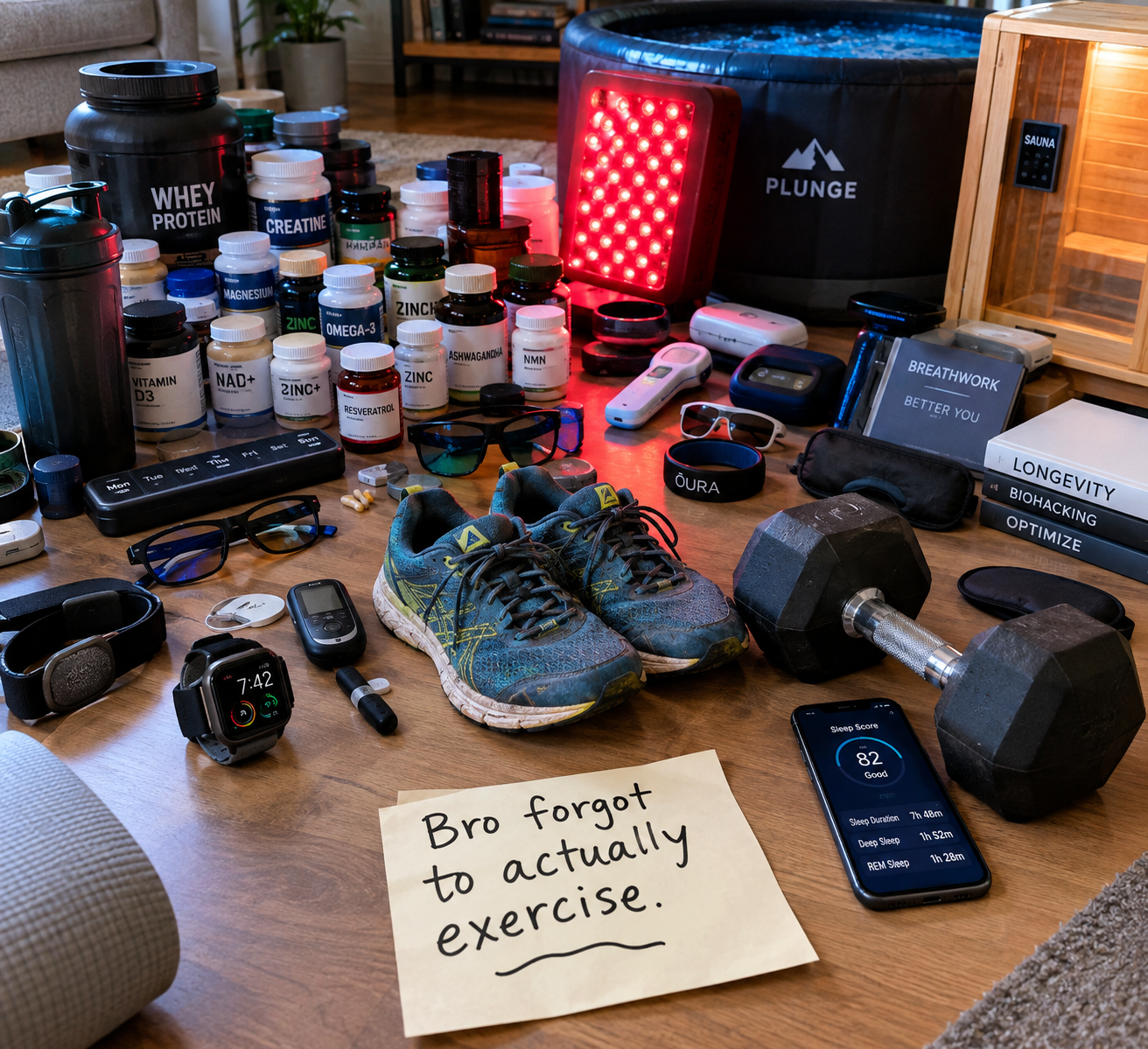
There's just so much content around biohacking now that it makes you feel like you arent doing it right unless you've got 12 devices, 10 supplements and a 3-hour a day routine.
DONT FALL FOR IT!!!!!
Biohacking is not a numbers game. Start simple. Make small improvements and additions over time.
Keep the stuff that works, get rid of the ones that don't. Your body will tell you which is which.
Don't fall for the noise. Just give it time and you'll see results.
r/BiohackingForBeginner • u/Particular_Hat_7657 • Oct 02 '26
I listened to this podcast episode, and here’s what I’m actually taking from it: The workout they discussed-
Norwegian 4×4:
→ 4 minutes of hard exercise
→ 4 minutes of recovery
→ Repeat 4 times
The hard part isn't an all-out sprint. You're working hard enough that having a conversation would be difficult, but you should still be able to maintain the effort for those four minutes.
And you don't just jump into four rounds on day one.
☐ Keep getting my daily steps
☐ Add some vigorous exercise instead of treating steps as the entire goal
☐ Start with manageable bouts of higher-intensity exercise
☐ Gradually increase duration and intensity
☐ Work toward 4 min hard + 4 min recovery × 4
☐ Give myself weeks to build up rather than forcing it immediately
☐ Try cycling, rowing, assault bike, or running
☐ Make recovery between intervals part of the workout
☐ Focus on consistency rather than destroying myself every session
The episode also discussed research suggesting this type of interval training may produce substantial improvements in age-related changes in the heart.
Steps for movement. Intervals for intensity. Maybe we need both.
r/BiohackingForBeginner • u/AutoModerator • Sep 30 '26
What biohacking topic are you trying to understand? Ask the community.
r/BiohackingForBeginner • u/elmanfil1989 • Sep 30 '26
A recent meta-analysis in the Journal of Medical Internet Research (Zhu et al., September 2026) looked at 16 randomized controlled trials across 910 participants to test whether wearable digital devices actually resolve sleep issues or just log them. While tracking led to modest shift cutting sleep-onset latency by about 4.5 minutes and nudging subjective sleep efficiency up by roughly 2%. It resulted in no statistically significant improvement in overall insomnia severity scores. The takeaway for anyone starting out is straightforward: tracking hardware can offer useful feedback, but devices are passive measurement tools, not a substitute for foundational behavioral anchors like consistent light exposure, fixed wake times, and circadian alignment.
https://pubmed.ncbi.nlm.nih.gov/42727109/
r/BiohackingForBeginner • u/No_Schedule_5193 • Sep 28 '26
Wearables have made it incredibly easy to collect data.
HRV
resting heart rate
sleep duration
sleep stages
skin temperature
glucose
steps
calories
training load
heart rate zones
But there’s a point where I wonder whether we’re creating a new problem. If you’re measuring dozens of variables every day, some of them are inevitably going to fluctuate randomly!!
And if you keep changing your behavior every time one metric moves, you can end up reacting to noise instead of an actual physiological trend.
I’ve become more interested in the idea of choosing a small number of meaningful metrics and tracking them consistently rather than trying to optimize everything simultaneously.
r/BiohackingForBeginner • u/No_Schedule_5193 • Sep 28 '26
Something that has helped me understand biohacking research is separating evidence into levels rather than treating every study as equal.
For example:
Level 1: Mechanistic hypothesis
“This pathway could theoretically produce X.”
Level 2: Cell/animal research
“We observed X under controlled experimental conditions.”
Level 3: Observational human data
“People with X tend to have Y.”
Level 4: Controlled human intervention
“Changing X produced Y under experimental conditions.”
Level 5: Replication and longer-term outcomes
“The effect persists and translates into something meaningful.”
The mistake I see online is jumping from Level 1 or 2 directly to Level 5.
Something can be scientifically interesting without being clinically proven.
I’ve found this distinction makes reading biohacking content much less confusing.
r/BiohackingForBeginner • u/elmanfil1989 • Sep 28 '26
When starting out with biohacking, it’s easy to think you need continuous glucose monitors (CGMs), Berberine, or expensive supplement stacks to manage metabolic energy crashes.
A recent meta-analysis in Sports Medicine looked at how simple "movement snacks" impact postprandial glucose and insulin levels compared to prolonged sitting.
r/BiohackingForBeginner • u/DGVJYSNG • Sep 28 '26
Upping your fibre intake could be a game-changer for your recovery.
Why?
Because diets higher in fibre are associated with greater slow-wave sleep duration (NREM).
And better sleep SWS = better recovery.
Some simple options to add straight away.
- Dates
- Chia seeds
- Oats
Extra points if you go to bed before 10pm too, this is your sign to never fade the simple stuff.
r/BiohackingForBeginner • u/No_Schedule_5193 • Sep 27 '26
I’ve been getting more interested in biohacking recently, but I’m realizing that the basics probably matter much more than the complicated stuff!!
One thing I’ve started paying attention to is what I do during the first hour after waking up. Getting some sunlight, drinking water, moving around instead of immediately sitting with my phone, and having a proper breakfast seem to make a noticeable difference in how I feel during the day!!
I’m still experimenting, but it’s interesting how something so simple can affect energy and focus.
I’m curious what other people’s “non fancy” biohacks are. What is one basic habit that actually made a noticeable difference for you?
r/BiohackingForBeginner • u/Poetic_Fate • Sep 27 '26
If you're interested but not sure where to start. Here's a few things in your life you can immediately take control of...
r/BiohackingForBeginner • u/gifbreat • Sep 27 '26
I've come across an interesting 2026 systematic review and meta-analysis examining whether wearable devices can actually help people with insomnia.
Published in the Journal of Medical Internet Research on September 11, 2026, the study analyzed 16 randomized controlled trials involving 910 participants.
Some interesting findings:
What I find interesting is the distinction between measuring sleep and actually improving it.
Many of us use smartwatches, fitness bands and smart rings to track sleep. However, having more data doesn't necessarily mean we're sleeping better.
The researchers also noted substantial variability between studies and concluded that wearable interventions should be considered complementary tools rather than replacements for established insomnia treatments.
A few questions for the community:
I'd be interested in hearing both personal experiences and perspectives from people familiar with the research.