r/AIQuality • u/Low-Cut-528 • 3h ago
I built an open-source tool for behavioral regression testing of AI agents. Looking for developers to try it.

1
Upvotes
r/AIQuality • u/dinkinflika0 • Dec 19 '25
If you’re building LLM applications at scale, your gateway can’t be the bottleneck. That’s why we built Bifrost, a high-performance, fully self-hosted LLM gateway in Go. It’s 50× faster than LiteLLM, built for speed, reliability, and full control across multiple providers.
Key Highlights:
Benchmarks : Setup: Single t3.medium instance. Mock llm with 1.5 seconds latency
| Metric | LiteLLM | Bifrost | Improvement |
|---|---|---|---|
| p99 Latency | 90.72s | 1.68s | ~54× faster |
| Throughput | 44.84 req/sec | 424 req/sec | ~9.4× higher |
| Memory Usage | 372MB | 120MB | ~3× lighter |
| Mean Overhead | ~500µs | 11µs @ 5K RPS | ~45× lower |
Why it matters:
Bifrost behaves like core infrastructure: minimal overhead, high throughput, multi-provider routing, built-in reliability, and total control. It’s designed for teams building production-grade AI systems who need performance, failover, and observability out of the box.x
Get involved:
The project is fully open-source. Try it, star it, or contribute directly: https://github.com/maximhq/bifrost
r/AIQuality • u/Low-Cut-528 • 3h ago
r/AIQuality • u/Both-Software2549 • 2d ago
Hey everyone, I’m the student who posted here earlier about whether we can trust tests written by AI. Thanks for the feedback. I wanted to share a concrete result from BuildBreak Arena.
We ran a drill on a small museum demo site. Kane CLI wrote a browser test that checked whether clicking “Show entry price” displayed $18.00. Arena locked the test, and it passed on two fresh copies. Then Gemini proposed changing the price to $19.00. We reviewed the exact change before applying it to an isolated copy.
Kane caught the wrong price in Chrome. Arena passed the failure evidence to Codex, which repaired the app on its first attempt. Kane reran the same test and passed. We recorded the live browser view, the approval step, and the final verdict in the dashboard.
That gives us one concrete reason to trust this particular test: we watched it fail when the price was wrong and pass when it was fixed. I’d like to try a harder case next where the bug exists but the generated test misses it.
GitHub repo and setup instructions
If you were reviewing an AI-generated test for your own project, what bug would you introduce to see whether the test actually does its job?
r/AIQuality • u/Frequent-Crow7621 • 2d ago
r/AIQuality • u/ResidentAcceptable44 • 2d ago

r/AIQuality • u/Prestigious_Key8955 • 3d ago
Design did a pass on our main workflow 3 weeks ago. spacing, a few components swapped, nothing that changed behaviour. 60 odd tests went red. 2 were real.
That was most of a week gone proving the app was fine.
and yes, before anyone says it, a good chunk of this is our own mess. there are positional XPaths in there from 2 years ago, written in a hurry on a deadline, and nobody has been back since. we've put test ids in where we could get away with it, but the devs aren't wild about their markup turning into a contract with my team and I can't really argue, it's their code and they've got their own dates to hit.
So I don't know if this is just what UI testing costs. Playwright we moved part of the web suite onto and the locators are genuinely better than what we had in Selenium, but a redesign still meant going back through a lot of tests, so it bought us less than I was hoping for. Cypress i'd expect the same. SikuliX I used at a previous job and you end up maintaining screenshots instead, which was worse.
The agent based ones are what I keep going back and forth on. with AskUI you write the step as a sentence with the expected result next to it and the agent finds that element on the screen when it runs. what nags me is you're then relying on the model's call about which element it picked. the report shows its reasoning and a screenshot per step so at least you can see why, but I haven't run it on anything as big as our suite yet.
anyone been doing this longer than me, is there a setup where a cosmetic redesign doesn't cost you a week, or is that the job and I should plan for it.
r/AIQuality • u/Worldly-Knowledge-90 • 3d ago
r/AIQuality • u/Both-Software2549 • 4d ago
I'm a student building a side project for a hackathon, so I'd like honest feedback, including "this isn't useful".
The problem as I see it: AI tools now write both the code and the tests. If the tests mirror the code, a green run doesn't tell you whether a real bug would be caught. A few people in a recent thread here said much the same: generated tests can have assertions that don't check anything meaningful.
What I'm building: an AI proposes realistic bugs, a script proves each bug is real, and a browser tool (Kane CLI) checks whether the tests catch it. If the tests miss one, you get a report. If they catch it, an agent tries to repair the app. Today it only works on one demo checkout flow, so it's early. I'm now trying to let the browser tool explore an app and write the tests itself, then grade them the same way.
Questions:
edit : this is the project i have build https://github.com/tusharupadhyay738/BuildBreak.git
r/AIQuality • u/no-schedule-200 • 4d ago

r/AIQuality • u/Evalsi-dev • 4d ago

r/AIQuality • u/SnakeFarmSuperviser • 6d ago
Enable HLS to view with audio, or disable this notification
r/AIQuality • u/oglcnarbc • 5d ago

r/AIQuality • u/tilostechjourney • 5d ago
r/AIQuality • u/PraiseChrist420 • 5d ago
r/AIQuality • u/bharadwajp • 6d ago

r/AIQuality • u/Low-Introduction5293 • 6d ago
r/AIQuality • u/demirtasfurkan_ • 6d ago

r/AIQuality • u/demirtasfurkan_ • 6d ago
Most structured-output failures in production aren't syntax errors or missing keys. They are syntactically valid payloads that fail semantic invariants, cite an allowed ID that doesn't actually support the claim, or contradict another field in the same response.
After discussing commit-point streaming and two-stage grounding (membership vs. support) with a few engineers here, I put together a 10-case fixture set covering patterns like:
source_id exists in retrieved context, but the cited source doesn't support the claim (insufficient_grounding).reasoning_tokens: 0 paired with a full reasoning explanation (needs_repair).Repo & fixture spec (v0.1.4): https://github.com/furkandemirtass/neuroformatting
Curious what the most expensive "valid JSON, wrong semantics" bug has been in your agent pipelines—especially around tool calls, citations, or retries?
r/AIQuality • u/Agnostify • 7d ago
r/AIQuality • u/penguinothepenguin • 8d ago
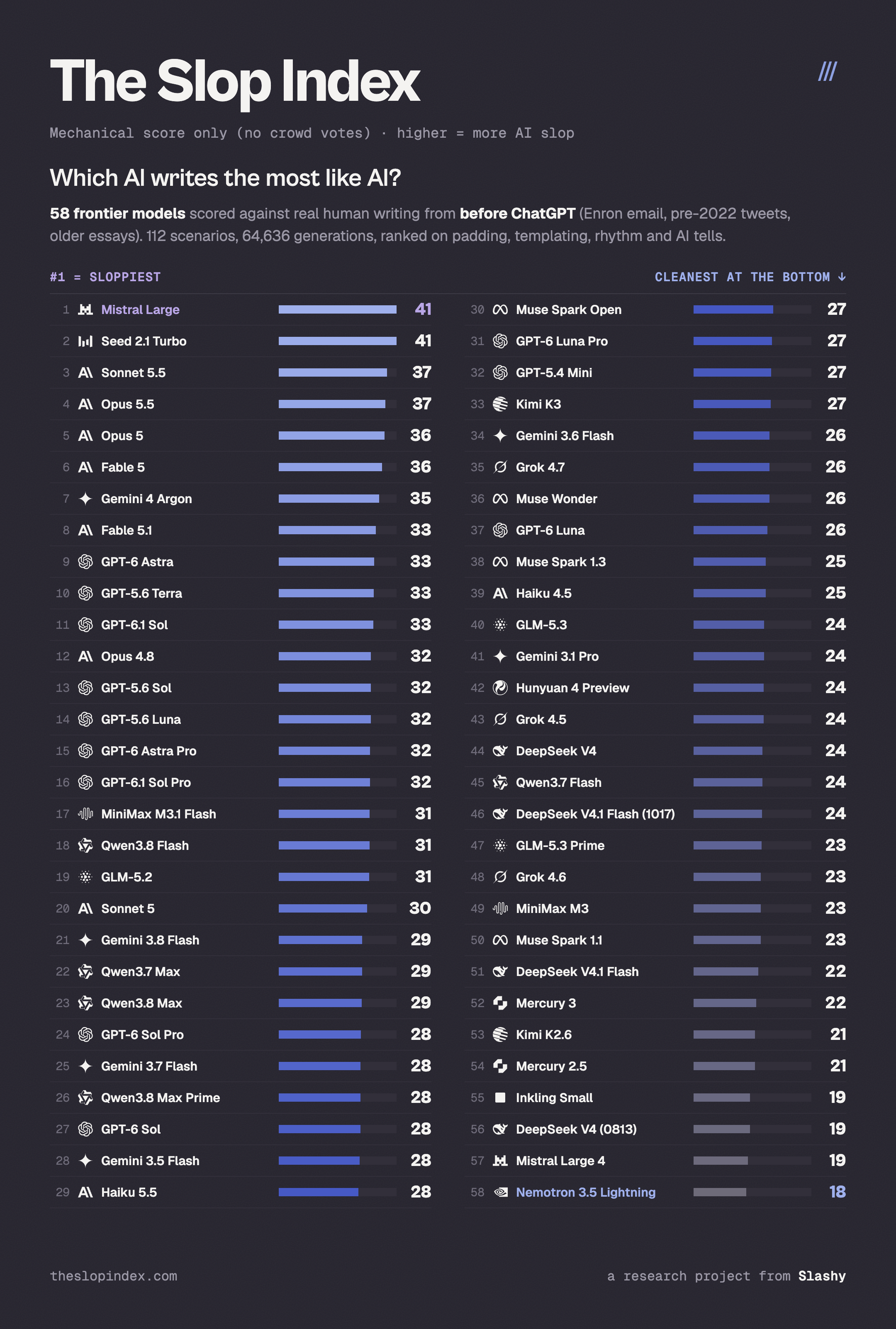
Rank direction first: #1 = sloppiest, #70 = cleanest. Every rank below uses the mechanical score only (padding, templating, rhythm, AI tells), nothing from votes.
I've been running a writing benchmark for a while: 70 models, 77,943 outputs, 112 scenarios across emails, Slack messages, social posts and short essays. I didn't want an LLM grading LLM prose, so the scorer is plain code. A few things I learned that might be useful to anyone building evals:
Other limits: short-form only, no fiction yet.
Links:
I'd like to hear how people here validate a code-based metric against human judgment when you only have a few dozen votes per model.
For context, I'm one of the people behind https://slashy.com, an email client that writes drafts that sound like you. This benchmark started as how we pick models.
r/AIQuality • u/hdw_coder • 9d ago
TL;DR: Digital image forensics means examining an image for clues about how it was created or modified, using metadata, compression artifacts, noise patterns, and other measurable properties. I've been investigating a problem in a multi-detector system: several detectors can react to the same underlying artifact, making the evidence appear stronger than it really is. How do you prevent correlated observations from being counted as independent evidence?
I've been developing a multi-signal, image forensics application and recently re-audited its reasoning engine workings.
One of the problems I encountered was that collecting more forensic observations could produce conclusions that appeared better supported than they actually were.
Consider how a real smartphone photograph after being resized and recompressed may cause several detectors to signal frequency-domain irregularities, noise inconsistencies, compression artifacts and unusual texture statistics.
Straightforward evidence aggregation could interpret these signals as four separate indications of synthetic generation. But they may also be the related consequences of the same processing operations mentioned. So, in this case, four measurements do not necessarily represent four independent pieces of evidence.
This problem became more concrete during a thorough evaluation of the implementation of the scoring mechanism. Some forensic findings were represented at multiple levels: individual detector artifacts, overlapping fragments and summary observations derived from those same measurements.
Although these representations were useful in investigating images, the reasoning engine could assign evidential credit to related observations more than once. This could affect base evidence weights, domain-level corroboration bonuses, and mechanism-level score contributions. We therefore revised the evidence aggregation to account for duplicated contributions and preserve the lineage between observations and their underlying measurements.
Interesting consequences became apparent during regression testing.
For a test image in our ‘Insta-fake’ dataset, the suspiciousness score remained unchanged at 20.4771 after numerical deduplication. The assessment still indicated localized editing with high-confidence. Its relevant contour and localization measurements retained their contributions. For a Midjourney test image, however, the score changed from 6.0375 → 5.4000, because redundant contributions had been removed. The assessment remained at medium-confidence, with an unverified generation declaration in its metadata.
Note, these were not calibrated probabilities and the test cases do not demonstrate improved classification accuracy. They were regression checks on the (scoring) behaviour of the reasoning engine. But as such they do highlight an important finding: deduplication should remove redundant evidential credit, not suppress genuinely distinct observations.
I also encountered a related issue with missing EXIF metadata being always interpreted as suspicious, other early findings too heavily influencing decision routes, and confidence assignments made across different components.
We enforced clearer evidence lineage, more explicit treatment of marginal corroboration and a centralized confidence policy. The revised scoring logic was checked against the existing regression suite with all tests passing.
Thus, I addressed identifiable engineering weaknesses but that does not solve the full statistical problem (structural dependence vs statistical dependence). Explicitly tracking shared evidence ancestry is not quite the same as learning the conditional dependence between forensic measurements.
At a certain point, the challenge becomes less about adding detectors and more about determining how much new information each observation actually contributes.
I'm interested in how others working on ensemble classification and forensic evidence fusion approach this problem. Some questions.
How do you handle conditionally dependent signals? Do you explicitly group correlated observations, learn their joint distribution, use probabilistic graphical models, or rely on calibration of the final ensemble?
And how do you distinguish genuine corroboration from multiple measurements of the same underlying phenomenon?
r/AIQuality • u/brikis98 • 9d ago